
(A Modern Mechanics College Textbook)
By David D. Nolte
The best parts of physics are the last topics that our students ever see. These are the exciting new frontiers of nonlinear and complex systems that are at the forefront of university research and are the basis of many of our high-tech businesses. Topics such as traffic on the World Wide Web, the spread of epidemics through globally mobile populations, or the synchronization of global economies are governed by universal principles just as profound as Newton’s laws. The textbook, Introduction to Modern Dynamics: From Classical Mechanics to Complex Systems, introduces all these topics and more at the Sophmore/Junior level for physics majors. The book takes a coherent approach, wrapping complex systems with classical mechanics, allowing students to master complex physics with ease.
Features:
- Expanded “Foundations” chapters satisfy junior-level physics curriculum .
- Extensive example problems give detailed solutions in each chapter.
- New analytical and computational homework problems are added to each chapter.
- Link to GitHub repository has codes that accompany the text and homework.
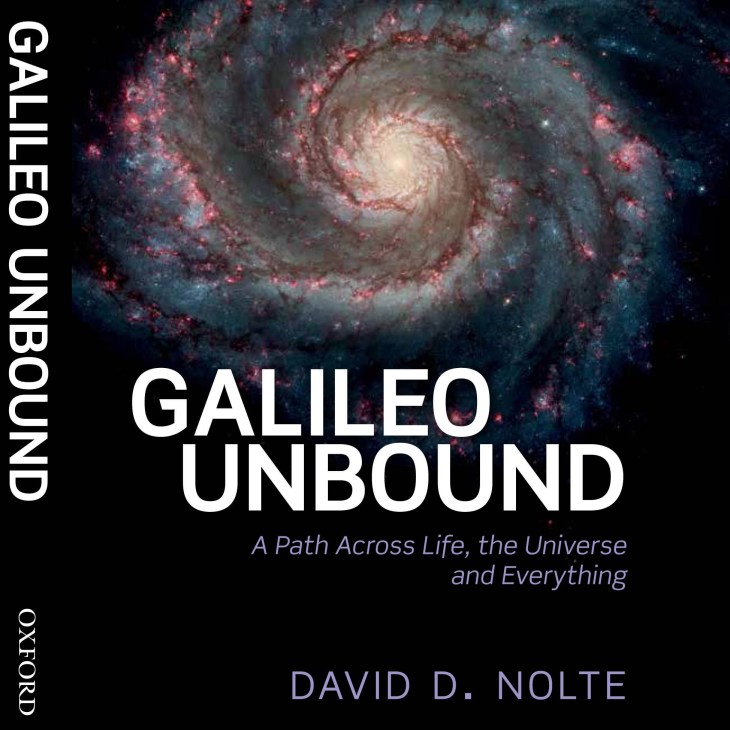
- Companion historical background is found at Galileo Unbound: A Path Across Life, the Universe and Everything (Oxford University Press).
- Solution manual for selected problems is available upon request.
For Instructors: Request an Inspection Copy from Oxford University Press
(Online Resource Hub)
Table of Contents
Link to the Table of Contents of the texbook.
Blog Posts
Link to a master page to find a wide range of blog posts related to the topics of “Introduction to Modern Dynamics”.
YouTube Lectures
Link to YouTube for a set of related online lectures
Matlab Programs
Link to a GitHub repository to access a wide range of Matlab programs for help with the computation homework problems in the textbook.
Course Materials
- Link to a Faculty Resource Page for Course Materials, including
- An example syllabus
- Solutions to selected homework problems from the Second Edition.
Why Adopt this Textbook?
Despite the compelling argument in favor of teaching undergraduates these advanced topics, the conventional university physics curriculum reserves most of these topics for advanced graduate study. Two justifications are given for this situation: first, that the mathematical tools needed to understand these topics are beyond the skill set of undergraduate students, and second, that these are specialty topics with no common theme and little overlap.
Introduction to Modern Dynamics: Chaos, Networks, Space and Time dispels these myths. The structure of the book combines the three main topics of modern dynamics—chaos theory, dynamics on complex networks and the geometry of dynamical spaces—into a coherent framework. By taking a geometric view of physics, concentrating on the time evolution of physical systems as trajectories through abstract spaces, these topics share a common and simple mathematical language with which any student can gain a unified physical intuition. Given the growing importance of complex dynamical systems in many areas of science and technology, this text provides students with an up-to-date foundation for their future careers.
While pursuing this aim, Introduction to Modern Dynamics embeds the topics of modern dynamics—chaos, synchronization, network theory, neural networks, evolutionary change, econophysics and relativity—within the context of traditional approaches to physics founded on the stationarity principles of variational calculus and Lagrangian and Hamiltonian physics. As the physics student explores the wide range of modern dynamics in this text, the fundamental tools that are needed for a physicist’s career in quantitative science are provided as well, including topics the student needs to know for the graduate record examination (GRE). The goal of this textbook is to modernize the teaching of junior-level dynamics, responsive to a changing employment landscape, while retaining the core traditions and common language of dynamics texts.
Available at Barnes & Noble
Available at Oxford University Press
Available at Amazon
About the Author
David D. Nolte is the Edward M. Purcell Distinguished Professor of Physics and Astronomy at Purdue University. His degrees are from Cornell University (BA) and the University of California at Berkeley (PhD). He worked at AT&T Bell Labs before joining Purdue. As an internationally recognized researcher in laser science, he has published over 200 journal papers, and he has secured 24 US patents in interferometric optics and biophotonics as the technical founder of the biotech start-up company that developed the laser-disc BioCD product for millions of pet animal owners. He is the author of three trade nonfiction books (Mind at Light Speed, Galileo Unbound, and Interference), two textbooks (Optical Interferometry for Biology and Medicine, and Introduction to Modern Dynamics), and he actively blogs on topics of science.
Historical Notes
Short historical notes can be found here:
The full histories behind the science are told in Galileo Unbound: A Path Across Life, the Universe and Everything (D. D. Nolte, Oxford University Press, 2018)
 Galileo Unbound