Let’s ask a really crazy question. As a pure intellectual exercise—not that it would ever happen—but just asking: What would it take to destroy American science? I know this is a silly question. After all, no one in their right mind would want to take down American science. It has been the guiding light in the world for the last 100 years, ushering in such technological marvels of modern life like transistors and the computer and lasers and solar panels and vaccines and immunotherapy and disease-resistant crops and such. So of course, American science is a National Treasure, more valuable than all the National Treasures in Washington, and no one would ever dream of attacking those.
But for the sake of argument, just to play Devil’s Advocate, what if someone with some power, someone who could make otherwise sensible people do his will, wanted to wash away the last 100 years of American leadership in Science? How would he do it?
The answer is obvious: Use science … and maybe even physics.
The laws of physics are really pretty simple: Cause and effect, action and reaction … those kinds of things. And modern physics is no longer about rocks thrown from cliffs, but is about the laws governing complex systems, like networks of people.
Can we really put equations to people? This was the grand vision of Isaac Asimov in his Foundation Trilogy. In that story, the number of people in a galaxy became so large that the behavior of the population as a whole could be explained by a physicist, Hari Seldon, using the laws of statistical mechanics. Asimov called it psychohistory.
It turns out we are not that far off today, and we don’t need a galaxy full of people to make it valid. But the name of the theory turns out to be a bit more prosaic than psychohistory: it’s called Network theory.
Network Theory
Network theory, at its core, is simply about nodes and links. It asks simple questions, like: What defines a community? What kind of synergy makes communities work? And when do things fall apart?
Science is a community.
In the United State, there are approximately a million scientists , 70% of whom work in industry with 20% in academia and 10% in government (at least, prior to 2025). Despite the low fraction employed in academia, all scientists and engineers received their degrees from universities and colleges and many received post-graduate training at those universities and at national labs like Los Alamos and the NIH labs in Washington. These are the backbone of the American scientific community, these are the hubs from which the vast network of scientists connect out across the full range of industrial and manufacturing activities that drive 70% of the GDP of the United States. The universities and colleges are also reservoirs for long-term science knowledge that can be tapped at a moment’s notice by industry when it pivots to new materials or new business models.
In network theory, hubs hold the key to the performance of the network. In technical terms, hubs have high average degree, which means that hubs connect to a large fraction of the total network. This is why hubs are central to network health and efficiency. Hubs also are the main cause of the “Small World Effect”, which states that everyone on a network is only a few links away from anyone else. This is also known as “Six degrees of Separation”, because in even vast networks that span the country, it only takes about 6 friends of friends of friends of friends of friends of friends before you connect to any given person. The world is small because you know someone who is a hub, and they know everyone else. This is a fundamental result of network theory, whether the network is of people, or servers, or computer chips.
Having established how important hubs are to network connectivity, it is clear that the disproportionate importance of hubs make them a disproportionate target for network disruption. For instance, in the power grid, take down a large central switching station and you can take down the grid over vast portions of the country. The same is true for science and the science community. Take down a few of the key pins, and the whole network can collapse—a topic of percolation theory.
Percolation and Collapse
Percolation theory says what it does––it tells when a path on a network is likely to “percolate” across it—like water percolating through coffee grounds. For a given number of nodes N, there needs to be enough links so that most of the nodes belong to the largest connected cluster. Then most starting paths can percolate across the whole network. On the other hand, if enough links are broken, then the network breaks apart into a lot of disconnected clusters, and you cannot get from one to the others.
Percolation theory says a lot about the percolation transition that occurs at the percolation threshold—which describes how the likelihood of having a percolating path across a network rises and falls as the number of links in the network increases or decreases. It turns out that for large networks, this transition from percolating to non-percolating is abrupt. When there are just barely enough links to keep the network connected, then removing just one link can separate it into disconnected clusters. In other words, the network collapses.
Therefore, network collapse can be sudden and severe. It is even possible to be near the critical percolation condition and not know it. All can seem fine, with plenty of paths to choose from to get across the network—then lose just a few links—and suddenly the network collapses into a bunch of islands. This is sometimes known as a tipping point—also as a bifurcation or as a catastrophe. Tipping points, bifurcations and percolation transitions get a lot of attention in network theory, because they are sudden and large events that can occur with little forewarning.
So the big question for this blog is: What would it take to have the scientific network of the United States collapse?
Department of Governmental Exterminations (DOGE)
The head of DOGE is a charismatic fellow, and like the villain of Jane Austen’s Pride and Prejudice, he was initially a likable character. But he turned out to be an arbiter of chaos and a cad. No one would want to be him in the end. The same is true in our own Austenesque story of Purge and Precipice: As DOGE purges, we approach the precipice.
Falling off a cliff is easy, because if a network has hubs, and those hubs have a disproportionate importance to keeping the network together, then an excellent strategy to destroy the network would be to randomly take out the most important hubs.
If the hubs of the scientific network across the US are the universities and colleges and government labs, then attack those, even though they only hold 20% to 30% of the scientists in the country, you can bring science to a standstill in the US by breaking apart the network into isolate islands. Alternatively, when talking about individuals in a network, the most important hubs are the scientists who are the repositories of the most knowledge—the elder statesmen of their fields—the ones you can get to buy out and retire.
Networks with strongly connected hubs are the most vulnerable to percolation collapse when the hubs are attacked specifically.
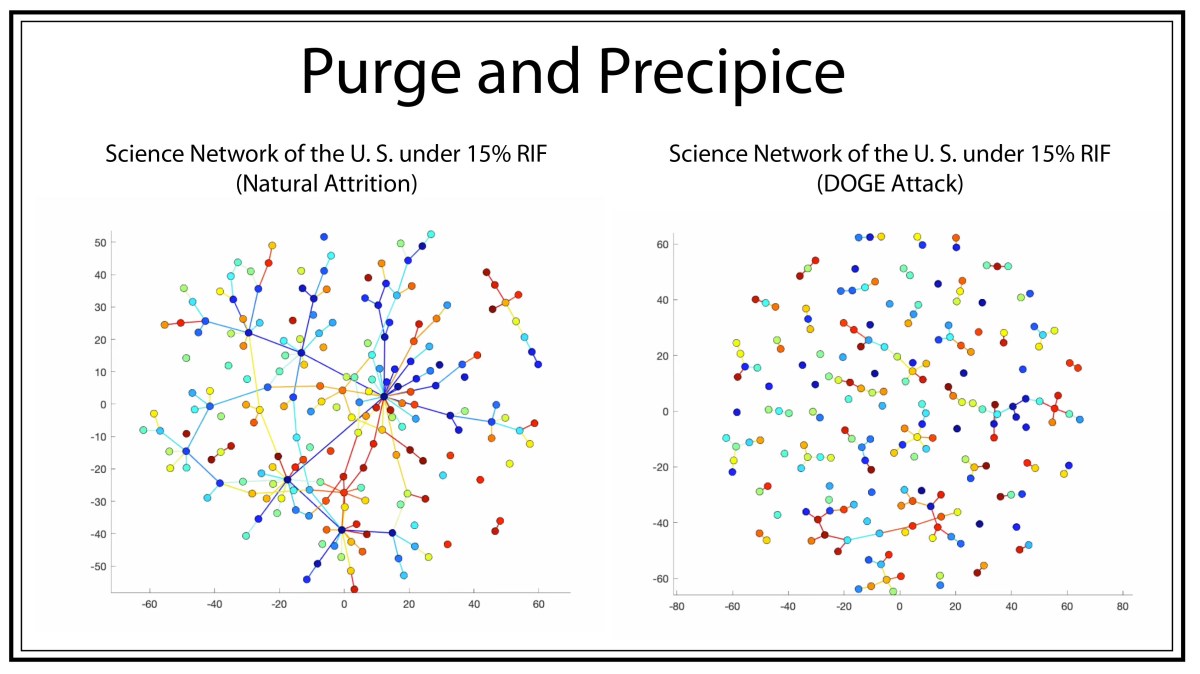
Science Network Evolving under Reduction in Force through Natural Attrition
This simulation looks at a reduction in force (RIF) of 15% and its effect on a healthy interaction network. It uses a scale-free network that evolves in time as individuals retire naturally or move to new jobs. When a node is removed from the net, it becomes a disconnected dot in the video. Other nodes that were “orphaned” by the retirement are reassigned to existing nodes. Links represent scientific interactions or lines of command. A few links randomly shift as interests change. Random retirements might hit a high-degree node (a hub), but the event is rare enough that the natural rearrangements of the links continue to keep the network connected and healthy as it adapts to the loss of key opinion leaders.
Science Network under DOGE Attack
Universities and government laboratories are high-degree nodes that have a disproportionate importance to the Science Network. By targeting these nodes, the network rapidly disintegrates. The effect is too drastic for the rearrangement of some links to fix it.
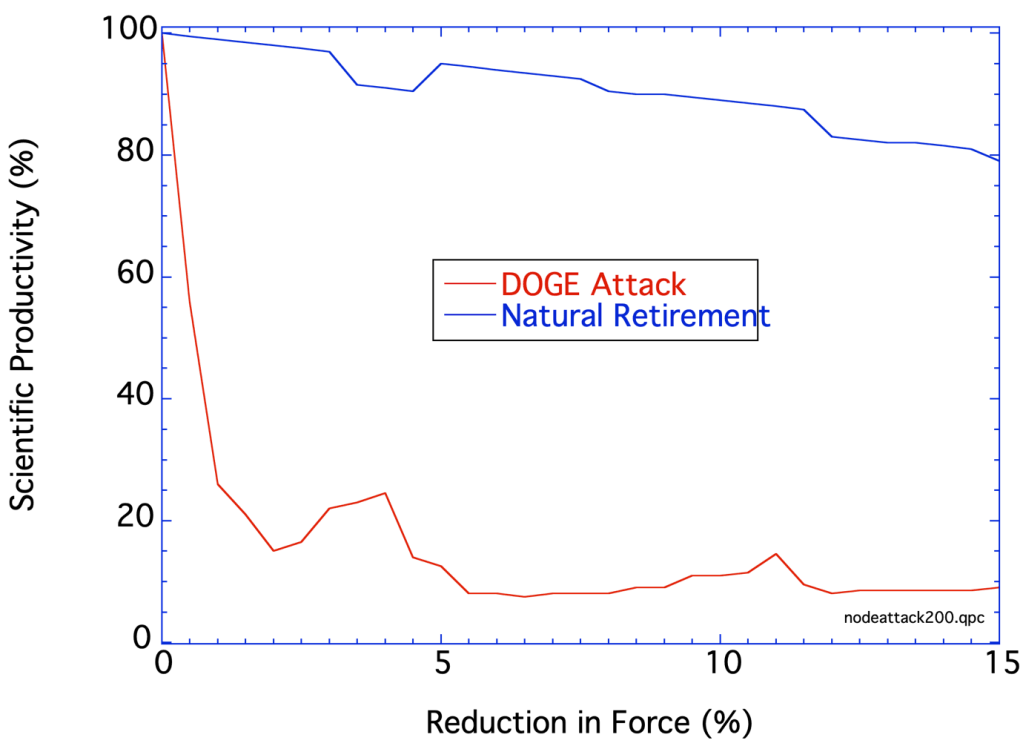
The percolation probability of an interaction network, like the Science Network, is a fair measure of scientific productivity. The more a network is interconnected, the more ideas flow across the web, eliciting new ideas and discoveries that often lead to new products and growth in the national GDP. But a disrupted network has low productivity. The scientific productivity is plotted in Fig. 3 as a function of the reduction in force up to 15%. Natural attrition can attain this RIF with minimal impact on the productivity of the network measured through its percolation probability. However, targeted attacks on the most influential scientific hubs rapidly degrades the network, breaking it apart into lots of disconnected clusters. There is no free flow of ideas and lost opportunities for new products and eventual erosion of the national GDP.
It takes about 15 years for scientific discoveries to establish new products in the market place. Therefore, a collapse of American science over the next few years won’t be fully felt until around the year 2040. All the politicians in office today will be long gone by then (let’s hope!), so they will never get the blame. But our country will be poorer and weaker, and our lives will be poorer and sicker—the victims of posturing and grandstanding for no real benefit other than the fleeting joy of wrecking what was built over the past century. When I watch the glee of the Perp in Chief and his henchmen as they wreak their havoc, I am reminded of “griefers” in Minecraft.
The Upshot
One of the problems with being a physicist is that sometimes you see the train wreck coming.
I see a train wreck coming.
PostScript
It is important not to take these simulations too literally as if they were an accurate numerical model of the Science Network in the US. The point of doing physics is not to fit all the parameters—that’s for the engineers. The point of doing physics is to recognize the possibilities and to see the phenomena—as well as the dangers.
Take heed of the precipice. It is real. Are we about to go over it? It’s hard to tell. But should we even take the chance?
 Galileo Unbound