Maxwellian Steampunk and the Origins of Maxwell’s Equations

Physicists of the nineteenth century were obsessed with mechanical models.  They must have dreamed, in their sleep, of spinning flywheels connected by criss-crossing drive belts turning enmeshed gears.  For them, Newton’s clockwork universe was more than a metaphor—they believed that mechanical description of a phenomenon could unlock further secrets and act as a tool of discovery. 

It is no wonder they thought this way—the mid-eighteenth century was at the peak of the industrial revolution, dominated by the steam engine and the profusion of mechanical power and gears across broad swaths of society. 

Steampunk

The Victorian obsession with steam and power is captured beautifully in the literary and animé genre known as Steampunk.  The genre is alternative historical fiction that portrays steam technology progressing into grand and wild new forms as electrical and gasoline technology fail to develop.  An early classic in the genre is Miyazaki’s 1986 anime´ film Castle in the Sky (1986) by Hayao Miyazaki about a world where all mechanical devices, including airships, are driven by steam.  A later archetype of the genre is the 2004 animé film Steam Boy (2004) by Katsuhiro Otomo about the discovery of superwater that generates unlimited steam power.  As international powers vie to possess it, mad scientists strive to exploit it for society, but they create a terrible weapon instead.   One of the classics that helped launch the genre is the novel The Difference Engine (1990) by William Gibson and Bruce Sterling that envisioned an alternative history of computers developed by Charles Babbage and Ada Lovelace.
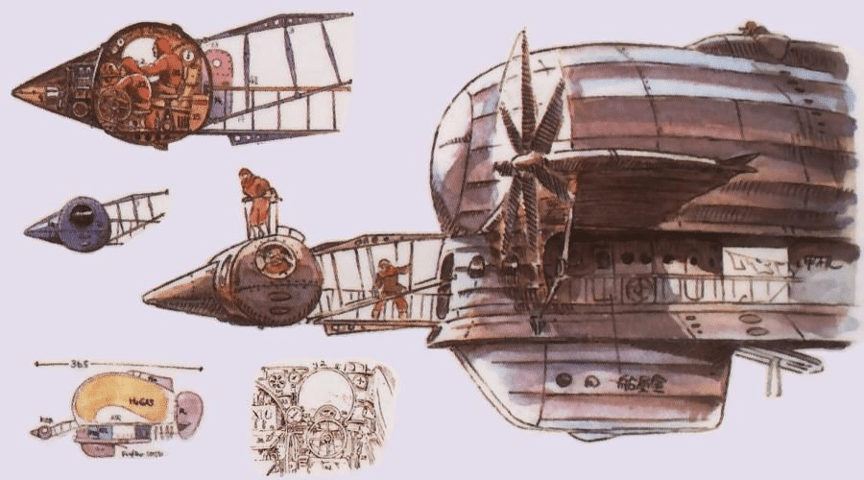
Scenes from Miyazaki's Castle in the Sky.

Steampunk is an apt, if excessively exaggerated, caricature of the Victorian mindset and approach to science.  Confidence in microscopic mechanical models among natural philosophers was encouraged by the success of molecular models of ideal gases as the foundation for macroscopic thermodynamics.  Pictures of small perfect spheres colliding with each other in simple billiard-ball-like interactions could be used to build up to overarching concepts like heat and entropy and temperature.  Kinetic theory was proposed in 1857 by the German physicist Rudolph Clausius and was quickly placed on a firm physical foundation using principles of Hamiltonian dynamics by the British physicist James Clerk Maxwell.

DVD cover of Steamboy by Otomo.

James Clerk Maxwell

James Clerk Maxwell (1831 – 1879) was one of three titans out of Cambridge who served as the intellectual leaders in mid-nineteenth-century Britain. The two others were George Stokes and William Thomson (Lord Kelvin).  All three were Wranglers, the top finishers on the Tripos exam at Cambridge, the grueling eight-day examination across all fields of mathematics.  The winner of the Tripos, known as first Wrangler, was announced with great fanfare in the local papers, and the lucky student was acclaimed like a sports hero is today.  Stokes in 1841 was first Wrangler while Thomson (Lord Kelvin) in 1845 and Maxwell in 1854 were each second Wranglers.  They were also each winners of the Smith’s Prize, the top examination at Cambridge for mathematical originality.  When Maxwell sat for the Smith’s Prize in 1854 one of the exam problems was a proof written by Stokes on a suggestion by Thomson.  Maxwell failed to achieve the proof, though he did win the Prize.  The problem became known as Stokes’ Theorem, one of the fundamental theorems of vector calculus, and the proof was eventually provided by Hermann Hankel in 1861.
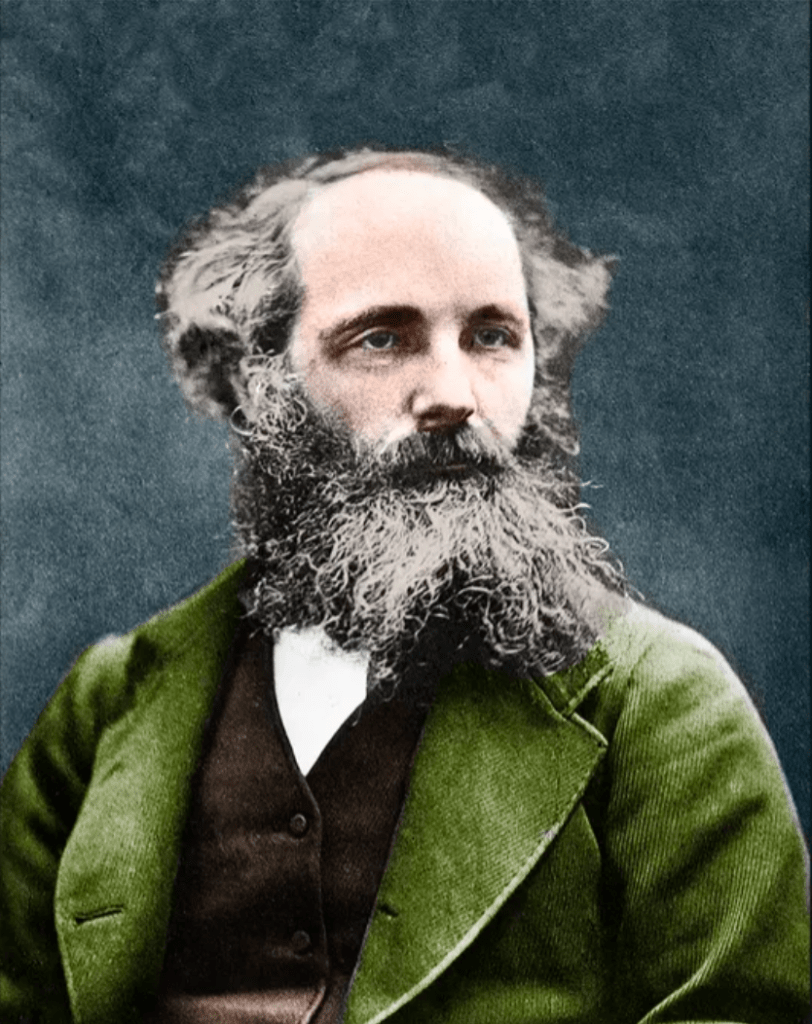
James Clerk Maxwell.

After graduation from Cambridge, Maxwell took the chair of natural philosophy at Marischal College in the city of Aberdeen in Scotland.  He was only 25 years old when he began, fifteen years younger than any of the other professors.  He split his time between the university and his family home at Glenlair in the south of Scotland, which he inherited from his father the same year he began his chair at Aberdeen.  His research interests spanned from the perception of color to the rings of Saturn.  He improved on Thomas Young’s three-color theory by correctly identifying red, green and blue as the primary receptors of the eye and invented a scheme for adding colors that is close to the HSV (hue-saturation-value) system used today in computer graphics.  In his work on the rings of Saturn, he developed a statistical mechanical approach to explain how the large-scale structure emerged from the interactions among the small grains.  He applied these same techniques several years later to the problem of ideal gases when he derived the speed distribution known today as the Maxwell-Boltzmann distribution.

Maxwell’s career at Aberdeen held great promise until he was suddenly fired from his post in 1860 when Marischal College merged with nearby King’s College to form the University of Aberdeen.  After the merger, the university had the abundance of two professors of Natural Philosophy while needing only one, and Maxwell was the junior.  With his new wife, Maxwell retired to Glenlair and buried himself in writing the first drafts of a paper titled “On Physical Lines of Force” [2].  The paper explored the mathematical and mechanical aspects of the curious lines of magnetic force that Michael Faraday had first proposed in 1831 and which Thomson had developed mathematically around 1845 as the first field theory in physics. 

As Maxwell explored the interrelationships among electric and magnetic phenomena, he derived a wave equation for the electric and magnetic fields and was astounded to find that the speed of electromagnetic waves was essentially the same as the speed of light.  The importance of this coincidence did not escape him, and he concluded that light—that rarified, enigmatic and quintessential fifth element—must be electromagnetic in origin. Ever since Francois Arago and Agustin Fresnel had shown that light was a wave phenomenon, scientists had been searching for other physical signs of the medium that supported the waves—a medium known as the luminiferous aether (or ether). With Maxwell’s new finding, it meant that the luminiferous ether must be related to electric and magnetic fields.  In the Steampunk tradition of his day, Maxwell began a search for a mechanical model.  He did not need to look far, because his friend Thomson had already built a theory on a foundation provided by the Irish mathematician James MacCullagh (1809 – 1847)

The Luminiferous Ether

The late 1830’s was a busy time for the luminiferous ether.  Agustin-Louis Cauchy published his extensive theory of the ether in 1836, and the self-taught George Green published his highly influential mathematical theory in 1838 which contained many new ideas, such as the emphasis on potentials and his derivation of what came to be called Green’s theorem

In 1839 MacCullagh took an approach that established a core property of the ether that later inspired both Thomson and Maxwell in their development of electromagnetic field theory.  What McCullagh realized was that the energy of the ether could be considered as if it had both kinetic energy and potential energy (ideas and nomenclature that would come several decades later).  Most insightful was the fact that the potential energy of the field depended on pure rotation like a vortex.  This rotationally elastic ether was a mathematical invention without any mechanical analog, but it successfully described reflection and refraction as well as polarization of light in crystalline optics. 

In 1856 Thomson put Faraday’s famous magneto-optic rotation of light (the Faraday Effect discovered by Faraday in 1845) into mathematical form and began putting Faraday’s initially abstract ideas of the theory of fields into concrete equations.  He drew from MacCullagh’s rotational ether as well as an idea from William Rankine about the molecular vortex model of atoms to develop a mechanical vortex model of the ether.  Thomson explained how the magnetic field rotated the linear polarization of light through the action of a multiplicity of molecular vortices.  Inspired by Thomson, Maxwell took up the idea of molecular vortices as well as Faraday’s magnetic induction in free space and transferred the vortices from being a property exclusively of matter to being a property of the luminiferous ether that supported the electric and magnetic fields. 

Maxwellian Cogwheels

Maxwell’s model of the electromagnetic fields in the ether is the apex of Victorian mechanistic philosophy—too explicit to be a true model of reality—yet it was amazingly fruitful as a tool of discovery, helping Maxwell develop his theory of electrodynamics. The model consisted of an array of elastic vortex cells separated by layers of small particles that acted as “idle wheels” to transfer spin from one vortex to another .  The magnetic field was represented by the rotation of the vortices, and the electric current was represented by the displacement of the idle wheels. 
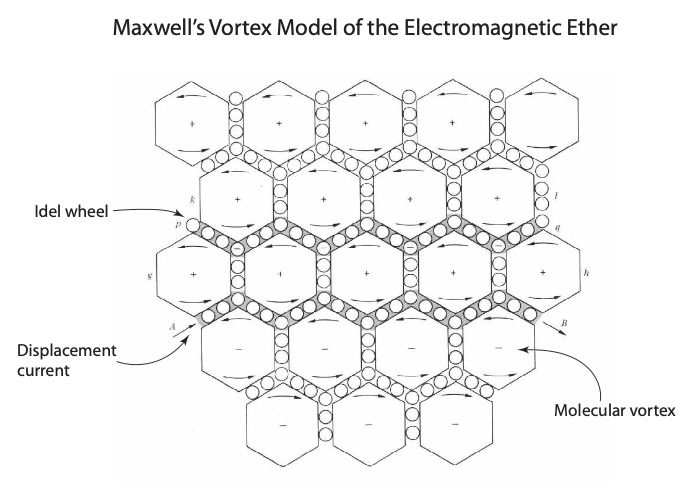
Maxwell's vortex model
Fig. 1 Maxwell’s vortex model of the electromagnetic ether.  The molecular vortices rotate according to the direction of the magnetic field, supported by idle wheels.  The physical displacement of the idle wheels became an analogy for Maxwell’s displacement current [2].

Two predictions by this outrightly mechanical model were to change the physics of electromagnetism forever:  First, any change in strain in the electric field would cause the idle wheels to shift, creating a transient current that was called a “displacement current”.  This displacement current was one of the last pieces in the electromagnetic puzzle that became Maxwell’s equations. 
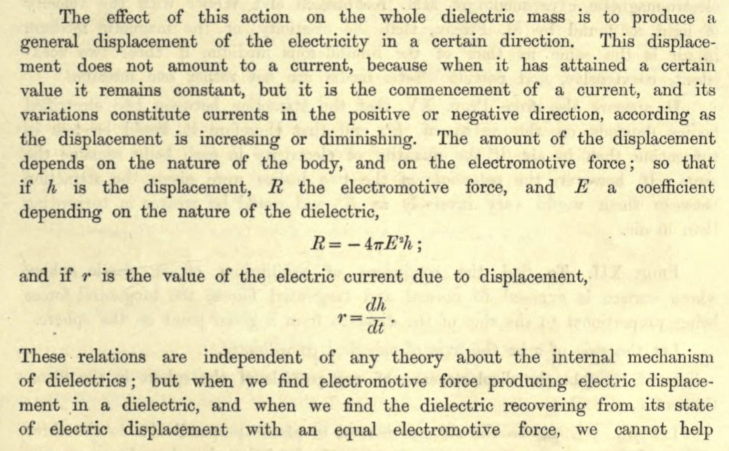
Maxwell's discovery of the displacement current
Fig. 2 In “Physical Lines of Force” in 1861, Maxwell introduces the idea of a displacement current [RefLink].

In this description, E is not the electric field, but is related to the dielectric permativity through the relation
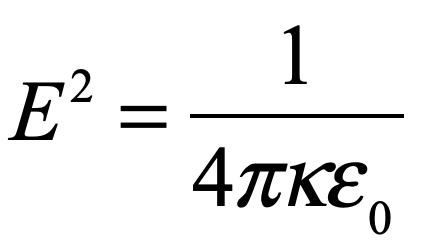
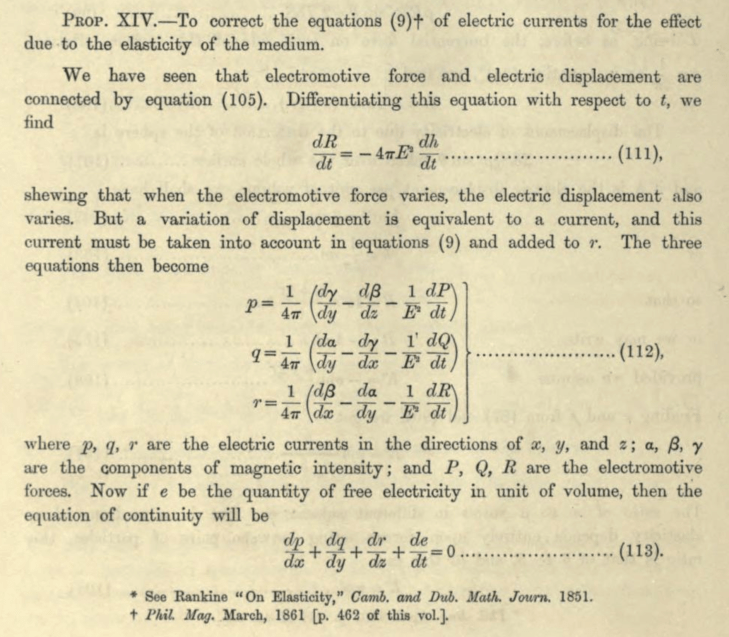
Maxwell went further to prove his Proposition XIV on the contribution of the displacement current to conventional electric currents.
Maxwell completing the laws of electromagnetics
Fig. 3 Maxwell’s Proposition XIV on adding the displacement current to the conventional electric current [RefLink].

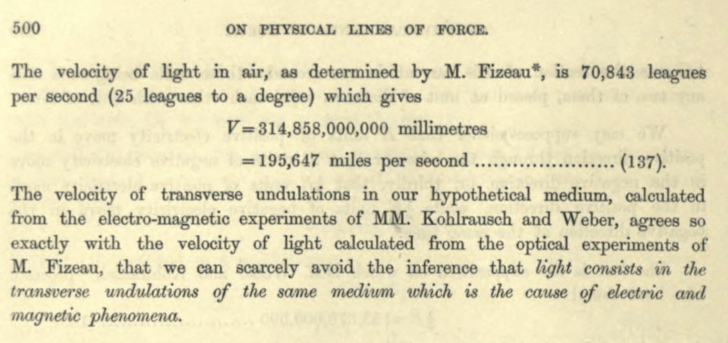
Second, Maxwell calculated that this elastic vortex ether propagated waves at a speed that was close to the known speed of light measured a decade previously by the French physicist Hippolyte Fizeau.  He remarked, “we can scarcely avoid the inference that light consists of the transverse undulations of the same medium which is the cause of electric and magnetic phenomena.” [1]  This was the first direct prediction that light, previously viewed as a physical process separate from electric and magnetic fields, was an electromagnetic phenomenon.
Maxwell's estimate of the speed of light
Fig. 4 Maxwell’s calculation of the speed of light in his mechanical ether. It matched closely the measured speed of light [RefLink].

These two predictions—of the displacement current and the electromagnetic origin of light—have stood the test of time and are center pieces of Maxwells’s legacy.  How strange that they arose from a mechanical model of vortices and idle wheels like so many cogs and gears in the machinery powering the Victorian age, yet such is the power of physical visualization.


[1] pg. 12, The Maxwellians, Bruce Hunt (Cornell University Press, 1991)

[2] Maxwell, J. C. (1861). “On physical lines of force”. Philosophical Magazine. 90: 11–23.
Books by David Nolte at Oxford University Press

The Aberration of Starlight: Relativity’s Crucible

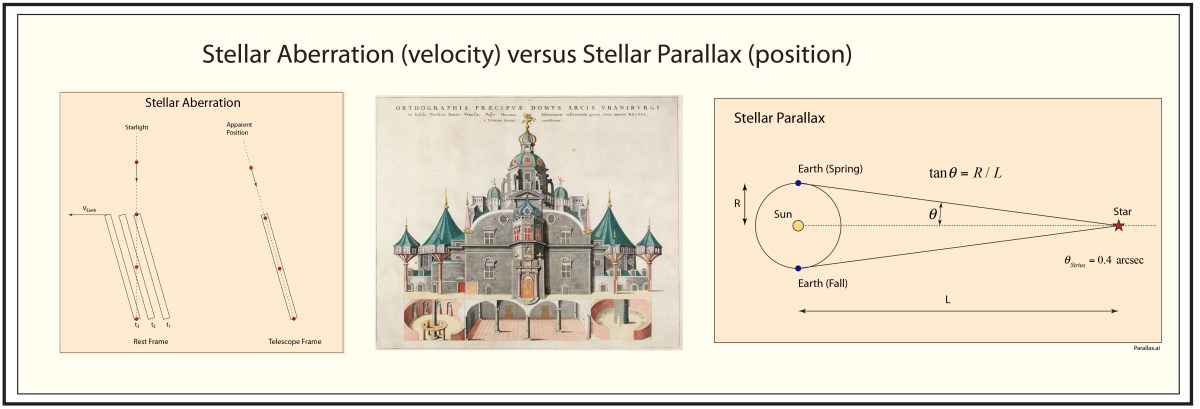
The Earth races around the sun with remarkable speed—at over one hundred thousand kilometers per hour on its yearly track.  This is about 0.01% of the speed of light—a small but non-negligible amount for which careful measurement might show the very first evidence of relativistic effects.  How big is this effect and how do you measure it?  One answer is the aberration of starlight, which is the slight deviation in the apparent position of stars caused by the linear speed of the Earth around the sun.

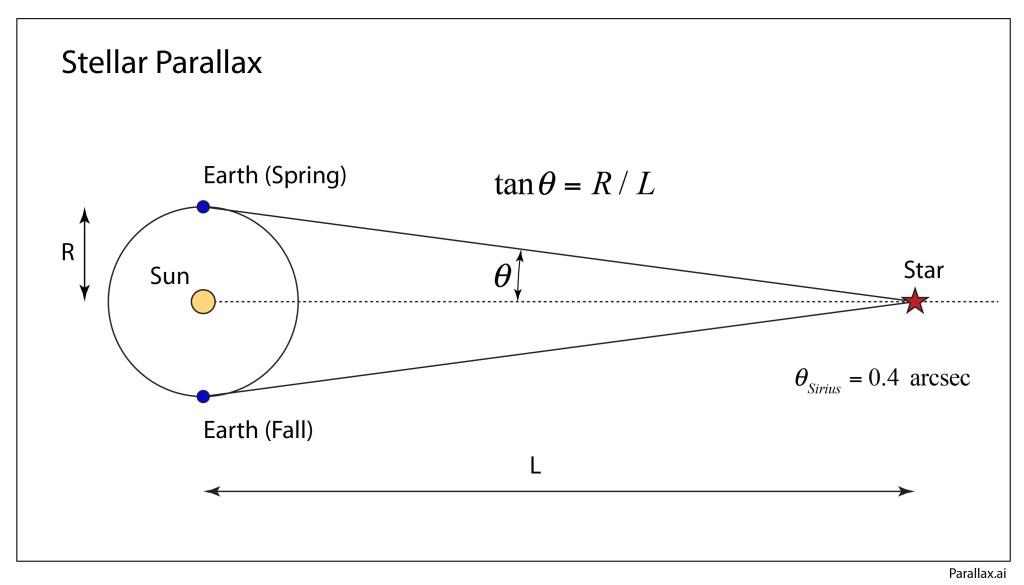
This is not parallax, which is caused the the changing position of the Earth around the sun. Ever since Copernicus, astronomers had been searching for parallax, which would give some indication how far away stars were. It was an important question, because the answer would say something about how big the universe was. But in the process of looking for parallax, astronomers found something else, something about 50 times bigger—aberration.

Aberration is the effect of the transverse speed of the Earth added to the speed of light coming from a star. For instance, this effect on the apparent location of stars in the sky is a simple calculation of the arctangent of 0.01%, which is an angle of about 20 seconds of arc, or about 40 seconds when comparing two angles 6 months apart.  This was a bit bigger than the accuracy of astronomical measurements at the time when Jean Picard travelled from Paris to Denmark in 1671 to visit the ruins of the old observatory of Tycho Brahe at Uranibourg.

Fig. 1 Stellar parallax is the change in apparent positions of a star caused by the change in the Earth’s position as it orbits the sun. If the change in angle (θ) could be measured, then based on Newton’s theory of gravitation that gives the radius of the Earth’s orbit (R), the distance to the star (L) could be found.

Jean Picard at Uranibourg

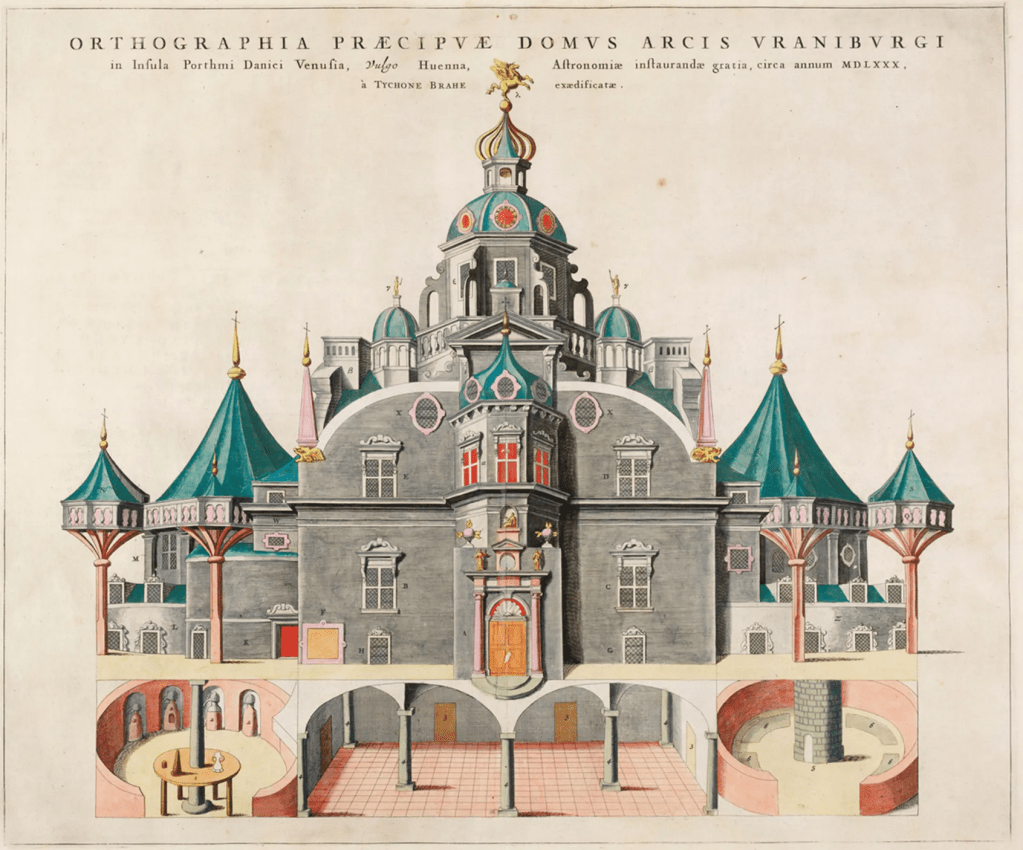
Fig. 2 A view of Tycho Brahe’s Uranibourg astronomical observatory in Hven, Denmark. Tycho had to abandon it near the end of his life when a new king thought he was performing witchcraft.

Jean Picard went to Uranibourg originally in 1671, and during subsequent years, to measure the eclipses of the moons of Jupiter to determine longitude at sea—an idea first proposed by Galileo.  When visiting Copenhagen, before heading out to the old observatory, Picard secured the services of an as yet unknown astronomer by the name of Ole Rømer.  While at Uranibourg, Picard and Rømer made their required measurements of the eclipses of the moons of Jupiter, but with extra observation hours, Picard also made measurements of the positions of selected stars, such as Polaris, the North Star.  His very precise measurements allowed him to track a tiny yearly shift, an aberration, in position by about 40 seconds of arc.  At the time (before Rømer’s great insight about the finite speed of light—see Chapter 1 of Interference (Oxford, 2023)), the speed of light was thought to be either infinite or unmeasurably fast, so Picard thought that this shift was the long-sought effect of stellar parallax that would serve as a way to measure the distance to the stars.  However, the direction of the shift of Polaris was completely wrong if it were caused by parallax, and Picard’s stellar aberration remained a mystery.

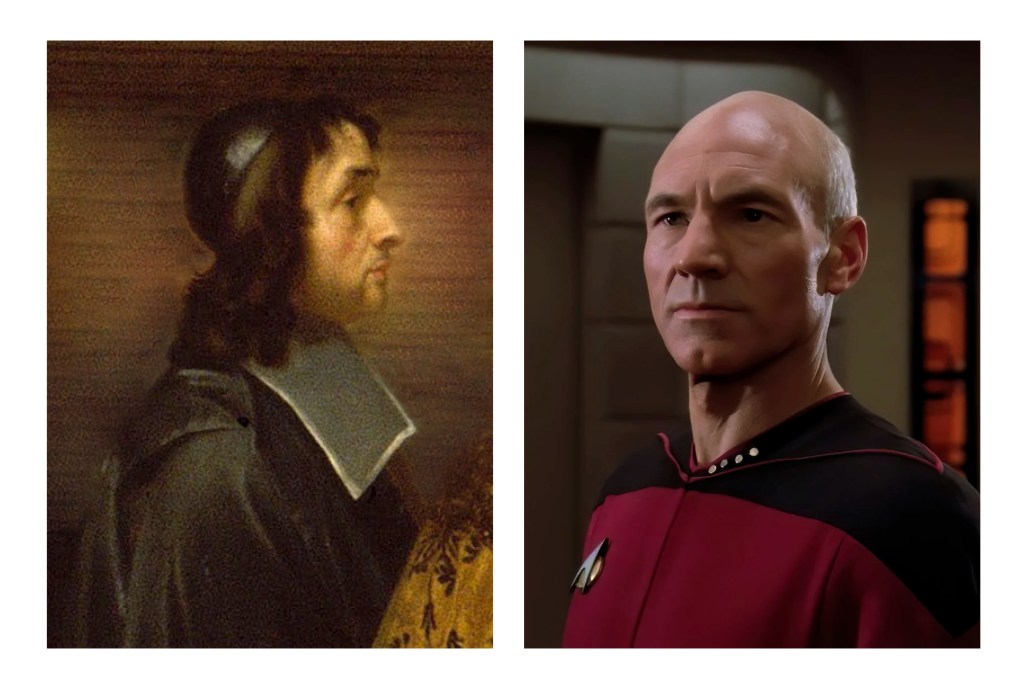
Fig. 3 Jean Picard (left) and his modern name-sake (right).

Samuel Molyneux and Murder in Kew

In 1725, the amateur Irish astronomer Samuel Molyneux (1689 – 1828) decided that the tools of astronomy had improved to the point that the question of parallax could be answered.  He enlisted the help of an instrument maker outside London to install a 24-foot zenith sector (a telescope that points vertically upwards) at his home in Kew.  Molyneux was an independently wealthy politician (he had married the first daughter of the second Earl of Essex) who sat in the British House of Commons, and he was also secretary to the Prince of Wales (the future George II).  Because his political activities made demands on his time, he looked for assistance with his observations and invited James Bradley (1693 – 1762), the newly installed Savilian Professor of Astronomy at Oxford University, to join him in his search.

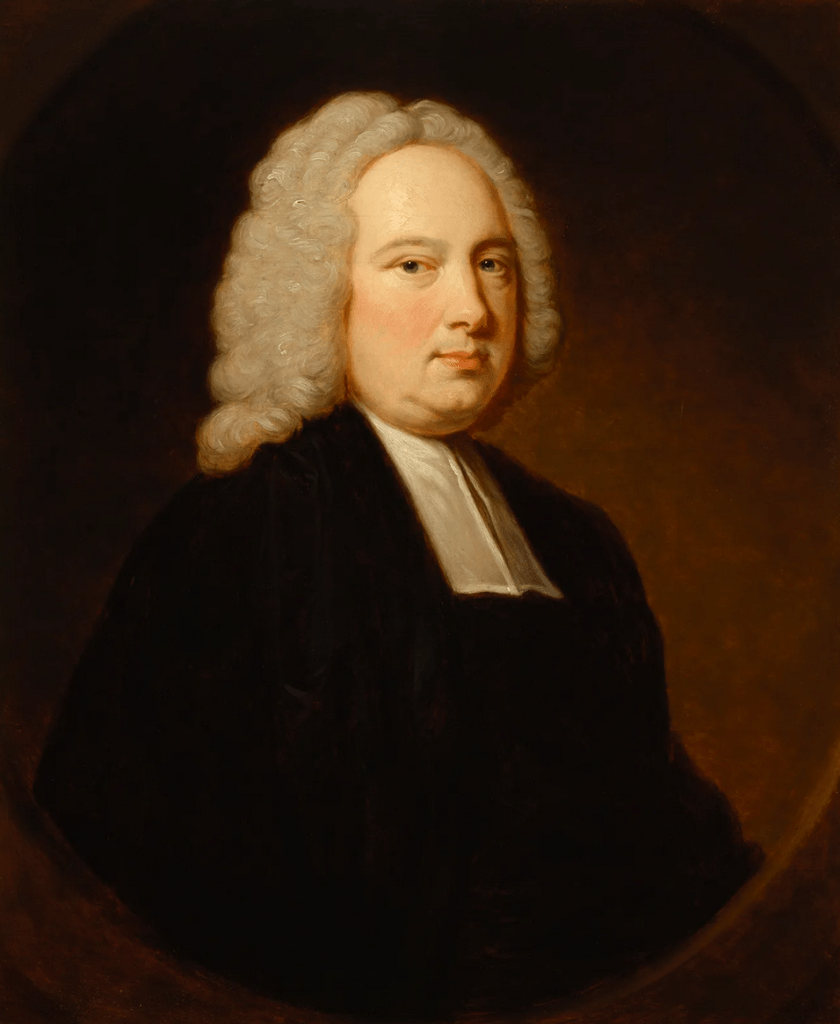
Fig. 4 James Bradley.

James Bradley was a rising star in the scientific circles of England.  He came from a modest background but had the good fortune that his mother’s brother, James Pound, was a noted amateur astronomer who had set up a small observatory at his rectory in Wanstead.  Bradley showed an early interest in astronomy, and Pound encouraged him, helping with the finances of his education that took him to degrees at Baliol College at Oxford.  Even more fortunate was the fact that Pound’s close friend was the Astronomer Royal Edmund Halley, who also took a special interest in Bradley.  With Halley’s encouragement, Bradley made important measurements of Mars and several nebulae, demonstrating an ability to work with great accuracy.  Halley was impressed and nominated Bradley to the Royal Society in 1718, telling everyone that Bradley was destined to be one of the great astronomers of his time. 

Molyneux must have sensed immediately that he had chosen wisely by selecting Bradley to help him with the parallax measurements.  Bradley was capable of exceedingly precise work and was fluent mathematically with the geometric complexities of celestial orbits.  Fastening the large zenith sector to the chimney of the house gave the apparatus great stability, and in December of 1725 they commenced observations of Gamma Draconis as it passed directly overhead.  Because of the accuracy of the sector, they quickly observed a deviation in the star’s position, but the deviation was in the wrong direction, just as Picard had observed.  They continued to make observations over two years, obtaining a detailed map of a yearly wobble in the star’s position as it changed angle by 40 seconds of arc (about one percent of a degree) over six months. 

When Molyneux was appointed Lord of the Admiralty in 1727, as well as becoming a member of the Irish Parliament (representing Dublin University), he had little time to continue with the observations of Gamma Draconis.  He helped Bradley set up a Zenith sector telescope at Bradley’s uncle’s observatory in Wanstead that had a wider field of view to observe more stars, and then he left the project to his friend.  A few months later, before either he or Bradley had understood the cause of the stellar aberration, Molyneux collapsed while in the House of Commons and was carried back to his house.  One of Molyneux’s many friends was the court anatomist Nathaniel St. André who attended to him over the next several days as he declined and died.  St. André was already notorious for roles he had played in several public hoaxes, and on the night of his friend’s death, before the body had grown cold, he eloped with Molyneux’s wife, raising accusations of murder (that could never be proven). 

James Bradley and the Light Wind

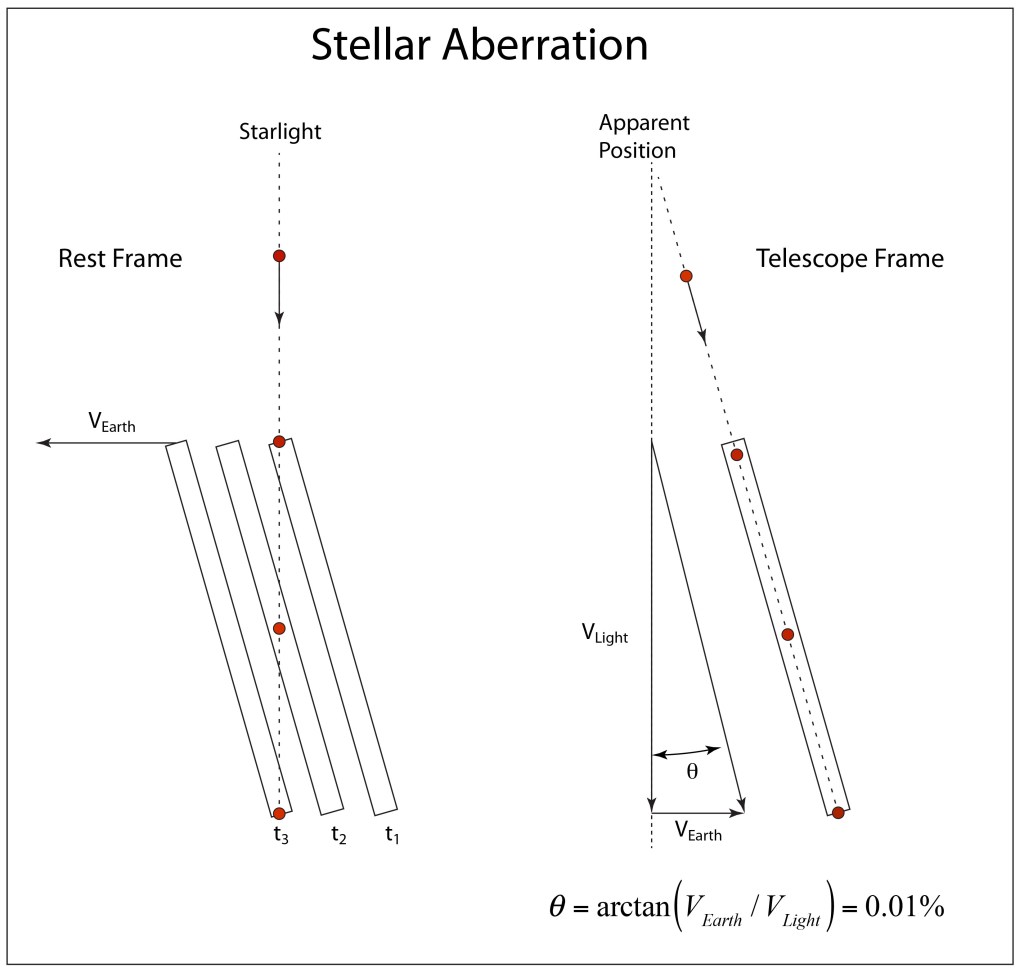
Over the following year, Bradley observed aberrations in several stars, all of them displaying the same yearly wobble of about 40 seconds of arc.  This common behavior of numerous stars demanded a common explanation, something they all shared.  It is said that the answer came to Bradley while he was boating on the Thames.  The story may be apocryphal, but he apparently noticed the banner fluttering downwind at the top of the mast, and after the boat came about, the banner pointed in a new direction.  The wind direction itself had not altered, but the motion of the boat relative to the wind had changed.  Light at that time was considered to be made of a flux of corpuscles, like a gentle wind of particles.  As the Earth orbited the Sun, its motion relative to this wind would change periodically with the seasons, and the apparent direction of the star would shift a little as a result.

Fig. 5 Principle of stellar aberration.  On the left is the rest frame of the star positioned directly overhead as a moving telescope tube must be slightly tilted at an angle (equal to the arctangent of the ratio of the Earth’s speed to the speed of light–greatly exaggerated in the figure) to allow the light to pass through it.  On the right is the rest frame of the telescope in which the angular position of the star appears shifted.

Bradley shared his observations and his explanation in a letter to Halley that was read before the Royal Society in January of 1729.  Based on his observations, he calculated the speed of light to be about ten thousand times faster than the speed of the Earth in its orbit around the Sun.  At that speed, it should take light eight minutes and twelve seconds to travel from the Sun to the Earth (the actual number is eight minutes and 19 seconds).  This number was accurate to within a percent of the true value compared with the estimates made by Huygens from the eclipses of the moons of Jupiter that were in error by 27 percent.  In addition, because he was unable to discern any effect of parallax in the stellar motions, Bradley was able to place a limit on how far the distant stars must be, more than 100,000 times farther the distance of the Earth from the Sun, which was much farther away than any had previously expected.  In January of 1729 the size of the universe suddenly jumped to an incomprehensibly large scale.

Bradley’s explanation of the aberration of starlight was simple and matched observations with good quantitative accuracy.  The particle nature of light made it like a wind, or a current, and the motion of the Earth was just a case of Galilean relativity that any freshman physics student can calculate.  At first there seemed to be no controversy or difficulties with this interpretation.  However, an obscure paper published in 1784 by an obscure English natural philosopher named John Michell (the first person to conceive of a “dark star”) opened a Pandora’s box that launched the crisis of the luminiferous ether and the eventual triumph of Einstein’s theory of Relativity (see Chapter 3 of Interference (Oxford, 2023)), .

By David D. Nolte, Sept. 27, 2023

Read more in Books by David Nolte at Oxford University Press

Book Preview: Interference. The History of Optical Interferometry

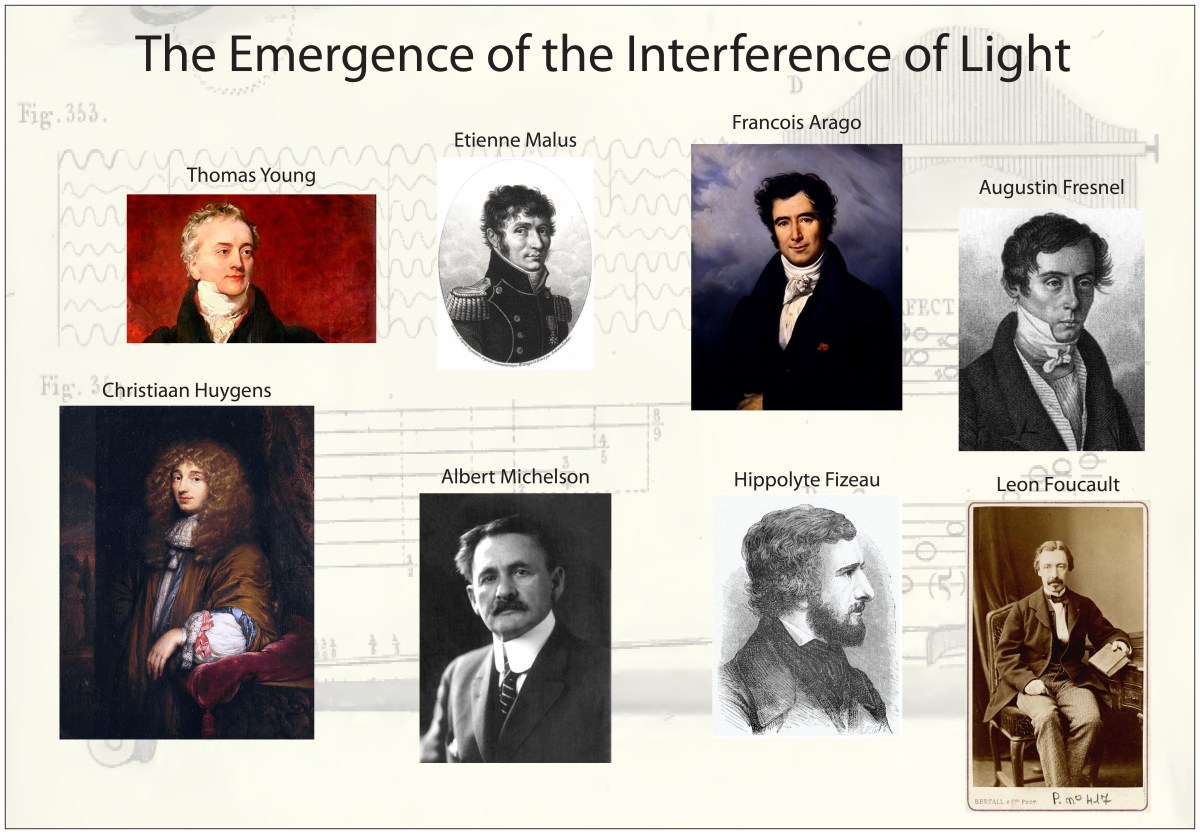
This history of interferometry has many surprising back stories surrounding the scientists who discovered and explored one of the most important aspects of the physics of light—interference. From Thomas Young who first proposed the law of interference, and Augustin Fresnel and Francois Arago who explored its properties, to Albert Michelson, who went almost mad grappling with literal firestorms surrounding his work, these scientists overcame personal and professional obstacles on their quest to uncover light’s secrets. The book’s stories, told around the topic of optics, tells us something more general about human endeavor as scientists pursue science.

Interference: The History of Optical Interferometry and the Scientists who Tamed Light, was published Ag. 6 and is available at Oxford University Press and Amazon. Here is a brief preview of the frist several chapters:

Chapter 1. Thomas Young Polymath: The Law of Interference

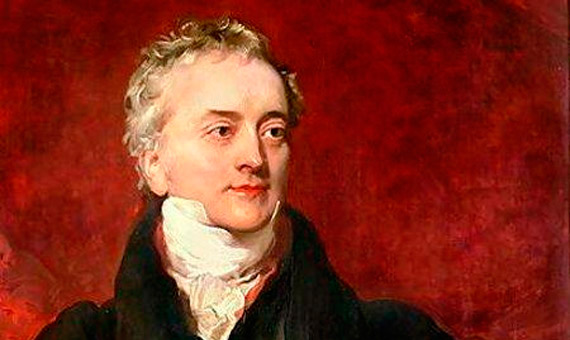
Thomas Young was the ultimate dabbler, his interests and explorations ranged far and wide, from ancient egyptology to naval engineering, from physiology of perception to the physics of sound and light. Yet unlike most dabblers who accomplish little, he made original and seminal contributions to all these fields. Some have called him the “Last Man Who Knew Everything”.

Thomas Young. The Law of Interference.

The chapter, Thomas Young Polymath: The Law of Interference, begins with the story of the invasion of Egypt in 1798 by Napoleon Bonaparte as the unlikely link among a set of epic discoveries that launched the modern science of light.  The story of interferometry passes from the Egyptian campaign and the discovery of the Rosetta Stone to Thomas Young.  Young was a polymath, known for his facility with languages that helped him decipher Egyptian hieroglyphics aided by the Rosetta Stone.  He was also a city doctor who advised the admiralty on the construction of ships, and he became England’s premier physicist at the beginning of the nineteenth century, building on the wave theory of Huygens, as he challenged Newton’s particles of light.  But his theory of the wave nature of light was controversial, attracting sharp criticism that would pass on the task of refuting Newton to a new generation of French optical physicists.

Chapter 2. The Fresnel Connection: Particles versus Waves

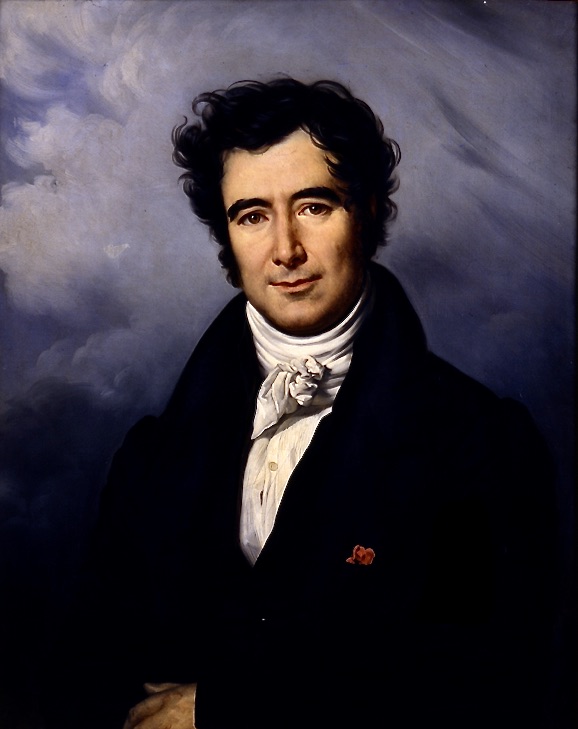
Augustin Fresnel was an intuitive genius whose talents were almost squandered on his job building roads and bridges in the backwaters of France until he was discovered and rescued by Francois Arago.

Augustin Fresnel. Image Credit.

The Fresnel Connection: Particles versus Waves describes the campaign of Arago and Fresnel to prove the wave nature of light based on Fresnel’s theory of interfering waves in diffraction.  Although the discovery of the polarization of light by Etienne Malus posed a stark challenge to the undulationists, the application of wave interference, with the superposition principle of Daniel Bernoulli, provided the theoretical framework for the ultimate success of the wave theory.  The final proof came through the dramatic demonstration of the Spot of Arago.

Chapter 3. At Light Speed: The Birth of Interferometry

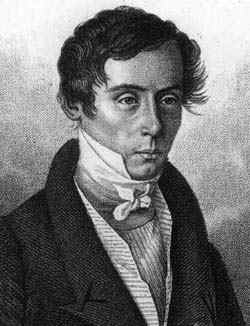
There is no question that Francois Arago was a swashbuckler. His life’s story reads like an adventure novel as he went from being marooned in hostile lands early in his career to becoming prime minister of France after the 1848 revolutions swept across Europe.

Francois Arago. Image Credit.

At Light Speed: The Birth of Interferometry tells how Arago attempted to use Snell’s Law to measure the effect of the Earth’s motion through space but found no effect, in contradiction to predictions using Newton’s particle theory of light.  Direct measurements of the speed of light were made by Hippolyte Fizeau and Leon Foucault who originally began as collaborators but had an epic falling-out that turned into an  intense competition.  Fizeau won priority for the first measurement, but Foucault surpassed him by using the Arago interferometer to measure the speed of light in air and water with increasing accuracy.  Jules Jamin later invented one of the first interferometric instruments for use as a refractometer.

Chapter 4. After the Gold Rush: The Trials of Albert Michelson

No name is more closely connected to interferometry than that of Albert Michelson. He succeeded, sometimes at great personal cost, in launching interferometric metrology as one of the most important tools used by scientists today.

Albert A. Michelson, 1907 Nobel Prize. Image Credit.

After the Gold Rush: The Trials of Albert Michelson tells the story of Michelson’s youth growing up in the gold fields of California before he was granted an extraordinary appointment to Annapolis by President Grant. Michelson invented his interferometer while visiting Hermann von Helmholtz in Berlin, Germany, as he sought to detect the motion of the Earth through the luminiferous ether, but no motion was detected. After returning to the States and a faculty position at Case University, he met Edward Morley, and the two continued the search for the Earth’s motion, concluding definitively its absence.  The Michelson interferometer launched a menagerie of interferometers (including the Fabry-Perot interferometer) that ushered in the golden age of interferometry.

Chapter 5. Stellar Interference: Measuring the Stars

Learning from his attempts to measure the speed of light through the ether, Michelson realized that the partial coherence of light from astronomical sources could be used to measure their sizes. His first measurements using the Michelson Stellar Interferometer launched a major subfield of astronomy that is one of the most active today.

R Hanbury Brown

Stellar Interference: Measuring the Stars brings the story of interferometry to the stars as Michelson proposed stellar interferometry, first demonstrated on the Galilean moons of Jupiter, followed by an application developed by Karl Schwarzschild for binary stars, and completed by Michelson with observations encouraged by George Hale on the star Betelgeuse.  However, the Michelson stellar interferometry had stability limitations that were overcome by Hanbury Brown and Richard Twiss who developed intensity interferometry based on the effect of photon bunching.  The ultimate resolution of telescopes was achieved after the development of adaptive optics that used interferometry to compensate for atmospheric turbulence.

And More

The last 5 chapters bring the story from Michelson’s first stellar interferometer into the present as interferometry is used today to search for exoplanets, to image distant black holes half-way across the universe and to detect gravitational waves using the most sensitive scientific measurement apparatus ever devised.

Chapter 6. Across the Universe: Exoplanets, Black Holes and Gravitational Waves

Moving beyond the measurement of star sizes, interferometry lies at the heart of some of the most dramatic recent advances in astronomy, including the detection of gravitational waves by LIGO, the imaging of distant black holes and the detection of nearby exoplanets that may one day be visited by unmanned probes sent from Earth.

Chapter 7. Two Faces of Microscopy: Diffraction and Interference

The complement of the telescope is the microscope. Interference microscopy allows invisible things to become visible and for fundamental limits on image resolution to be blown past with super-resolution at the nanoscale, revealing the intricate workings of biological systems with unprecedented detail.

Chapter 8. Holographic Dreams of Princess Leia: Crossing Beams

Holography is the direct legacy of Young’s double slit experiment, as coherent sources of light interfere to record, and then reconstruct, the direct scattered fields from illuminated objects. Holographic display technology promises to revolutionize virtual reality.

Chapter 9. Photon Interference: The Foundations of Quantum Communication and Computing

Quantum information science, at the forefront of physics and technology today, owes much of its power to the principle of interference among single photons.

Chapter 10. The Quantum Advantage: Interferometric Computing

Photonic quantum systems have the potential to usher in a new information age using interference in photonic integrated circuits.

A popular account of the trials and toils of the scientists and engineers who tamed light and used it to probe the universe.

Io, Europa, Ganymede, and Callisto: Galileo’s Moons in the History of Science

When Galileo trained his crude telescope on the planet Jupiter, hanging above the horizon in 1610, and observed moons orbiting a planet other than Earth, it created a quake whose waves have rippled down through the centuries to today.  Never had such hard evidence been found that supported the Copernican idea of non-Earth-centric orbits, freeing astronomy and cosmology from a thousand years of error that shaded how people thought.

The Earth, after all, was not the center of the Universe.

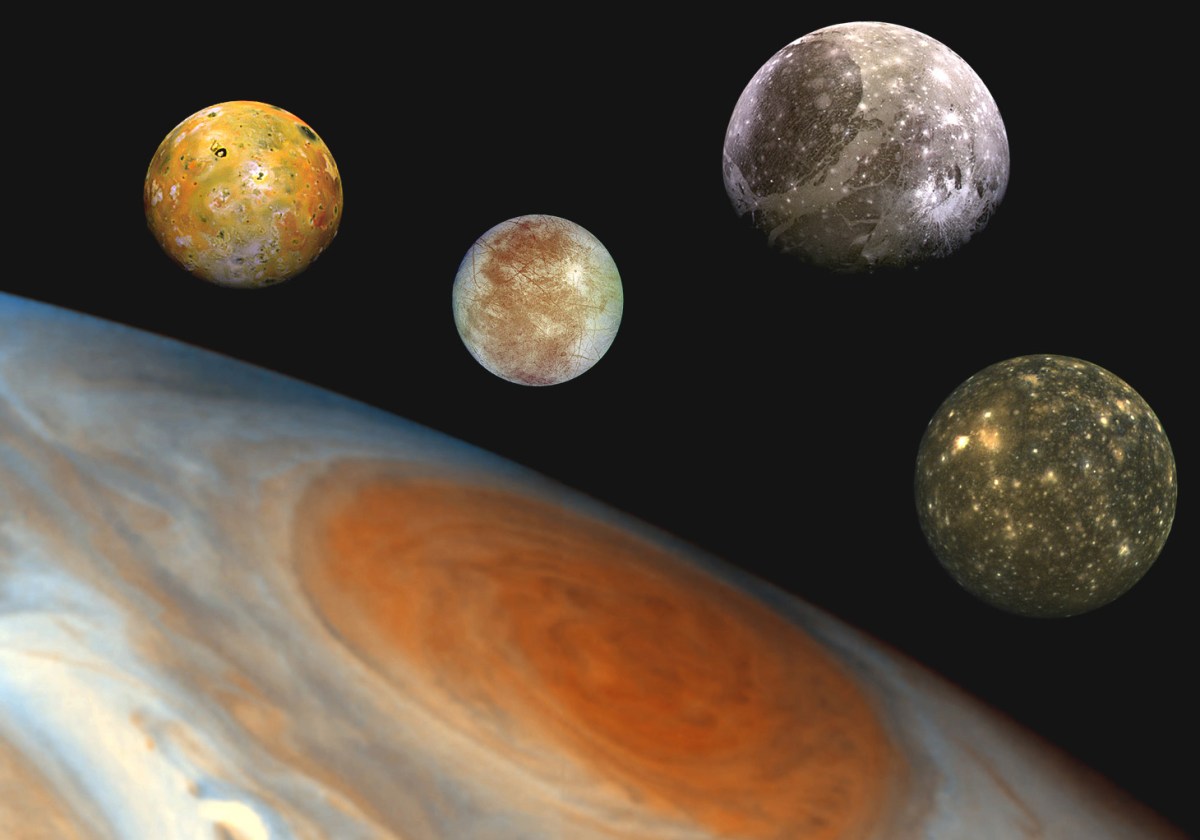
Galileo’s moons: the Galilean Moons—Io, Europa, Ganymede, and Callisto—have drawn our eyes skyward now for over 400 years.  They have been the crucible for numerous scientific discoveries, serving as a test bed for new ideas and new techniques, from the problem of longitude to the speed of light, from the birth of astronomical interferometry to the beginnings of exobiology.  Here is a short history of Galileo’s Moons in the history of physics.

Galileo (1610): Celestial Orbits

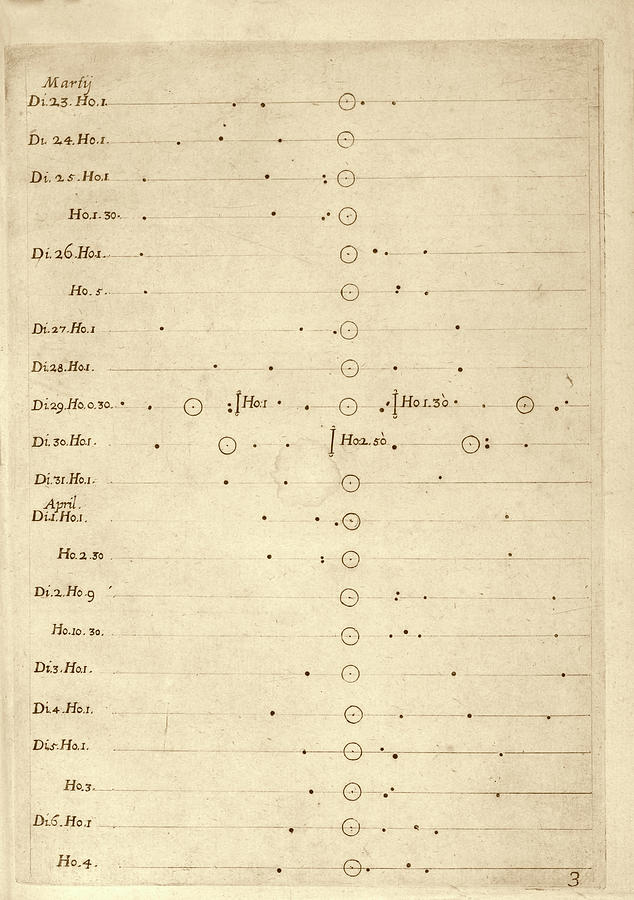
In late 1609, Galileo (1564 – 1642) received an unwelcome guest to his home in Padua—his mother.  She was not happy with his mistress, and she was not happy with his chosen profession, but she was happy to tell him so.  By the time she left in early January 1610, he was yearning for something to take his mind off his aggravations, and he happened to point his new 20x telescope in the direction of the planet Jupiter hanging above the horizon [1].  Jupiter appeared as a bright circular spot, but nearby were three little stars all in line with the planet.  The alignment caught his attention, and when he looked again the next night, the position of the stars had shifted.  On successive nights he saw them shift again, sometimes disappearing into Jupiter’s bright disk.  Several days later he realized that there was a fourth little star that was also behaving the same way.  At first confused, he had a flash of insight—the little stars were orbiting the planet.  He quickly understood that just as the Moon orbited the Earth, these new “Medicean Planets” were orbiting Jupiter.  In March 1610, Galileo published his findings in Siderius Nuncius (The Starry Messenger). 

Page from Galileo’s Starry Messenger showing the positions of the moon of Jupiter

It is rare in the history of science for there not to be a dispute over priority of discovery.  Therefore, by an odd chance of fate, on the same nights that Galileo was observing the moons of Jupiter with his telescope from Padua, the German astronomer Simon Marius (1573 – 1625) also was observing them through a telescope of his own from Bavaria.  It took Marius four years to publish his observations, long after Galileo’s Siderius had become a “best seller”, but Marius took the opportunity to claim priority.  When Galileo first learned of this, he called Marius “a poisonous reptile” and “an enemy of all mankind.”  But harsh words don’t settle disputes, and the conflicting claims of both astronomers stood until the early 1900’s when a scientific enquiry looked at the hard evidence.  By that same odd chance of fate that had compelled both men to look in the same direction around the same time, the first notes by Marius in his notebooks were dated to a single day after the first notes by Galileo!  Galileo’s priority survived, but Marius may have had the last laugh.  The eternal names of the “Galilean” moons—Io, Europe, Ganymede and Callisto—were given to them by Marius.

Picard and Cassini (1671):  Longitude

The 1600’s were the Age of Commerce for the European nations who relied almost exclusively on ships and navigation.  While latitude (North-South) was easily determined by measuring the highest angle of the sun above the southern horizon, longitude (East-West) relied on clocks which were notoriously inaccurate, especially at sea. 

The Problem of Determining Longitude at Sea is the subject of Dava Sobel’s thrilling book Longitude (Walker, 1995) [2] where she reintroduced the world to what was once the greatest scientific problem of the day.  Because almost all commerce was by ships, the determination of longitude at sea was sometimes the difference between arriving safely in port with a cargo or being shipwrecked.  Galileo knew this, and later in his life he made a proposal to the King of Spain to fund a scheme to use the timings of the eclipses of his moons around Jupiter to serve as a “celestial clock” for ships at sea.  Galileo’s grant proposal went unfunded, but the possibility of using the timings of Jupiter’s moons for geodesy remained an open possibility, one which the King of France took advantage of fifty years later.

In 1671 the newly founded Academie des Sciences in Paris funded an expedition to the site of Tycho Brahe’s Uranibourg Observatory in Hven, Denmark, to measure the time of the eclipses of the Galilean moons observed there to be compared the time of the eclipses observed in Paris by Giovanni Cassini (1625 – 1712).  When the leader of the expedition, Jean Picard (1620 – 1682), arrived in Denmark, he engaged the services of a local astronomer, Ole Rømer (1644 – 1710) to help with the observations of over 100 eclipses of the Galilean moon Io by the planet Jupiter.  After the expedition returned to France, Cassini and Rømer calculated the time differences between the observations in Paris and Hven and concluded that Galileo had been correct.  Unfortunately, observing eclipses of the tiny moon from the deck of a ship turned out not to be practical, so this was not the long-sought solution to the problem of longitude, but it contributed to the early science of astrometry (the metrical cousin of astronomy).  It also had an unexpected side effect that forever changed the science of light.

Ole Rømer (1676): The Speed of Light

Although the differences calculated by Cassini and Rømer between the times of the eclipses of the moon Io between Paris and Hven were small, on top of these differences was superposed a surprisingly large effect that was shared by both observations.  This was a systematic shift in the time of eclipse that grew to a maximum value of 22 minutes half a year after the closest approach of the Earth to Jupiter and then decreased back to the original time after a full year had passed and the Earth and Jupiter were again at their closest approach.  At first Cassini thought the effect might be caused by a finite speed to light, but he backed away from this conclusion because Galileo had shown that the speed of light was unmeasurably fast, and Cassini did not want to gainsay the old master.

Ole Rømer

Rømer, on the other hand, was less in awe of Galileo’s shadow, and he persisted in his calculations and concluded that the 22 minute shift was caused by the longer distance light had to travel when the Earth was farthest away from Jupiter relative to when it was closest.  He presented his results before the Academie in December 1676 where he announced that the speed of light, though very large, was in fact finite.  Unfortnately, Rømer did not have the dimensions of the solar system at his disposal to calculate an actual value for the speed of light, but the Dutch mathematician Huygens did.

When Christian Huygens read the proceedings of the Academie in which Rømer had presented his findings, he took what he knew of the radius of Earth’s orbit and the distance to Jupiter and made the first calculation of the speed of light.  He found a value of 220,000 km/second (kilometers did not exist yet, but this is the equivalent of what he calculated).  This value is 26 percent smaller than the true value, but it was the first time a number was given to the finite speed of light—based fundamentally on the Galilean moons. For a popular account of the story of Picard and Rømer and Huygens and the speed of light, see Ref. [3].

Michelson (1891): Astronomical Interferometry

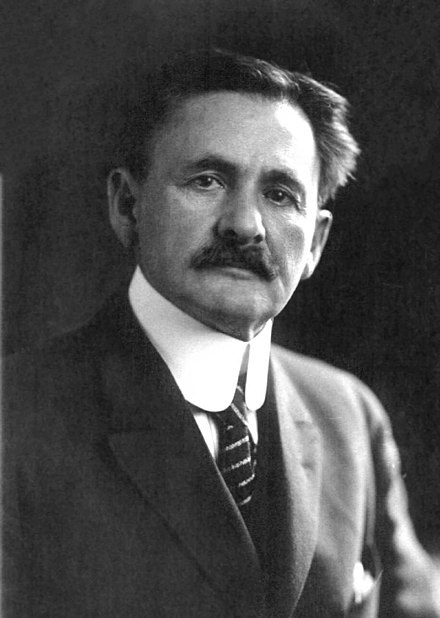
Albert Michelson (1852 – 1931) was the first American to win the Nobel Prize in Physics.  He received the award in 1907 for his work to replace the standard meter, based on a bar of metal housed in Paris, with the much more fundamental wavelength of red light emitted by Cadmium atoms.  His work in Paris came on the heels of a new and surprising demonstration of the use of interferometry to measure the size of astronomical objects.

Albert Michelson

The wavelength of light (a millionth of a meter) seems ill-matched to measuring the size of astronomical objects (thousands of meters) that are so far from Earth (billions of meters).  But this is where optical interferometry becomes so important.  Michelson realized that light from a distant object, like a Galilean moon of Jupiter, would retain some partial coherence that could be measured using optical interferometry.  Furthermore, by measuring how the interference depended on the separation of slits placed on the front of a telescope, it would be possible to determine the size of the astronomical object.

From left to right: Walter Adams, Albert Michelson, Walther Mayer, Albert Einstein, Max Ferrand, and Robert Milliken. Photo taken at Caltech.

In 1891, Michelson traveled to California where the Lick Observatory was poised high above the fog and dust of agricultural San Jose (a hundred years before San Jose became the capitol of high-tech Silicon Valley).  Working with the observatory staff, he was able to make several key observations of the Galilean moons of Jupiter.  These were just close enough that their sizes could be estimated (just barely) from conventional telescopes.  Michelson found from his calculations of the interference effects that the sizes of the moons matched the conventional sizes to within reasonable error.  This was the first demonstration of astronomical interferometry which has burgeoned into a huge sub-discipline of astronomy today—based originally on the Galilean moons [4].

Pioneer (1973 – 1974): The First Tour

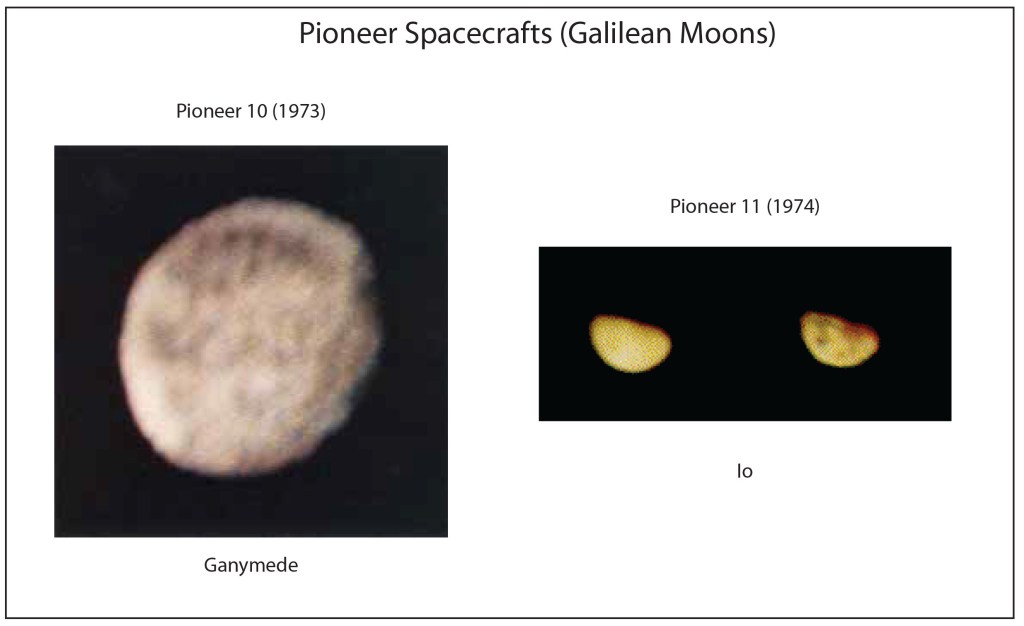
Pioneer 10 was launched on March 3, 1972 and made its closest approach to Jupiter on Dec. 3, 1973. Pioneer 11 was launched on April 5, 1973 and made its closest approach to Jupiter on Dec. 3, 1974 and later was the first spacecraft to fly by Saturn. The Pioneer spacecrafts were the first to leave the solar system (there have now been 5 that have left, or will leave, the solar system). The cameras on the Pioneers were single-pixel instruments that made line-scans as the spacecraft rotated. The point light detector was a Bendix Channeltron photomultiplier detector, which was a vacuum tube device (yes vacuum tube!) operating at a single-photon detection efficiency of around 10%. At the time of the system design, this was a state-of-the-art photon detector. The line scanning was sufficient to produce dramatic photographs (after extensive processing) of the giant planets. The much smaller moons were seen with low resolution, but were still the first close-ups ever to be made of Galileo’s moons.

Voyager (1979): The Grand Tour

Voyager 1 was launched on Sept. 5, 1977 and Voyager 2 was launched on August 20, 1977. Although Voyager 1 was launched second, it was the first to reach Jupiter with closest approach on March 5, 1979. Voyager 2 made its closest approach to Jupiter on July 9, 1979.

In the Fall of 1979, I had the good fortune to be an undergraduate at Cornell University when Carl Sagan gave an evening public lecture on the Voyager fly-bys, revealing for the first time the amazing photographs of not only Jupiter but of the Galilean Moons. Sitting in the audience listening to Sagan, a grand master of scientific story telling, made you feel like you were a part of history. I have never been so convinced of the beauty and power of science and technology as I was sitting in the audience that evening.

The camera technology on the Voyagers was a giant leap forward compared to the Pioneer spacecraft. The Voyagers used cathode ray vidicon cameras, like those used in television cameras of the day, with high-resolution imaging capabilities. The images were spectacular, displaying alien worlds in high-def for the first time in human history: volcanos and lava flows on the moon of Io; planet-long cracks in the ice-covered surface of Europa; Callisto’s pock-marked surface; Ganymede’s eerie colors.

The Voyager’s discoveries concerning the Galilean Moons were literally out of this world. Io was discovered to be a molten planet, its interior liquified by tidal-force heating from its nearness to Jupiter, spewing out sulfur lava onto a yellowed terrain pockmarked by hundreds of volcanoes, sporting mountains higher than Mt. Everest. Europa, by contrast, was discovered to have a vast flat surface of frozen ice, containing no craters nor mountains, yet fractured by planet-scale ruptures stained tan (for unknown reasons) against the white ice. Ganymede, the largest moon in the solar system, is a small planet, larger than Mercury. The Voyagers revealed that it had a blotchy surface with dark cratered patches interspersed with light smoother patches. Callisto, again by contrast, was found to be the most heavily cratered moon in the solar system, with its surface pocked by countless craters.

Galileo (1995): First in Orbit

The first mission to orbit Jupiter was the Galileo spacecraft that was launched, not from the Earth, but from Earth orbit after being delivered there by the Space Shuttle Atlantis on Oct. 18, 1989. Galileo arrived at Jupiter on Dec. 7, 1995 and was inserted into a highly elliptical orbit that became successively less eccentric on each pass. It orbited Jupiter for 8 years before it was purposely crashed into the planet (to prevent it from accidentally contaminating Europa that may support some form of life).

Galileo made many close passes to the Galilean Moons, providing exquisite images of the moon surfaces while its other instruments made scientific measurements of mass and composition. This was the first true extended study of Galileo’s Moons, establishing the likely internal structures, including the liquid water ocean lying below the frozen surface of Europa. As the largest body of liquid water outside the Earth, it has been suggested that some form of life could have evolved there (or possibly been seeded by meteor ejecta from Earth).

Juno (2016): Still Flying

The Juno spacecraft was launched from Cape Canaveral on Aug. 5, 2011 and entered a Jupiter polar orbit on July 5, 2016. The mission has been producing high-resolution studies of the planet. The mission was extended in 2021 to last to 2025 to include several close fly-bys of the Galilean Moons, especially Europa, which will be the object of several upcoming missions because of the possibility for the planet to support evolved life. These future missions include NASA’s Europa Clipper Mission, the ESA’s Jupiter Icy Moons Explorer, and the Io Volcano Observer.

Epilog (2060): Colonization of Callisto

In 2003, NASA identified the moon Callisto as the proposed site of a manned base for the exploration of the outer solar system. It would be the next most distant human base to be established after Mars, with a possible start date by the mid-point of this century. Callisto was chosen because it is has a low radiation level (being the farthest from Jupiter of the large moons) and is geologically stable. It also has a composition that could be mined to manufacture rocket fuel. The base would be a short-term way-station (crews would stay for no longer than a month) for refueling before launching and using a gravity assist from Jupiter to sling-shot spaceships to the outer planets.

By David D. Nolte, May 29, 2023


[1] See Chapter 2, A New Scientist: Introducing Galileo, in David D. Nolte, Galileo Unbound (Oxford University Press, 2018).

[2] Dava Sobel, Longitude: The True Story of a Lone Genius who Solved the Greatest Scientific Problem of his Time (Walker, 1995)

[3] See Chap. 1, Thomas Young Polymath: The Law of Interference, in David D. Nolte, Interference: The History of Optical Interferometry and the Scientists who Tamed Light (Oxford University Press, 2023)

[4] See Chapter 5, Stellar Interference: Measuring the Stars, in David D. Nolte, Interference: The History of Optical Interferometry and the Scientists who Tamed Light (Oxford University Press, 2023).


Read more in Books by David Nolte at Oxford University Press