Science Underground: Neutrino Physics and Deep Gold Mines

“By rights, we shouldn’t even be here,” says Samwise Gamgee to Frodo Baggins in the Peter Jackson movie The Lord of the Rings: The Two Towers

But we are!

We, our world, our Galaxy, our Universe of matter, should not exist.  The laws of physics, as we currently know them, say that all the matter created at the instant of the Big Bang should have annihilated with all the anti-matter there too.  The great flash of creation should have been followed by a great flash of destruction, and all that should be left now is a faint glow of light without matter.

Except that we are here, and so is our world, and our Galaxy and our Universe … against the laws of physics as we know them.

So, there must be more that we have yet to know.  We are not done yet with the laws of physics.

Which is why the scientists of the Sanford Underground Research Facility (SURF), a kilometer deep under the Black Hills of South Dakota, are probing the deep questions of the universe near the bottom of a century-old gold mine.

Homestake Mine

>>> Twenty of us are plunging vertically at one meter per second into the depths of the earth, packed into a steel cage, seven to a row, dressed in hard hats and fluorescent safety vests and personal protective gear plus a gas filter that will keep us alive for a mere 60 minutes if something goes very wrong.  It is dark, except for periodic fast glimpses of LED-lit mine drifts flying skyward, then rock again, repeating over and over for ten minutes.  Drops of water laced with carbonate drip from the cage ceiling, that, when dried, leave little white stalagmites on our clothing.  A loud bang tells everyone inside that a falling boulder has crashed into the top of the cage, and we all instinctively press our hard hats more tightly onto our heads.  Finally, the cage slows, eventually to a crawl, as it settles to the 4100 level of the Homestake mine. <<<

The Homestake mine was founded in 1877 on land that had been deeded for all time to the Lakota Sioux by the United States Government in the Treaty of Fort Laramie in 1868—that is, before George Custer, twice cursed, found gold in the rolling forests of Ȟe Sápa—the Black Hills, South Dakota.  The prospectors rushed in, and the Lakota were pushed out.

Gold was found washed down in the streams around the town of Deadwood, but the source of the gold was found a year later at the high Homestake site by prospectors.  The stake was too large for them to operate themselves, so they sold it to a California consortium headed by George Hearst, who moved into town and bought or stole all the land around it.  By 1890, the mine was producing the bulk of gold and silver in the US.  When George Hearst died in 1891, his wife Phoebe donated part of the fortune to building projects at the University of California at Berkeley, including the Hearst Mining Building, which was the largest building devoted to the science of mining engineering in the world.  Their son, William Randolph Hearst, became a famous newspaper magnate and a possible inspiration for Orson Well’s Citizen Cane.
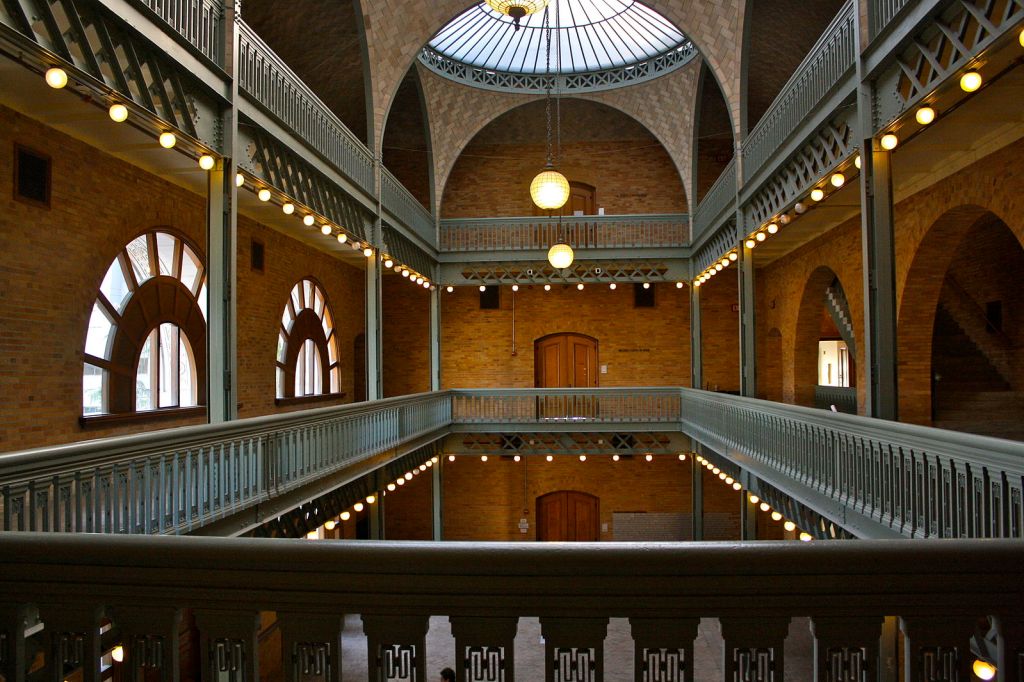
The interior of Hearst Mining Building, UC Berkeley campus.

By the late 1900’s, the mining company had excavated over 300 miles of tunnels and extracted nearly 40 million ounces of gold (equivalent to $100B today).  Over the years, the mine had gone deeper and deeper, eventually reaching the 8000 foot level (about 3000 feet below sea level). 

This unique structure presented a unique opportunity for a nuclear chemist, Ray Davis, at Brookhaven National Laboratory who was interested in the physics of neutrinos, the elementary particles that Enrico Fermi had named the “little neutral ones” that accompany radioactive decay. 

Neutrinos are unlike any other fundamental particles, passing through miles of solid rock as if it were transparent, except for exceedingly rare instances when a neutrino might collide with a nucleus.  However, neutrino detectors on the surface of the Earth were overwhelmed by signals from cosmic rays.  What was needed was a thick shield to protect the neutrino detector, and what better shield than thousands of feet of rock? 

Davis approached the Homestake mining company to request space in one of their tunnels for his detector.  While a mining company would not usually be receptive to requests like this, one of its senior advisors had previously had an academic career at Harvard, and he tipped the scales in favor of Davis.  The experiment would proceed.

The Solar Neutrino Problem

>>> After we disembark onto the 4100 level (4100 feet below the surface) from the Ross Shaft, we load onto the rail cars of a toy train, the track width little more than a foot wide.  The diminutive engine clunks and clangs and jerks itself forward, gathering speed as it pushes and pulls us, disappearing into a dark hole (called a drift) on a mile-long trek to our experimental site.  Twice we get stuck, the engine wheels spinning without purchase, and it is not clear if the engineers can get it going again. 

At this point we have been on the track for a quarter of an hour and the prospect of walking back to the Ross is daunting.  The only other way out, the Yates Shaft, is down for repairs.  The drift is unlit except by us with our battery-powered headlamps sweeping across the rock face, and who knows how long the batteries will last?  The ground is broken and uneven, punctuated with small pools of black water.  There would be a lot of stumbling and falls if we had to walk our way out.  I guess this is why I had to initial and sign in twenty different places on six pages, filled with legal jargon nearly as dense as the rock around us, before they let me come down here. <<<

In 1965, the Homestake mining crews carved out a side cavern for Davis near the Yates shaft at the 4850 level of the mine.  He constructed a large vat to hold cleaning fluid that contained lots of chlorine atoms.  When a rare neutrino interacted with a chlorine nucleus, the nucleus would convert to argon and give off a characteristic flash of light.  By tallying the flashes of light, and by calculating how likely it was for a neutrino to interact with a nucleus, the total flux of neutrinos through the vat could be back calculated.

The main source for neutrinos in our neck of the solar system is the sun.  As hydrogen fuses into helium, it gives off neutrinos.  These pass through the overlying layers of the sun and pass through the Earth and through Davis’ vat—except those rare cases when chlorine converts to argon.  The rate at which solar neutrinos should be detected in the vat was calculated very accurately by John Bahcall at Cal Tech.

By the early 1970’s, there were enough data that the total neutrino flux could be calculated and compared to the theoretical value based on the fusion reactions in the sun—and they didn’t match.  Worse, they didn’t match within a factor of three!  There were three times fewer neutrino events detected that there should have been.  Where were all the missing neutrinos?
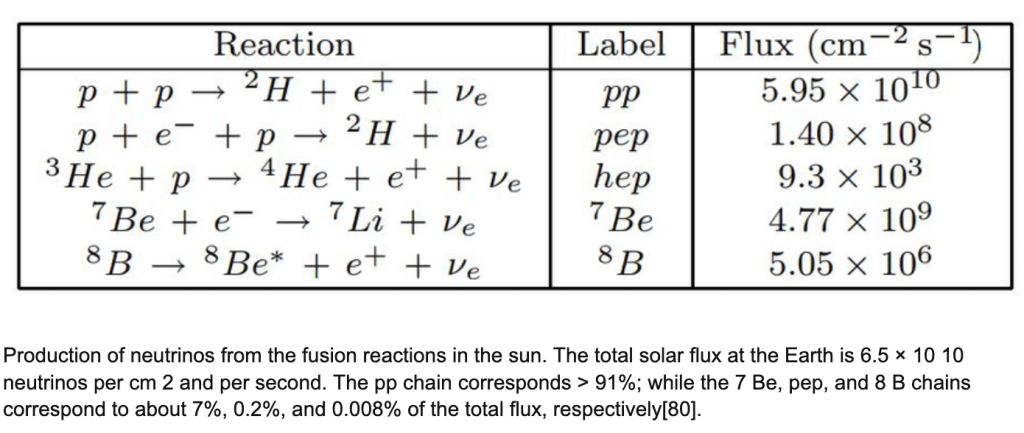
Origins and fluxes of solar neutrinos.

This came to be called the “Solar neutrino problem”.  At first, everyone assumed that the experiment was wrong, but Davis knew he was right.  Then others said the theoretical values were wrong, but Bahcall knew he was right.  The problem was, that Davis and Bahcall couldn’t both be right, could they?

Enter neutrino oscillations

The neutrinos coming from the sun originate mostly as what are known as electron neutrinos.  These interact with a neutron in a chlorine nucleus to convert it to a proton plus an ejected electron.  But if the neutrino were of a different kind, perhaps a muon neutrino, then there isn’t enough energy for the neutron to eject a muon, so the reaction doesn’t take place. 
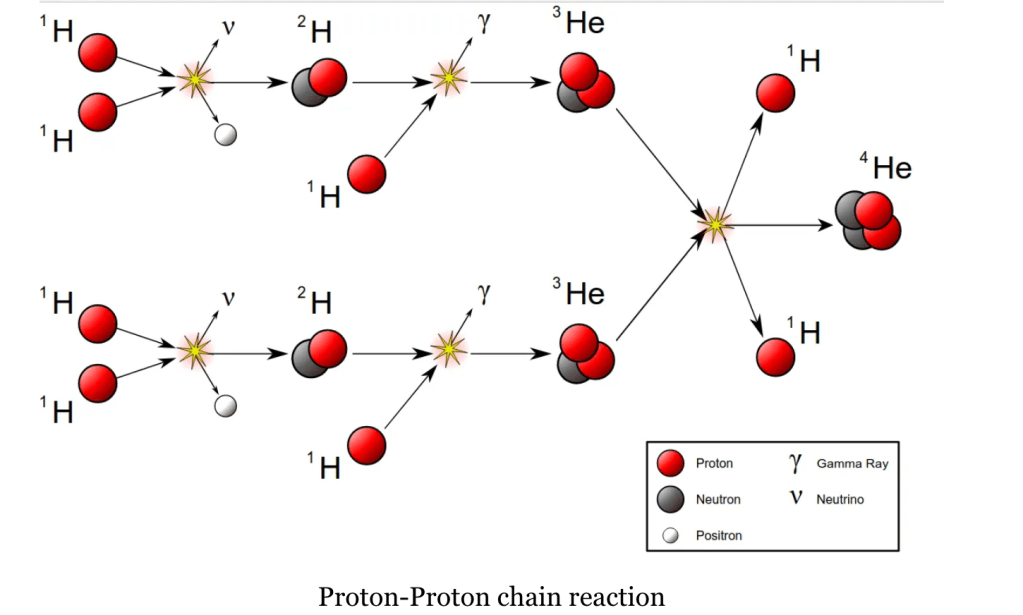
Hydrogen fusion in the sun.

This became the leading explanation for the missing solar neutrinos.  If many of them converted to muon neutrinos on their way to the Earth, then the Davis experiment wouldn’t detect them—hence the missing events.

The way that neutrinos can oscillate from electron neutrinos to muon neutrinos is if neutrinos have a very small but finite mass.  This was the solution, then, to the solar neutrino problem.  Neutrinos have mass.  Ray Davis was awarded the Nobel Prize in Physics in 2002 for his discovery of the missing neutrinos.

But one solution begets another problem: the Standard Model of elementary particles says that neutrinos are massless.  What can be going on with the Standard Model?

Once again, the answer may be found deep underground.

Sanford Underground Research Facility (SURF)

>>> The rock of the Homestake is one of the hardest and densest rocks you will find, black as night yet shot through with white streaks of calcite like the tails of comets.  It is impermeable, and despite being so deep, the rock is surprisingly dry—most of the fractures are too tight to allow a trickle through. 

As our toy train picks up speed, the veins flash by in our headlamps, sometimes sparkling with pin pricks of reflected light.  A gold fleck perhaps?  Yet the drift as a whole (or as a hole) is a shabby thing, rusty wedges half buried in the ceiling to keep slabs from falling, bent and battered galvanized metal pinned to the walls by rock bolts to hold them back, flimsy metal webbing strung across the ceiling to keep boulders from crushing our heads.  It’s dirty and dark and damp and hewn haphazardly from the compressed crust.  There is no art, no sense of place.  These shafts were dynamited through, at three-to-five feet per detonation, driven by money and the need for the gold, so nobody had any sense of aesthetics. <<<

The Homestake mine closed operations in 2001 due to the low grade of ore and the sagging price of gold.  They continued pumping water from the mine for two more years in anticipation of handing the extensive underground facility over to the National Science Foundation for use as a deep underground science lab.  However, delays in the transfer and the cost of pumping forced them to turn off the pumps and the water slowly began rising through the levels, taking a year or more to rise and flood the famous 4850 level while negotiations continued. 
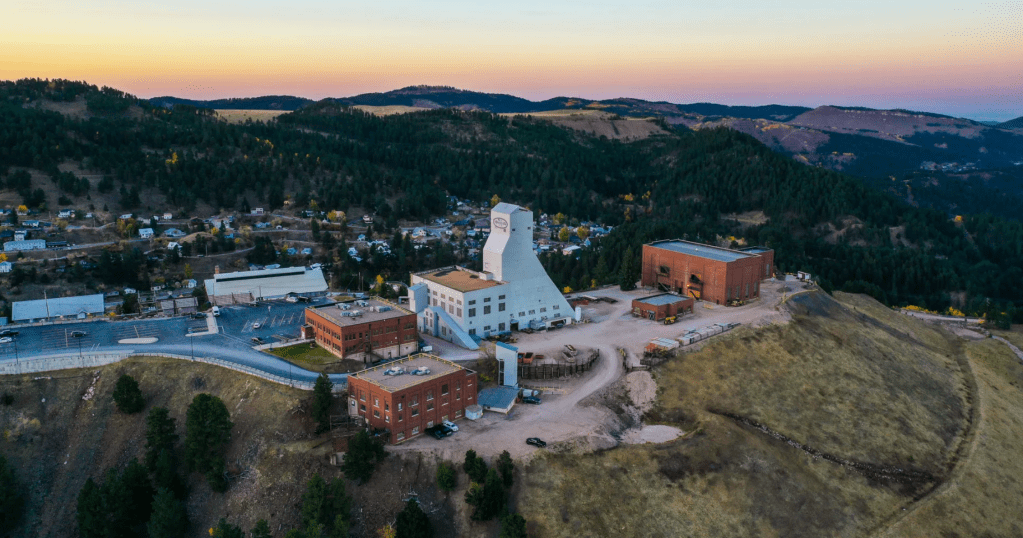
The surface buildings of the Sanford Underground Research Facility (SURF).
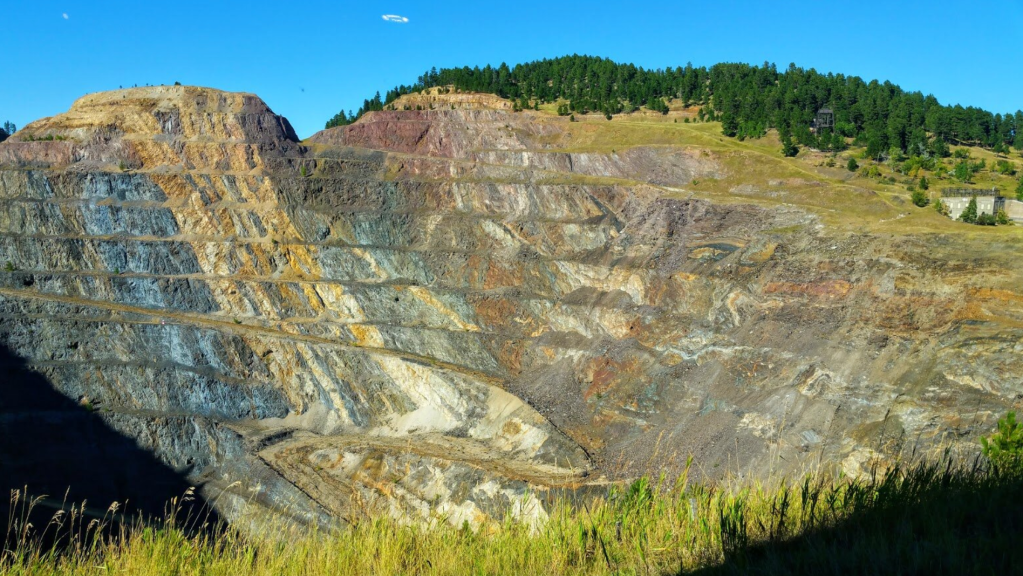
The open pit at Homestake.

Finally, the NSF took over the facility to house the Deep Underground Science and Engineering Laboratory (DUSEL) that would operate at the deepest levels, but these had already been flooded.  After a large donation from South Dakota banker T. Denny Sanford and support from the Governor Mike Rounds, the facility became the Sanford Underground Research Fability (SURF).  The 4850 level was “dewatered”, and the lab was dedicated in 2009.  But things were still not settled.  NSF had second thoughts, and in 2011 the plans for DUSEL (still under water) were terminated and the lab was transferred to the Department of Energy (DOE), administered through the Lawrence Berkeley National Laboratory, to host experiments at the 4850 level and higher.
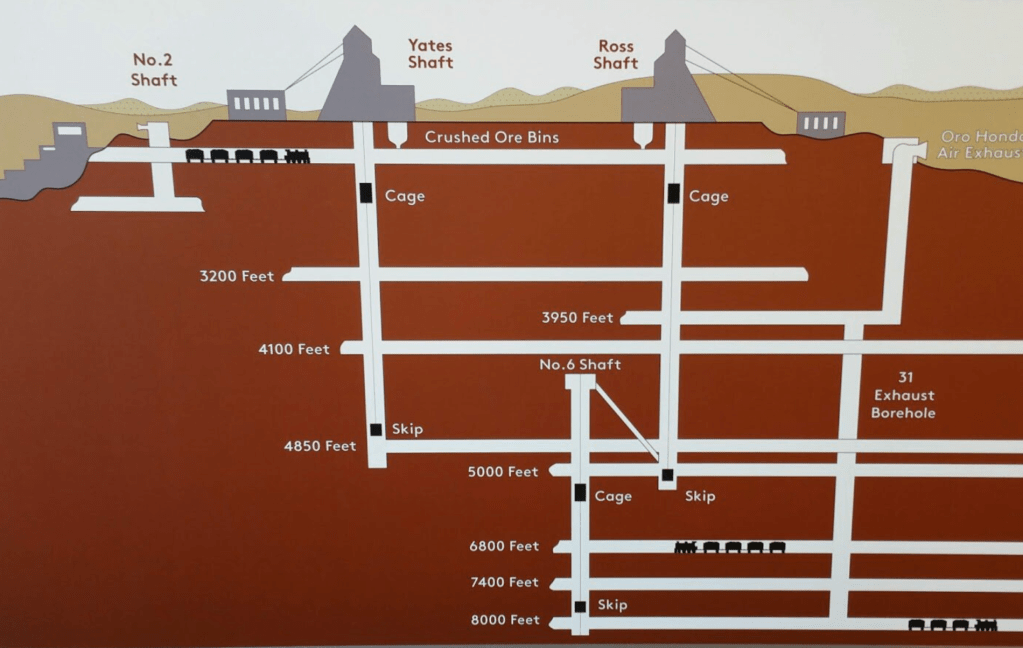
Layout of the mine levels at SURF.

Two early experiments at SURF were the Majorana Demonstrator and LUX. 

The Majorana Demonstrator was an experiment designed to look for neutrino-less double-beta decay where two neutrons in a nucleus decay simultaneously, each emitting a neutrino. A theory of neutrinos proposed by the Italian physicist, Ettore Marjorana, in 1937 that goes beyond the Standard Model ,says that a neutrino is its own antiparticle. If this were the case, then the two neutrinos emitted in the double beta decay could annihilate each otherhence a “neutrinoless” double beta decay. The Demonstrator was too small to actually see such an event, but it tested the concept and laid the ground for later larger experiments. It operated between 2016 and 2021.
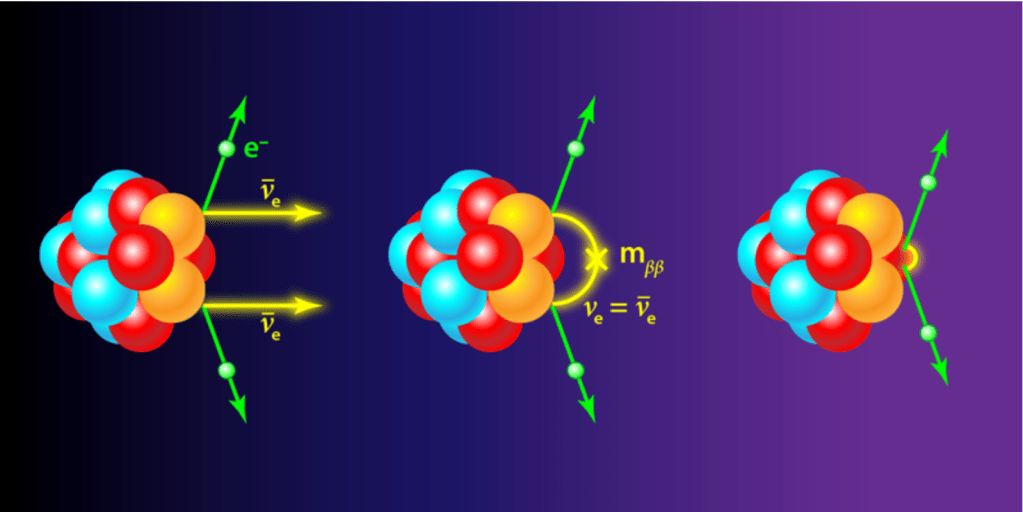
Neutrinoless double-beta decay.

The Large Underground Xenon (LUX) experiment was a prototype for the search for dark matter. Dark matter particles are expected to interact very weakly with ordinary matter (sort of like neutrinos, but even less interactive). Such weakly interacting massive particles (WIMPs) might scatter off a nucleus in an atom of Xenon, shifting the nucleus enough that it emits electrons and light. These would be captured by detectors at the caps of the liquid Xenon container.

Once again, cosmic rays at the surface of the Earth would make the experiment unworkable, but deep underground there is much less background within which to look for the “needle in the haystack”. LUX operated from 2009 to 2016 and was not big enough to hope to see a WIMP, but like the Demonstrator, it was a proof-of-principle to show that the idea worked and could be expanded to a much larger 7-ton experiment called LUX-Zeplin that began in 2020 and is ongoing, looking for the biggest portion of mass in our universe. (About a quarter of the energy of the universe is composed of dark matter. The usual stuff we see around us only makes up about 4% of the energy of the universe.)
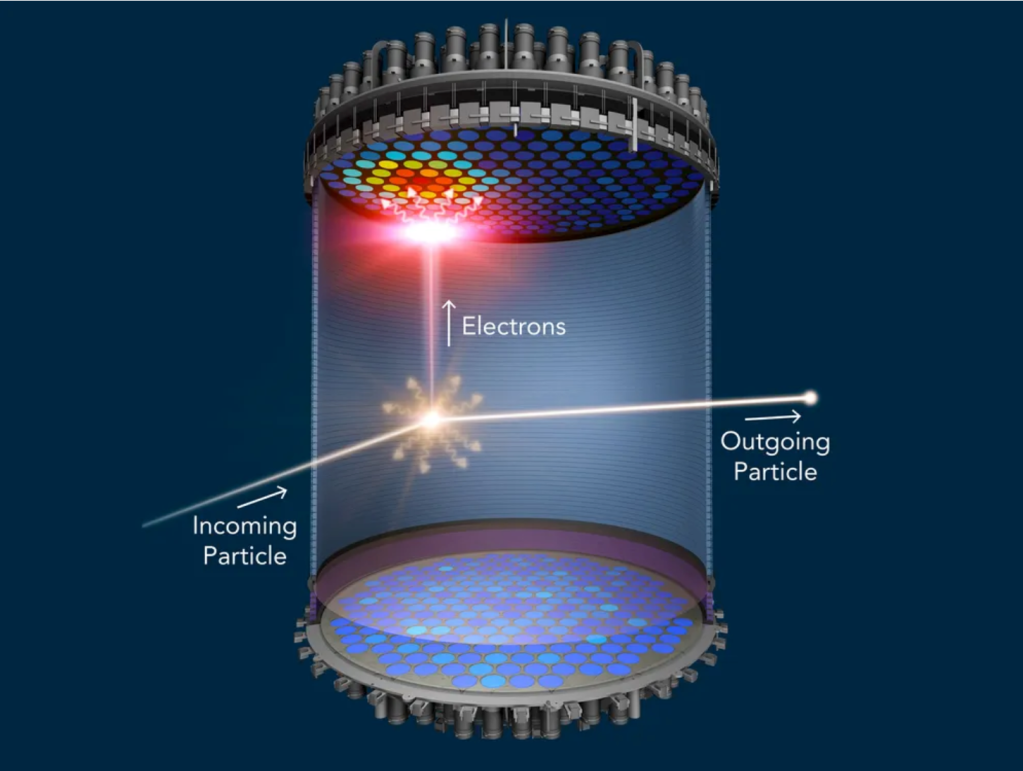
LUX-Zeplin Experiment

Deep Underground Neutrino Experiment (DUNE)

>>> “Always keep a sense of where you are,” Bill the geologist tells us, in case we must hike our way out.  But what sense is there?  I have a natural built-in compass that has served me well over the years, but it seems to run on the heavens.  When I visited South Africa, I had an eerie sense of disorientation the whole time I was there.  When you are a kilometer underground, the heavens are about as far away as Heaven.  There is no sense of orientation, only the sense of lefts and rights. 

We were told there would be signs directing us towards the Ross or Yates Shafts.  But once we are down here, it turns out that these “signs” are crudely spray-painted marks on the black rock, like bad graffiti.  When you see them, your first thought is of kids with spray cans making a mess—until you suddenly recognize an R or an O or two S’s along with an indistinct arrow that points slightly more one way than the other. <<<

Deep Underground Neutrino Experiment (DUNE).

One of the most ambitious high-energy experiments ever devised is the Long Baseline Neutrino Facility (LBNF) that is 800 miles long. It begins in Batavia, Illinois, at the Fermilab accelerator that launches a beam of neutrinos that travel 800 miles through the Earth to detectors at the Deep Underground Neutrino Experiment (DUNE) at SURF in Lead, South Dakota. The neutrinos are expected to oscillate in flavor, just like solar neutrinos, and the detection rates at DUNE could finally answer one of the biggest outstanding questions of physics: Why is our universe made of matter?

At the instant of the Big Bang, equal amounts of matter and antimatter should have been generated, and these should have annihilated in equal manner, and the universe should be filled with nothing but photons. But it’s not. Matter is everywhere. Why?

In the Standard Model there are many symmetries, also known as conserved properties. One power symmetry is known as CPT symmetry, where C is a symmetry of changing particles into the antiparticles, P is a reflection of left-handed or right-handed particles, and T is time-reversal symmetry. Yet there could be a CP symmetry too, which you might expect if time-reversal is taken as a symmetric property of physics. But it’s not!

There is a strange meson called a Kaon that does not decay the same way for its particle and antiparticle pair, violating CP symmetry. This was discovered in 1964 by James Cronin and Val Fitch who won the 1980 Nobel prize in physics. The discovery shocked the physics world. Since then, additional violations of CP symmetry have been observed in quarks. Such a broken symmetry is allowed in the Standard Model of particles, but the effect is so exceedingly smallCP is so extremely close to being a true symmetrythat it cannot explain the size of the matter-antimatter asymmetry in the universe.

Neutrino oscillations also can violate CP symmetry, but the effects have been hard to measurethus the need for DUNE. By creating large amounts of neutrinos, beaming them 800 miles through the Earth, and detecting them in the vast liquid Argon vats in the underground caverns of SURF, the parameters of neutrino oscillation can be measured directly, possibly explaining the matter asymmetry of the universeand answering Samwise’s question of why we are here.

Center for Understanding Subsurface Signals and Permeability (CUSSP)

>>> Finally, in the distance, as we rush down the dark drift, we see a bright glow that grows to envelope us with a string of white LED lights.  The drift is not so shabby here, with fresh pipes and electrical cables laid neatly by the side.  We had arrived at the CUSSP experimental site.  It turned out it was just a few steps away from the inactive Yates Shaft, that, if it had been operating, would have removed the need for the crazy train ride through black rock along broken tunnels.  But that is OK.  Because we are here, and this is what had brought us down into the Earth to answer questions down-to-Earth as we try to answer questions related to our future existence on this planet, learning what we need to generate the power for our high-tech society without making our planet unlivable.  <<<

Not all the science at SURF is so ethereal. For instance, research on Enhanced Geothermal Systems (EGS) is funded by the DOE Office of Basic Energy Sciences.  Geothermal systems can generate power by extracting super-heated water from underground to run turbines. However, superheated water is nasty stuff, very corrosive and full of minerals that tend to block up the fractures that the water flows through. The idea of enhanced geothermal systems is to drill boreholes and use “fracking” to create fractures in the hard rock, possibly refracturing older fractures that had become blocked. If this could be done reliably, then geothermal sites could be kept operating.

The Center for Understanding Subsurface Signals and Permeability (CUSSP) was recently funded by the DoE to use the facilities at SURF to study how well fracks can be controlled. The team is led by Pacific Northwest National Lab (PNNL) with collaborations from Lawrence Berkeley Lab, Maryland, Illinois and Purdue, among others. We are installing seismic equipment as well as electrical resistivity to monitor the induced fractures.

The CUSSP installation on the 4100 level was the destination of our underground journey, to see the boreholes in person and to get a sense of the fracture orientations at the drift wall. During the half hour at the site, rocks were examined, questions were answered, tall tales were told, and it was time to return.

Shooting to the Stars

>>> At the end of the tour, we pack again into the Ross cage and are thrust skyward at 2 meters per second—twice the speed as coming down because of the asymmetry of slack cables that could snag and snap.  Ears pop, and pop again, until the cage slows, and we settle to the exit level, relieved and tired and ready to see the sky. Thinking back, as we were shooting up the shaft, I imagined that the cage would never stop, flying up past the massive hoist, up and onward into the sky and to the stars.  <<<

In a video we had been shown about SURF, Jace DeCory, a scholar of the Lakota Sioux, spoke of the sacred ground of Ȟe Sápa—the Black Hills.  Are we taking again what is not ours?  This time it seems not.  The scientists of SURF are linking us to the stars, bringing knowledge instead of taking gold.  Jace quoted Carl Sagan: “We are made of star-stuff.”  Then she reminded us, the Lakota Sioux have known that all along.

A Brief History of Nothing: The Physics of the Vacuum from Atomism to Higgs

It may be hard to get excited about nothing … unless nothing is the whole ball game. 

The only way we can really know what is, is by knowing what isn’t.  Nothing is the backdrop against which we measure something.  Experimentalists spend almost as much time doing control experiments, where nothing happens (or nothing is supposed to happen) as they spend measuring a phenomenon itself, the something.

Even the universe, full of so much something, came out of nothing during the Big Bang.  And today the energy density of nothing, so-called Dark Energy, is blowing our universe apart, propelling it ever faster to a bitter cold end.

So here is a brief history of nothing, tracing how we have understood what it is, where it came from, and where is it today.

With sturdy shoulders, space stands opposing all its weight to nothingness. Where space is, there is being.

Friedrich Nietzsche

40,000 BCE – Cosmic Origins

This is a human history, about how we homo sapiens try to understand the natural world around us, so the first step on a history of nothing is the Big Bang of human consciousness that occurred sometime between 100,000 – 40,000 years ago.  Some sort of collective phase transition happened in our thought process when we seem to have become aware of our own existence within the natural world.  This time frame coincides with the beginning of representational art and ritual burial.  This is also likely the time when human language skills reached their modern form, and when logical arguments–stories–first were told to explain our existence and origins. 

Roughly two origin stories emerged from this time.  One of these assumes that what is has always been, either continuously or cyclically.  Buddhism and Hinduism are part of this tradition as are many of the origin philosophies of Indigenous North Americans.  Another assumes that there was a beginning when everything came out of nothing.  Abrahamic faiths (Let there be light!) subscribe to this creatio ex nihilo.  What came before creation?  Nothing!

500 BCE – Leucippus and Democritus Atomism

The Greek philosopher Leucippus and his student Democritus, living around 500 BCE, were the first to lay out the atomic theory in which the elements of substance were indivisible atoms of matter, and between the atoms of matter was void.  The different materials around us were created by the different ways that these atoms collide and cluster together.  Plato later adhered to this theory, developing ideas along these lines in his Timeaus.

300 BCEAristotle Vacuum

Aristotle is famous for arguing, in his Physics Book IV, Section 8, that nature abhors a vacuum (horror vacui) because any void would be immediately filled by the imposing matter surrounding it.  He also argued more philosophically that nothing, by definition, cannot exist.

1644 – Rene Descartes Vortex Theory

Fast forward a millennia and a half, and theories of existence were finally achieving a level of sophistication that can be called “scientific”.  Rene Descartes followed Aristotle’s views of the vacuum, but he extended it to the vacuum of space, filling it with an incompressible fluid in his Principles of Philosophy (1644).  Just like water, laminar motion can only occur by shear, leading to vortices.  Descartes was a better philosopher than mathematician, so it took Christian Huygens to apply mathematics to vortex motion to “explain” the gravitational effects of the solar system.

Rene Descartes, Vortex Theory, 1644. Image Credit

1654 – Otto von Guericke Vacuum Pump

Otto von Guericke is one of those hidden gems of the history of science, a person who almost no-one remembers today, but who was far in advance of his own day.  He was a powerful politician, holding the position of Burgomeister of the city of Magdeburg for more than 30 years, helping to rebuild it after it was sacked during the Thirty Years War.  He was also a diplomat, playing a key role in the reorientation of power within the Holy Roman Empire.  How he had free time is anyone’s guess, but he used it to pursue scientific interests that spanned from electrostatics to his invention of the vacuum pump.

With a succession of vacuum pumps, each better than the last, von Geuricke was like a kid in a toy factory, pumping the air out of anything he could find.  In the process, he showed that a vacuum would extinguish a flame and could raise water in a tube.

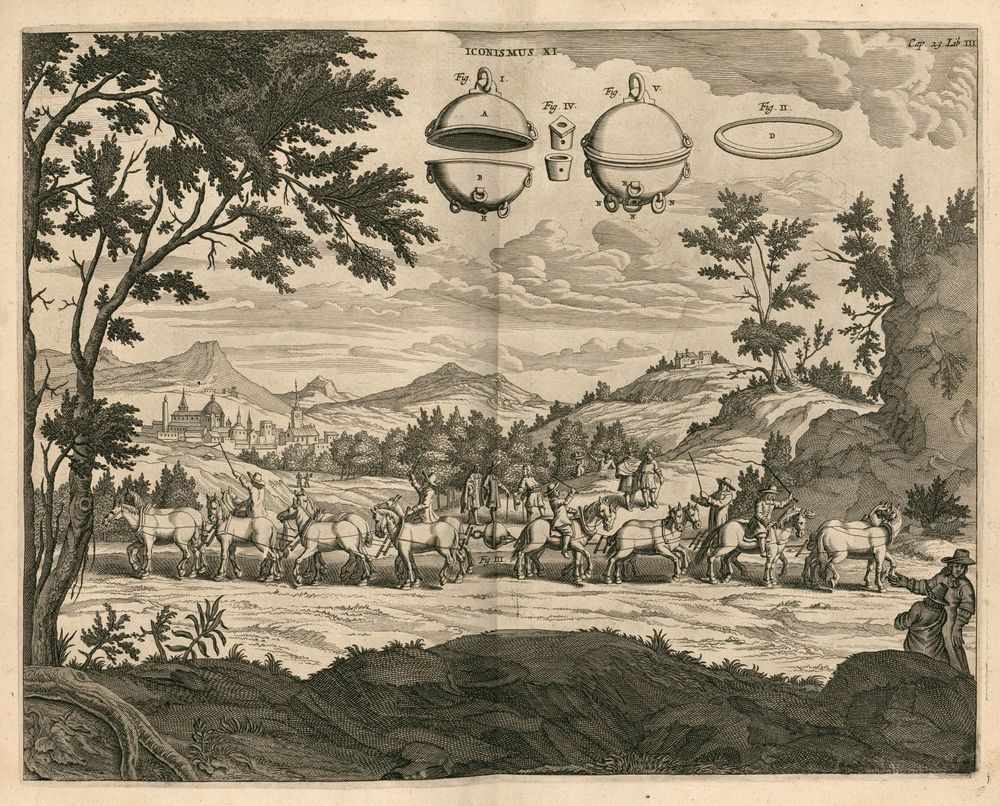
The Magdeburg Experiment. Image Credit

His most famous demonstration was, of course, the Magdeburg sphere demonstration.  In 1657 he fabricated two 20-inch hemispheres that he attached together with a vacuum seal and used his vacuum pump to evacuate the air from inside.  He then attached chains from the hemispheres to a team of eight horses on each side, for a total of 16 horses, who were unable to separate the spheres.  This dramatically demonstrated that air exerts a force on surfaces, and that Aristotle and Descartes were wrong—nature did allow a vacuum!

1667 – Isaac Newton Action at a Distance

When it came to the vacuum, Newton was agnostic.  His universal theory of gravitation posited action at a distance, but the intervening medium played no direct role.

Nothing comes from nothing, Nothing ever could.

Rogers and Hammerstein, The Sound of Music

This would seem to say that Newton had nothing to say about the vacuum, but his other major work, his Optiks, established particles as the elements of light rays.  Such light particles travelled easily through vacuum, so the particle theory of light came down on the empty side of space.

Statue of Isaac Newton by Sir Eduardo Paolozzi based on a painting by William Blake. Image Credit

1821 – Augustin Fresnel Luminiferous Aether

Today, we tend to think of Thomas Young as the chief proponent for the wave nature of light, going against the towering reputation of his own countryman Newton, and his courage and insights are admirable.  But it was Augustin Fresnel who put mathematics to the theory.  It was also Fresnel, working with his friend Francois Arago, who established that light waves are purely transverse.

For these contributions, Fresnel stands as one of the greatest physicists of the 1800’s.  But his transverse light waves gave birth to one of the greatest red herrings of that century—the luminiferous aether.  The argument went something like this, “if light is waves, then just as sound is oscillations of air, light must be oscillations of some medium that supports it – the luminiferous aether.”  Arago searched for effects of this aether in his astronomical observations, but he didn’t see it, and Fresnel developed a theory of “partial aether drag” to account for Arago’s null measurement.  Hippolyte Fizeau later confirmed the Fresnel “drag coefficient” in his famous measurement of the speed of light in moving water.  (For the full story of Arago, Fresnel and Fizeau, see Chapter 2 of “Interference”. [1])

But the transverse character of light also required that this unknown medium must have some stiffness to it, like solids that support transverse elastic waves.  This launched almost a century of alternative ideas of the aether that drew in such stellar actors as George Green, George Stokes and Augustin Cauchy with theories spanning from complete aether drag to zero aether drag with Fresnel’s partial aether drag somewhere in the middle.

1849 – Michael Faraday Field Theory

Micheal Faraday was one of the most intuitive physicists of the 1800’s. He worked by feel and mental images rather than by equations and proofs. He took nothing for granted, able to see what his experiments were telling him instead of looking only for what he expected.

This talent allowed him to see lines of force when he mapped out the magnetic field around a current-carrying wire. Physicists before him, including Ampere who developed a mathematical theory for the magnetic effects of a wire, thought only in terms of Newton’s action at a distance. All forces were central forces that acted in straight lines. Faraday’s experiments told him something different. The magnetic lines of force were circular, not straight. And they filled space. This realization led him to formulate his theory for the magnetic field.

Others at the time rejected this view, until William Thomson (the future Lord Kelvin) wrote a letter to Faraday in 1845 telling him that he had developed a mathematical theory for the field. He suggested that Faraday look for effects of fields on light, which Faraday found just one month later when he observed the rotation of the polarization of light when it propagated in a high-index material subject to a high magnetic field. This effect is now called Faraday Rotation and was one of the first experimental verifications of the direct effects of fields.

Nothing is more real than nothing.

Samuel Beckett

In 1949, Faraday stated his theory of fields in their strongest form, suggesting that fields in empty space were the repository of magnetic phenomena rather than magnets themselves [2]. He also proposed a theory of light in which the electric and magnetic fields induced each other in repeated succession without the need for a luminiferous aether.

1861 – James Clerk Maxwell Equations of Electromagnetism

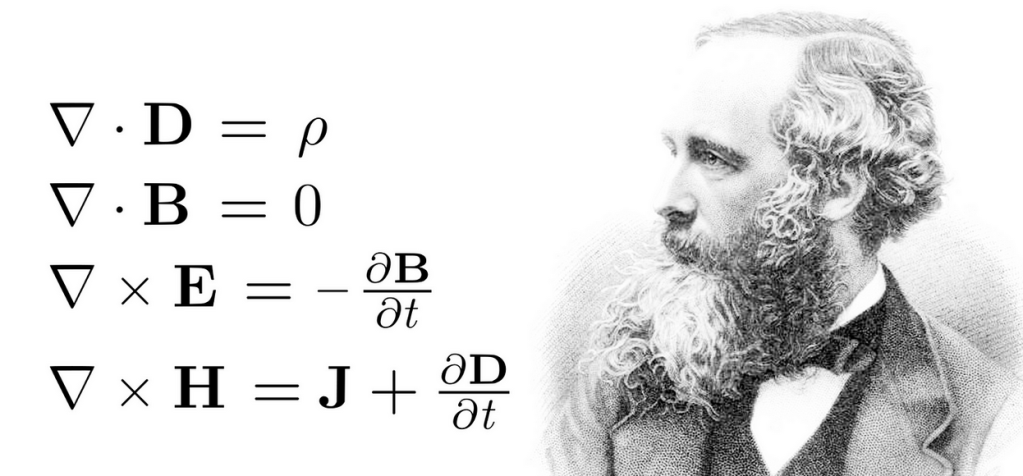
James Clerk Maxwell pulled the various electric and magnetic phenomena together into a single grand theory, although the four succinct “Maxwell Equations” was condensed by Oliver Heaviside from Maxwell’s original 15 equations (written using Hamilton’s awkward quaternions) down to the 4 vector equations that we know and love today.

One of the most significant and most surprising thing to come out of Maxwell’s equations was the speed of electromagnetic waves that matched closely with the known speed of light, providing near certain proof that light was electromagnetic waves.

However, the propagation of electromagnetic waves in Maxwell’s theory did not rule out the existence of a supporting medium—the luminiferous aether.  It was still not clear that fields could exist in a pure vacuum but might still be like the stress fields in solids.

Late in his life, just before he died, Maxwell pointed out that no measurement of relative speed through the aether performed on a moving Earth could see deviations that were linear in the speed of the Earth but instead would be second order.  He considered that such second-order effects would be far to small ever to detect, but Albert Michelson had different ideas.

1887 – Albert Michelson Null Experiment

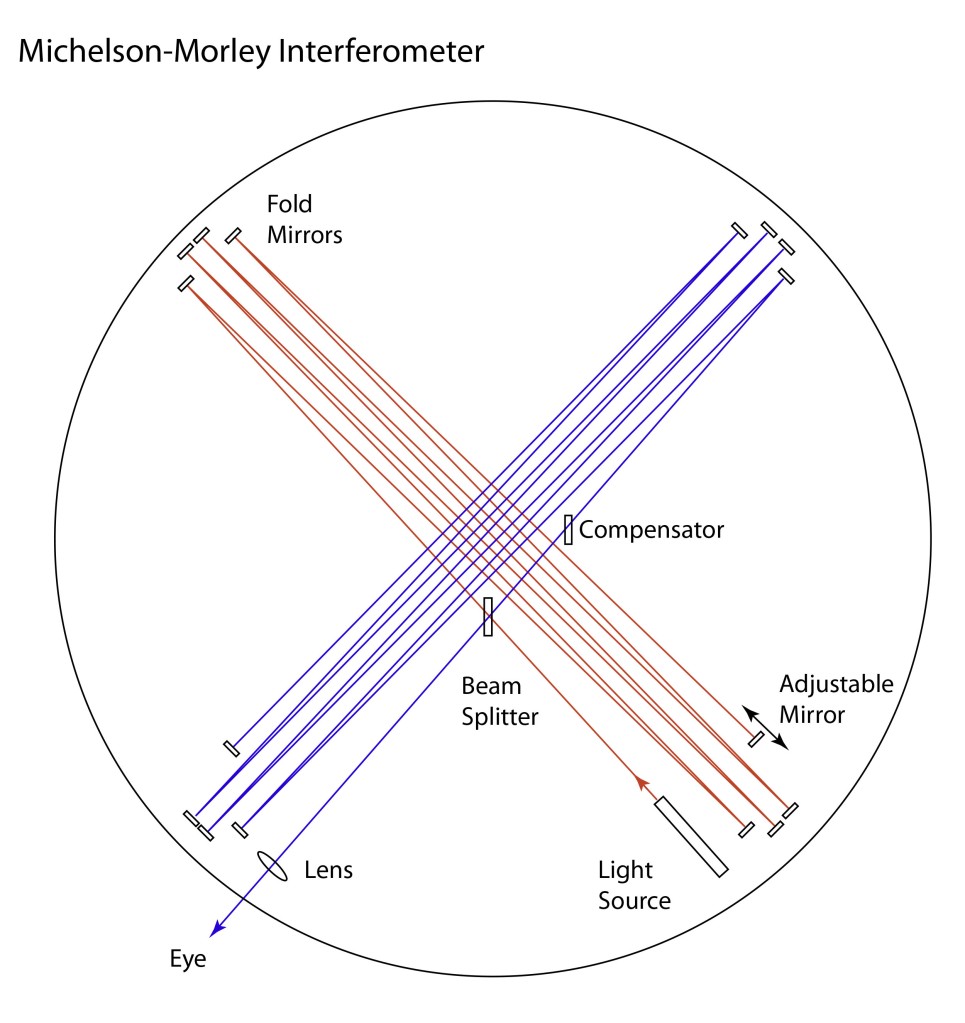
Albert Michelson was convinced of the existence of the luminiferous aether, and he was equally convinced that he could detect it.  In 1880, working in the basement of the Potsdam Observatory outside Berlin, he operated his first interferometer in a search for evidence of the motion of the Earth through the aether.  He had built the interferometer, what has come to be called a Michelson Interferometer, months earlier in the laboratory of Hermann von Helmholtz in the center of Berlin, but the footfalls of the horse carriages outside the building disturbed the measurements too much—Postdam was quieter. 

But he could find no difference in his interference fringes as he oriented the arms of his interferometer parallel and orthogonal to the Earth’s motion.  A simple calculation told him that his interferometer design should have been able to detect it—just barely—so the null experiment was a puzzle.

Seven years later, again in a basement (this time in a student dormitory at Western Reserve College in Cleveland, Ohio), Michelson repeated the experiment with an interferometer that was ten times more sensitive.  He did this in collaboration with Edward Morley.  But again, the results were null.  There was no difference in the interference fringes regardless of which way he oriented his interferometer.  Motion through the aether was undetectable.

(Michelson has a fascinating backstory, complete with firestorms (literally) and the Wild West and a moment when he was almost committed to an insane asylum against his will by a vengeful wife.  To read all about this, see Chapter 4: After the Gold Rush in my recent book Interference (Oxford, 2023)).

The Michelson Morley experiment did not create the crisis in physics that it is sometimes credited with.  They published their results, and the physics world took it in stride.  Voigt and Fitzgerald and Lorentz and Poincaré toyed with various ideas to explain it away, but there had already been so many different models, from complete drag to no drag, that a few more theories just added to the bunch.

But they all had their heads in a haze.  It took an unknown patent clerk in Switzerland to blow away the wisps and bring the problem into the crystal clear.

1905 – Albert Einstein Relativity

So much has been written about Albert Einstein’s “miracle year” of 1905 that it has lapsed into a form of physics mythology.  Looking back, it seems like his own personal Big Bang, springing forth out of the vacuum.  He published 5 papers that year, each one launching a new approach to physics on a bewildering breadth of problems from statistical mechanics to quantum physics, from electromagnetism to light … and of course, Special Relativity [3].

Whereas the others, Voigt and Fitzgerald and Lorentz and Poincaré, were trying to reconcile measurements of the speed of light in relative motion, Einstein just replaced all that musing with a simple postulate, his second postulate of relativity theory:

  2. Any ray of light moves in the “stationary” system of co-ordinates with the determined velocity c, whether the ray be emitted by a stationary or by a moving body. Hence …

Albert Einstein, Annalen der Physik, 1905

And the rest was just simple algebra—in complete agreement with Michelson’s null experiment, and with Fizeau’s measurement of the so-called Fresnel drag coefficient, while also leading to the famous E = mc2 and beyond.

There is no aether.  Electromagnetic waves are self-supporting in vacuum—changing electric fields induce changing magnetic fields that induce, in turn, changing electric fields—and so it goes. 

The vacuum is vacuum—nothing!  Except that it isn’t.  It is still full of things.

1931 – P. A. M Dirac Antimatter

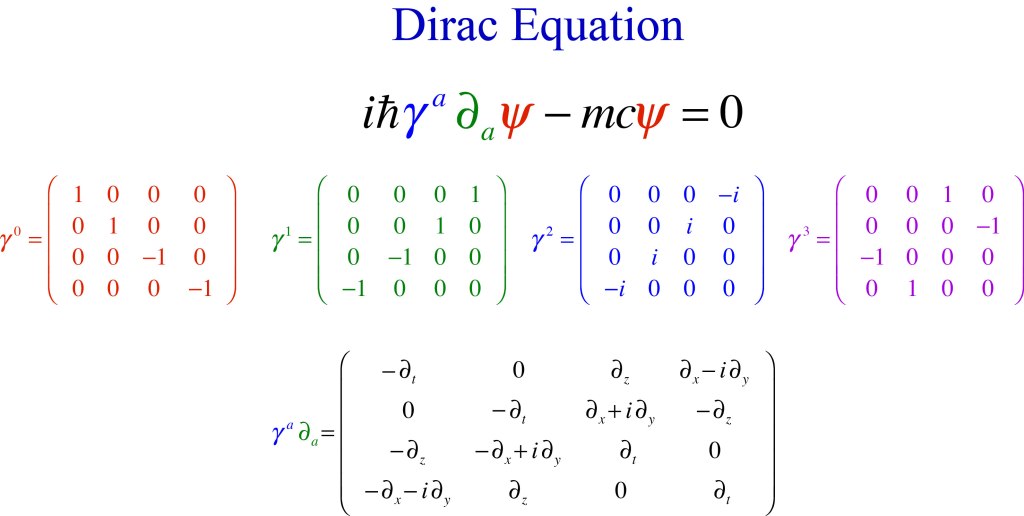
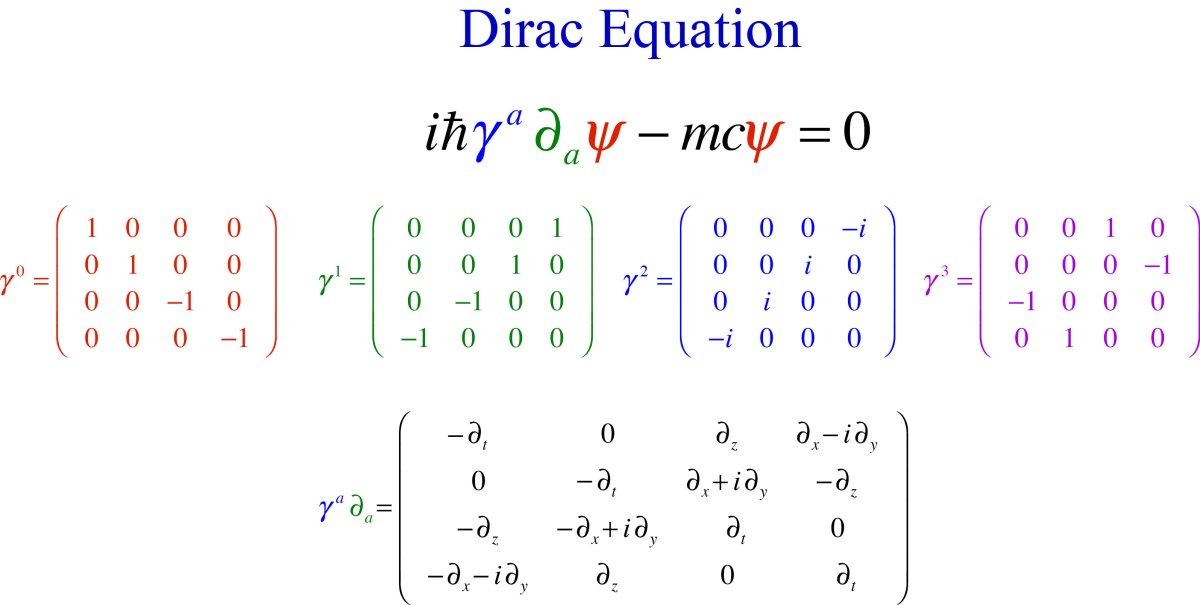
The Dirac equation is the famous end-product of P. A. M. Dirac’s search for a relativistic form of the Schrödinger equation. It replaces the asymmetric use in Schrödinger’s form of a second spatial derivative and a first time derivative with Dirac’s form using only first derivatives that are compatible with relativistic transformations [4]. 

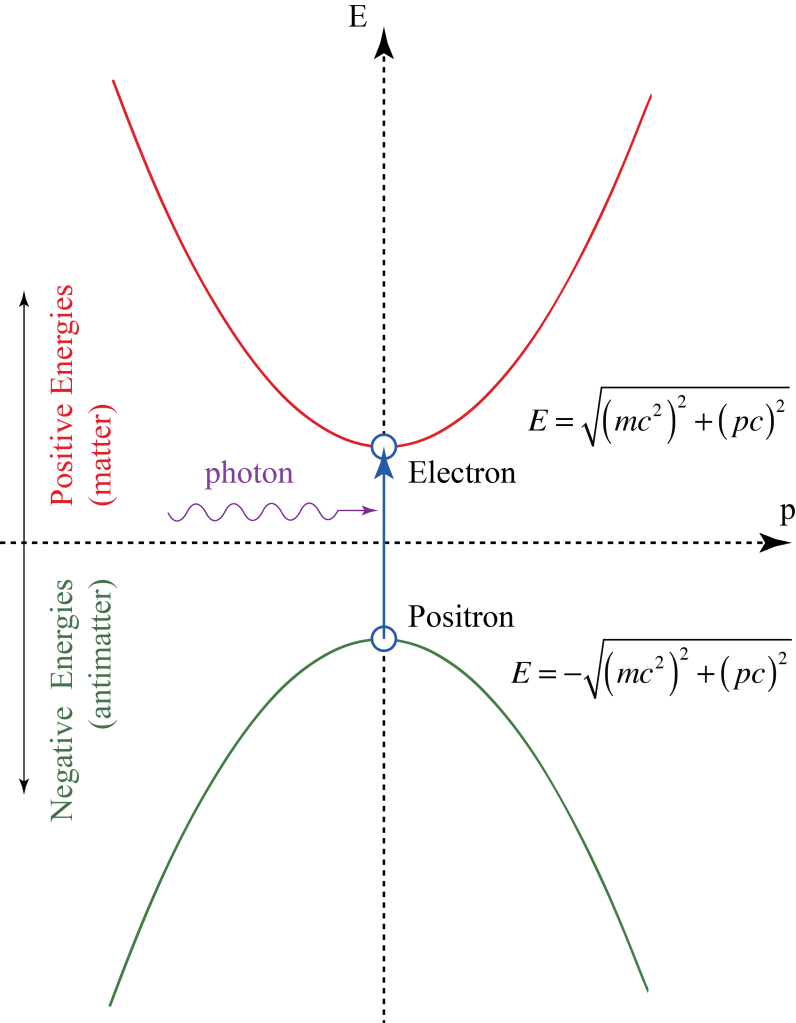
One of the immediate consequences of this equation is a solution that has negative energy. At first puzzling and hard to interpret [5], Dirac eventually hit on the amazing proposal that these negative energy states are real particles paired with ordinary particles. For instance, the negative energy state associated with the electron was an anti-electron, a particle with the same mass as the electron, but with positive charge. Furthermore, because the anti-electron has negative energy and the electron has positive energy, these two particles can annihilate and convert their mass energy into the energy of gamma rays. This audacious proposal was confirmed by the American physicist Carl Anderson who discovered the positron in 1932.

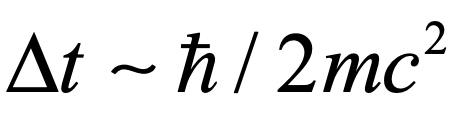
The existence of particles and anti-particles, combined with Heisenberg’s uncertainty principle, suggests that vacuum fluctuations can spontaneously produce electron-positron pairs that would then annihilate within a time related to the mass energy

Although this is an exceedingly short time (about 10-21 seconds), it means that the vacuum is not empty, but contains a frothing sea of particle-antiparticle pairs popping into and out of existence.

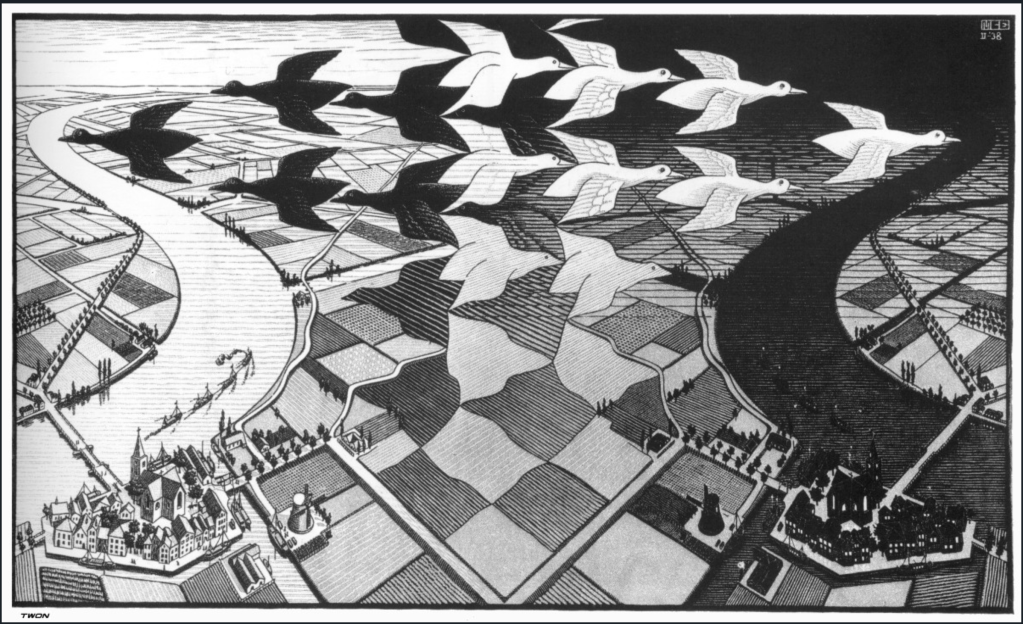
1938 – M. C. Escher Negative Space

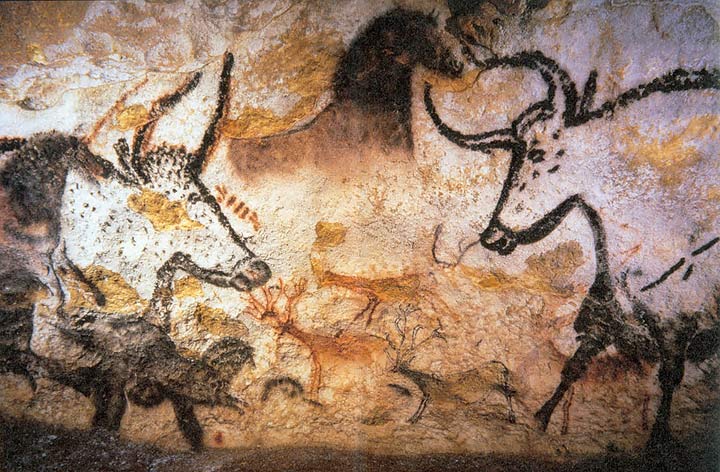
Scientists are not the only ones who think about empty space. Artists, too, are deeply committed to a visual understanding of our world around us, and the uses of negative space in art dates back virtually to the first cave paintings. However, artists and art historians only talked explicitly in such terms since the 1930’s and 1940’s [6].  One of the best early examples of the interplay between positive and negative space was a print made by M. C. Escher in 1938 titled “Day and Night”.

M. C. Escher. Day and Night. Image Credit

1946 – Edward Purcell Modified Spontaneous Emission

In 1916 Einstein laid out the laws of photon emission and absorption using very simple arguments (his modus operandi) based on the principles of detailed balance. He discovered that light can be emitted either spontaneously or through stimulated emission (the basis of the laser) [7]. Once the nature of vacuum fluctuations was realized through the work of Dirac, spontaneous emission was understood more deeply as a form of stimulated emission caused by vacuum fluctuations. In the absence of vacuum fluctuations, spontaneous emission would be inhibited. Conversely, if vacuum fluctuations are enhanced, then spontaneous emission would be enhanced.

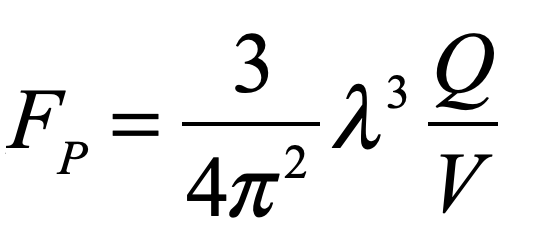
This effect was observed by Edward Purcell in 1946 through the observation of emission times of an atom in a RF cavity [8]. When the atomic transition was resonant with the cavity, spontaneous emission times were much faster. The Purcell enhancement factor is

where Q is the “Q” of the cavity, and V is the cavity volume. The physical basis of this effect is the modification of vacuum fluctuations by the cavity modes caused by interference effects. When cavity modes have constructive interference, then vacuum fluctuations are larger, and spontaneous emission is stimulated more quickly.

1948 – Hendrik Casimir Vacuum Force

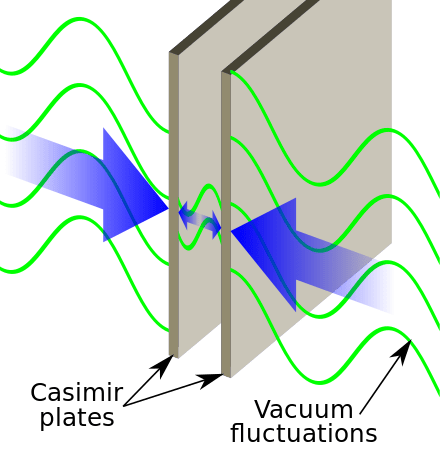
Interference effects in a cavity affect the total energy of the system by excluding some modes which become inaccessible to vacuum fluctuations. This lowers the internal energy internal to a cavity relative to free space outside the cavity, resulting in a net “pressure” acting on the cavity. If two parallel plates are placed in close proximity, this would cause a force of attraction between them. The effect was predicted in 1948 by Hendrik Casimir [9], but it was not verified experimentally until 1997 by S. Lamoreaux at Yale University [10].

Two plates brought very close feel a pressure exerted by the higher vacuum energy density external to the cavity.

1949 – Shinichiro Tomonaga, Richard Feynman and Julian Schwinger QED

The physics of the vacuum in the years up to 1948 had been a hodge-podge of ad hoc theories that captured the qualitative aspects, and even some of the quantitative aspects of vacuum fluctuations, but a consistent theory was lacking until the work of Tomonaga in Japan, Feynman at Cornell and Schwinger at Harvard. Feynman and Schwinger both published their theory of quantum electrodynamics (QED) in 1949. They were actually scooped by Tomonaga, who had developed his theory earlier during WWII, but physics research in Japan had been cut off from the outside world. It was when Oppenheimer received a letter from Tomonaga in 1949 that the West became aware of his work. All three received the Nobel Prize for their work on QED in 1965. Precision tests of QED now make it one of the most accurately confirmed theories in physics.

Richard Feynman’s first “Feynman diagram”.

1964 – Peter Higgs and The Higgs

The Higgs particle, known as “The Higgs”, was the brain-child of Peter Higgs, Francois Englert and Gerald Guralnik in 1964. Higgs’ name became associated with the theory because of a response letter he wrote to an objection made about the theory. The Higg’s mechanism is spontaneous symmetry breaking in which a high-symmetry potential can lower its energy by distorting the field, arriving at a new minimum in the potential. This mechanism can allow the bosons that carry force to acquire mass (something the earlier Yang-Mills theory could not do). 

Spontaneous symmetry breaking is a ubiquitous phenomenon in physics. It occurs in the solid state when crystals can lower their total energy by slightly distorting from a high symmetry to a low symmetry. It occurs in superconductors in the formation of Cooper pairs that carry supercurrents. And here it occurs in the Higgs field as the mechanism to imbues particles with mass . 

Conceptual graph of a potential surface where the high symmetry potential is higher than when space is distorted to lower symmetry. Image Credit

The theory was mostly ignored for its first decade, but later became the core of theories of electroweak unification. The Large Hadron Collider (LHC) at Geneva was built to detect the boson, announced in 2012. Peter Higgs and Francois Englert were awarded the Nobel Prize in Physics in 2013, just one year after the discovery.

The Higgs field permeates all space, and distortions in this field around idealized massless point particles are observed as mass. In this way empty space becomes anything but.

1981 – Alan Guth Inflationary Big Bang

Problems arose in observational cosmology in the 1970’s when it was understood that parts of the observable universe that should have been causally disconnected were in thermal equilibrium. This could only be possible if the universe were much smaller near the very beginning. In January of 1981, Alan Guth, then at Cornell University, realized that a rapid expansion from an initial quantum fluctuation could be achieved if an initial “false vacuum” existed in a positive energy density state (negative vacuum pressure). Such a false vacuum could relax to the ordinary vacuum, causing a period of very rapid growth that Guth called “inflation”. Equilibrium would have been achieved prior to inflation, solving the observational problem.Therefore, the inflationary model posits a multiplicities of different types of “vacuum”, and once again, simple vacuum is not so simple.

Energy density as a function of a scalar variable. Quantum fluctuations create a “false vacuum” that can relax to “normal vacuum: by expanding rapidly. Image Credit

1998 – Saul Pearlmutter Dark Energy

Einstein didn’t make many mistakes, but in the early days of General Relativity he constructed a theoretical model of a “static” universe. A central parameter in Einstein’s model was something called the Cosmological Constant. By tuning it to balance gravitational collapse, he tuned the universe into a static Ithough unstable) state. But when Edwin Hubble showed that the universe was expanding, Einstein was proven incorrect. His Cosmological Constant was set to zero and was considered to be a rare blunder.

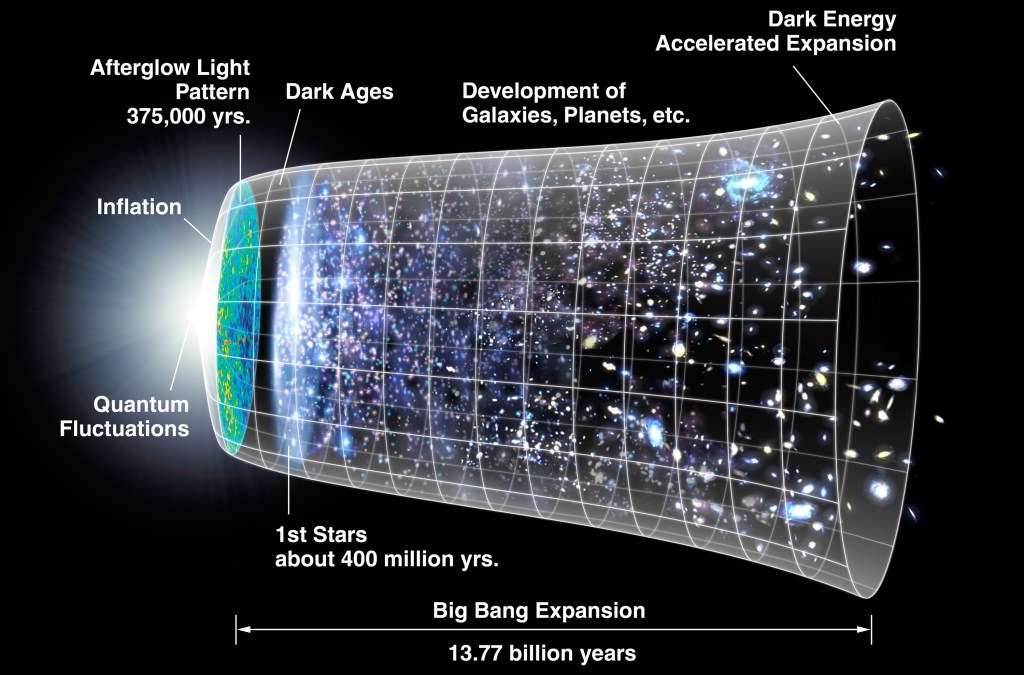
Fast forward to 1999, and the Supernova Cosmology Project, directed by Saul Pearlmutter, discovered that the expansion of the universe was accelerating. The simplest explanation was that Einstein had been right all along, or at least partially right, in that there was a non-zero Cosmological Constant. Not only is the universe not static, but it is literally blowing up. The physical origin of the Cosmological Constant is believed to be a form of energy density associated with the space of the universe. This “extra” energy density has been called “Dark Energy”, filling empty space.

The expanding size of the Universe. Image Credit

Bottom Line

The bottom line is that nothing, i.e., the vacuum, is far from nothing. It is filled with a froth of particles, and energy, and fields, and potentials, and broken symmetries, and negative pressures, and who knows what else as modern physics has been much ado about this so-called nothing, almost more than it has been about everything else.

References:

[1] David D. Nolte, Interference: The History of Optical Interferometry and the Scientists Who Tamed Light (Oxford University Press, 2023)

[2] L. Peirce Williams in “Faraday, Michael.” Complete Dictionary of Scientific Biography, vol. 4, Charles Scribner’s Sons, 2008, pp. 527-540.

[3] A. Einstein, “On the electrodynamics of moving bodies,” Annalen Der Physik 17, 891-921 (1905).

[4] Dirac, P. A. M. (1928). “The Quantum Theory of the Electron”. Proceedings of the Royal Society A: Mathematical, Physical and Engineering Sciences. 117 (778): 610–624.

[5] Dirac, P. A. M. (1930). “A Theory of Electrons and Protons”. Proceedings of the Royal Society A: Mathematical, Physical and Engineering Sciences. 126 (801): 360–365.

[6] Nikolai M Kasak, Physical Art: Action of positive and negative space, (Rome, 1947/48) [2d part rev. in 1955 and 1956].

[7] A. Einstein, “Strahlungs-Emission un -Absorption nach der Quantentheorie,” Verh. Deutsch. Phys. Ges. 18, 318 (1916).

[8] Purcell, E. M. (1946-06-01). “Proceedings of the American Physical Society: Spontaneous Emission Probabilities at Ratio Frequencies”. Physical Review. American Physical Society (APS). 69 (11–12): 681.

[9] Casimir, H. B. G. (1948). “On the attraction between two perfectly conducting plates”. Proc. Kon. Ned. Akad. Wet. 51: 793.

[10] Lamoreaux, S. K. (1997). “Demonstration of the Casimir Force in the 0.6 to 6 μm Range”. Physical Review Letters. 78 (1): 5–8.


Read more in Books by David Nolte at Oxford University Press

Dirac: From Quantum Field Theory to Antimatter

Paul Adrian Maurice Dirac (1902 – 1984) was given the moniker of “the strangest man” by Niels Bohr while he was reminiscing about the many great scientists with whom he had worked over the years [1].  It is a moniker that resonates with the innumerable “Dirac stories” that abound in the mythology of the hallways of physics departments around the world.  Dirac was awkward, shy, a loner, rarely said anything, was completely literal, had not the slightest comprehension of art or poetry, nor any clear understanding of human interpersonal interaction.  Dirac was also brilliant, providing the theoretical foundation for the central paradigm of modern physics—quantum field theory.  The discovery of the Higgs boson in 2012, a human achievement that capped nearly a century of scientific endeavor, rests solidly on the theory of quantum fields that permeate space.  The Higgs particle, when it pops into existence at the Large Hadron Collider in Geneva, is a singular quantum excitation of the Higgs field, a field that usually resides in a vacuum state, frothing with quantum fluctuations that imbue all particles—and you and me—with mass.  The Higgs field is Dirac’s legacy.

… all of a sudden he had a new equation with four-dimensional space-time symmetry.

Copenhagen and Bohr

Although Dirac as a young scientist was initially enthralled with relativity theory, he was working under Ralph Fowler (1889 – 1944) in the physics department at Cambridge in 1925 when he had the chance to read advanced proofs of Heisenberg’s matrix mechanics paper.  This chance event launched him on his own trajectory in quantum theory.  After Dirac was awarded his doctorate from Cambridge in 1926, he received a stipend that sent him to work with Niels Bohr (1885 – 1962) in Copenhagen—ground zero of the new physics. During his time there, Dirac became famous for taking long walks across Copenhagen as he played about with things in his mind, performing mental juggling of abstract symbols, envisioning how they would permute and act.  His attention was focused on the electromagnetic field and how it interacted with the quantized states of atoms.  Although the electromagnetic field was the classical field of light, it was also the quantum field of Einstein’s photon, and he wondered how the quantized harmonic oscillators of the electromagnetic field could be generated by quantum wavefunctions acting as operators.  But acting on what?  He decided that, to generate a photon, the wavefunction must operate on a state that had no photons—the ground state of the electromagnetic field known as the vacuum state.

            In late 1926, nearing the end of his stay in Copenhagen with Bohr, Dirac put these thoughts into their appropriate mathematical form and began work on two successive manuscripts.  The first manuscript contained the theoretical details of the non-commuting electromagnetic field operators.  He called the process of generating photons out of the vacuum “second quantization”.  This phrase is a bit of a misnomer, because there is no specific “first quantization” per se, although he was probably thinking of the quantized energy levels of Schrödinger and Heisenberg.  In second quantization, the classical field of electromagnetism is converted to an operator that generates quanta of the associated quantum field out of the vacuum (and also annihilates photons back into the vacuum).  The creation operators can be applied again and again to build up an N-photon state containing N photons that obey Bose-Einstein statistics, as they must, as required by their integer spin, agreeing with Planck’s blackbody radiation. 

            Dirac then went further to show how an interaction of the quantized electromagnetic field with quantized energy levels involved the annihilation and creation of photons as they promoted electrons to higher atomic energy levels, or demoted them through stimulated emission.  Very significantly, Dirac’s new theory explained the spontaneous emission of light from an excited electron level as a direct physical process that creates a photon carrying away the energy as the electron falls to a lower energy level.  Spontaneous emission had been explained first by Einstein more than ten years earlier when he derived the famous A and B coefficients, but Einstein’s arguments were based on the principle of detailed balance, which is a thermodynamic argument.  It is impressive that Einstein’s deep understanding of thermodynamics and statistical mechanics could allow him to derive the necessity of both spontaneous and stimulated emission, but the physical mechanism for these processes was inferred rather than derived. Dirac, in late 1926, had produced the first direct theory of photon exchange with matter.  This was the birth of quantum electrodynamics, known as QED, and the birth of quantum field theory [2].

Fig. 1 Paul Dirac in his early days.

Göttingen and Born

            Dirac’s next stop on his postodctoral fellowship was in Göttingen to work with Max Born (1882 – 1970) and the large group of theoreticians and mathematicians who were like electrons in a cloud orbiting around the nucleus represented by the new quantum theory.  Göttingen was second only to Copenhagen as the Mecca for quantum theorists.  Hilbert was there and von Neumann too, as well as the brash American J. Robert Oppenheimer (1904 – 1967) who was finishing his PhD with Born.  Dirac and Oppenheimer struck up an awkward friendship.  Oppenheimer was considered arrogant by many others in the group, but he was in awe of Dirac who arrived with his manuscript on quantum electrodynamics ready for submission.  Oppenheimer struggled at first to understand Dirac’s new approach to quantizing fields, but he quickly grasped the importance, as did Pascual Jordan (1902 – 1980), who was also in Göttingen.

            Jordan had already worked on ideas very close to Dirac’s on the quantization of fields.  He and Dirac seemed to be going down the same path, independently arriving at very similar conclusions around the same time.  In fact, Jordan was often a step ahead of Dirac, tending to publish just before Dirac, as with non-commuting matrices, transformation theory and the relationship of canonical transformations to second quantization.  However, Dirac’s paper on quantum electrodynamics was a masterpiece in clarity and comprehensiveness, launching a new field in a way that Jordan had not yet achieved with his own work.  But because of the closeness of Jordan’s thinking to Dirac’s, he was able to see immediately how to extend Dirac’s approach.  Within the year, he published a series of papers that established the formalism of quantum electrodynamics as well as quantum field theory.  With Pauli, he systematized the operators for creation and annihilation of photons [3].  With Wigner, he developed second quantization for de Broglie matter waves, defining creation and annihilation operators that obeyed the Pauli exclusion principle of electrons[4].  Jordan was on a roll, forging ahead of Dirac on extensions of quantum electrodynamics and field theory, but Dirac was about to eclipse Jordan once and for all.

St. John’s at Cambridge

            At the end of the Spring semester in 1927, Dirac was offered a position as a fellow of St. John’s College at Cambridge, which he accepted, returning to England to begin his life as a college professor.  During the summer and into the Fall, Dirac returned to his first passion in physics, relativity, which had yet to be successfully incorporated into quantum physics.  Oskar Klein and Walter Gordon had made initial attempts at formulating relativistic quantum theory, but they could not correctly incorporate the spin properties of the electron, and their wave equation had the bad habit of producing negative probabilities.  Probabilities went negative because the Klein-Gordon equation had two time derivatives instead of one.  The reason it had two (while the non-relativistic Schrödinger equation has only one) is because space-time symmetry required the double space derivative of the Schrödinger equation to be paired with a double time derivative.  Dirac, with creative insight, realized that the problem could be flipped by requiring the single time derivative to be paired with a single space derivative.  The problem was that a single space derivative did not seem to make any sense [5].

St. John’s College at Cambridge

            As Dirac puzzled how to get an equation with only single derivatives, he was playing around with Pauli spin matrices and hit on a simple identity that related the spin matrices to the electron momentum.  At first he could not get the identity to apply to four-dimensional relativistic momenta using the usual 2×2 spin matrices.  Then he realized that four-dimensional space-time could be captured if he expanded Pauli’s 2×2 spin matrices to 4×4 spin matrices, and all of a sudden he had a new equation with four-dimensional space-time symmetry with single derivatives on space and time.  As a test of his new equation, he calculated fine details of the experimentally-measured hydrogen spectrum, known as the fine structure, which had resisted theoretical explanation, and he derived answers in close agreement with experiment.  He also showed that the electron had spin-1/2, and he calculated its magnetic moment.  He finished his manuscript at the end of the Fall semester in 1927, and the paper was published in early 1928[6].  His relativistic quantum wave equation was an instant sensation, becoming known for all time as “the Dirac Equation”.  He had succeeded at finding a correct and long-sought relativistic quantum theory where many others had failed, such as Oskar Klein and Paul Gordon.  It was a crowning achievement, placing Dirac firmly in the firmament of the quantum theorists.

Fig. 1 The relativistic Dirac equation. The wavefunction is a four-component spinor. The gamma-del product is a 4×4 matrix operator. The time and space derivatives are both first-order operators.

Antimatter

            In the process of ridding the Klein-Gordon equation of negative probability, which Dirac found abhorent, his new equation created an infinite number of negative energy states, which he did not find abhorent.  It is perhaps a matter of taste what one theoriest is willing to accept over another, and for Dirac, negative energies were better than negative probabilities.  Even so, one needed to deal with an infinite number of negative energy states in quantum theory, because they are available to quantum transitions.  In 1929 and 1930, as Dirac was writing his famous textbook on quantum theory, he became intrigued by the similarity between the positive and negative electron states of the vacuum and the energy levels of valence electrons on atoms.  An electron in a state outside a filled electron shell behaves very much like a single-electron atom, like sodium and lithium with their single valence electrons.  Conversely, an atomic shell that has one electron less than a full complement can be described as having a “hole” that behaves “as if” it were a positive particle.  It is like a bubble in water.  As water sinks, the bubble rises to the top of the water level.  For electrons, if all the electrons go one way in an electric field, then the hole goes the opposite direction, like a positive charge. 

            Dirac took this analogy of nearly-filled atomic shells and applied it to the vacuum states of the electron, viewing the filled negative energy states like the filled electron shells of atoms.  If there is a missing electron, a hole in this infinite sea, then it would behave as if it had positive charge.  Initially, Dirac speculated that the “hole” was the proton, and he even wrote a paper on that possibility.  But Oppenheimer pointed out that the idea was inconsistent with observations, especially the inability of the electron and proton to annihilate, and that the ground state of the infinite electron sea must be completely filled. Hermann Weyl further pointed out that the electron-proton theory did not have the correct symmetry, and Dirac had to rethink.  In early 1931 he hit on an audacious solution to the puzzle.  What if the hole in the infinite negative energy sea did not just behave like a positive particle, but actually was a positive particle, a new particle that Dirac dubbed the “anti-electron”?  The anti-electron would have the same mass as the electron, but would have positive charge. He suggested that such particles might be generated in high-energy collisions in vacuum, and he finished his paper with the suggestion that there also could be an anti-proton with the mass of the proton but with negative charge.  In this singular paper, titled “Quantized Singularities of the Electromagnetic Field” published in 1931, Dirac predicted the existence of antimatter.  A year later the positron was discovered by Carl David Anderson at Cal Tech.  Anderson had originally called the particle the positive electron, but a journal editor of the Physical Review changed it to positron, and the new name stuck.

Fig. 3 An electron-positron pair is created by the absorption of a photon (gamma ray). Positrons have negative energy and can be viewed as a hole in a sea of filled electron states. (Momentum conservation is satisfied if a near-by heavy particle takes up the recoil momentum.)

            The prediction and subsequent experimental validation of antmatter stands out in the history of physics in the 20th Century.  In previous centuries, theory was performed mainly in the service of experiment, explaining interesting new observed phenomena either as consequences of known physics, or creating new physics to explain the observations.  Quantum theory, revolutionary as a way of understanding nature, was developed to explain spectroscopic observations of atoms and molecules and gases.  Similarly, the precession of the perihelion of Mercury was a well-known phenomenon when Einstein used his newly developed general relativity to explain it.  As a counter example, Einstein’s prediction of the deflection of light by the Sun was something new that emerged from theory.  This is one reason why Einstein became so famous after Eddington’s expedition to observe the deflection of apparent star locations during the total eclipse.  Einstein had predicted something that had never been seen before.  Dirac’s prediction of the existence of antimatter similarly is a triumph of rational thought, following the mathematical representation of reality to an inevitable conclusion that cannot be ignored, no matter how wild and initially unimaginable it is.  Dirac went on to receive the Nobel prize in Physics in 1933, sharing the prize that year with Schrödinger (Heisenberg won it the previous year in 1932).


Read the stories behind the history of quantum field theory, in Galileo Unbound from Oxford University Press


References

[1] Framelo, “The Strangest Man: The Hidden Life of Paul Dirac” (Basic Books, 2011)

[2] Dirac, P. A. M. (1927). “The quantum theory of the emission and absorption of radiation.” Proceedings of the Royal Society of London Series A114(767): 243-265.;  Dirac, P. A. M. (1927). “The quantum theory of dispersion.” Proceedings of the Royal Society of London Series A114(769): 710-728.

[3] Jordan, P. and W. Pauli, Jr. (1928). “To quantum electrodynamics of free charge fields.” Zeitschrift Fur Physik 47(3-4): 151-173.

[4] Jordan, P. and E. Wigner (1928). “About the Pauli’s equivalence prohibited.” Zeitschrift Fur Physik 47(9-10): 631-651.

[5] This is because two space derivatives measure the curvative of the wavefunction which is related to the kinetic energy of the electron.

[6] Dirac, P. A. M. (1928). “The quantum theory of the electron.” Proceedings of the Royal Society of London Series A 117(778): 610-624.;  Dirac, P. A. M. (1928). “The quantum theory of the electron – Part II.” Proceedings of the Royal Society of London Series A118(779): 351-361.