Science Underground: Neutrino Physics and Deep Gold Mines

“By rights, we shouldn’t even be here,” says Samwise Gamgee to Frodo Baggins in the Peter Jackson movie The Lord of the Rings: The Two Towers

But we are!

We, our world, our Galaxy, our Universe of matter, should not exist.  The laws of physics, as we currently know them, say that all the matter created at the instant of the Big Bang should have annihilated with all the anti-matter there too.  The great flash of creation should have been followed by a great flash of destruction, and all that should be left now is a faint glow of light without matter.

Except that we are here, and so is our world, and our Galaxy and our Universe … against the laws of physics as we know them.

So, there must be more that we have yet to know.  We are not done yet with the laws of physics.

Which is why the scientists of the Sanford Underground Research Facility (SURF), a kilometer deep under the Black Hills of South Dakota, are probing the deep questions of the universe near the bottom of a century-old gold mine.

Homestake Mine

>>> Twenty of us are plunging vertically at one meter per second into the depths of the earth, packed into a steel cage, seven to a row, dressed in hard hats and fluorescent safety vests and personal protective gear plus a gas filter that will keep us alive for a mere 60 minutes if something goes very wrong.  It is dark, except for periodic fast glimpses of LED-lit mine drifts flying skyward, then rock again, repeating over and over for ten minutes.  Drops of water laced with carbonate drip from the cage ceiling, that, when dried, leave little white stalagmites on our clothing.  A loud bang tells everyone inside that a falling boulder has crashed into the top of the cage, and we all instinctively press our hard hats more tightly onto our heads.  Finally, the cage slows, eventually to a crawl, as it settles to the 4100 level of the Homestake mine. <<<

The Homestake mine was founded in 1877 on land that had been deeded for all time to the Lakota Sioux by the United States Government in the Treaty of Fort Laramie in 1868—that is, before George Custer, twice cursed, found gold in the rolling forests of Ȟe Sápa—the Black Hills, South Dakota.  The prospectors rushed in, and the Lakota were pushed out.

Gold was found washed down in the streams around the town of Deadwood, but the source of the gold was found a year later at the high Homestake site by prospectors.  The stake was too large for them to operate themselves, so they sold it to a California consortium headed by George Hearst, who moved into town and bought or stole all the land around it.  By 1890, the mine was producing the bulk of gold and silver in the US.  When George Hearst died in 1891, his wife Phoebe donated part of the fortune to building projects at the University of California at Berkeley, including the Hearst Mining Building, which was the largest building devoted to the science of mining engineering in the world.  Their son, William Randolph Hearst, became a famous newspaper magnate and a possible inspiration for Orson Well’s Citizen Cane.
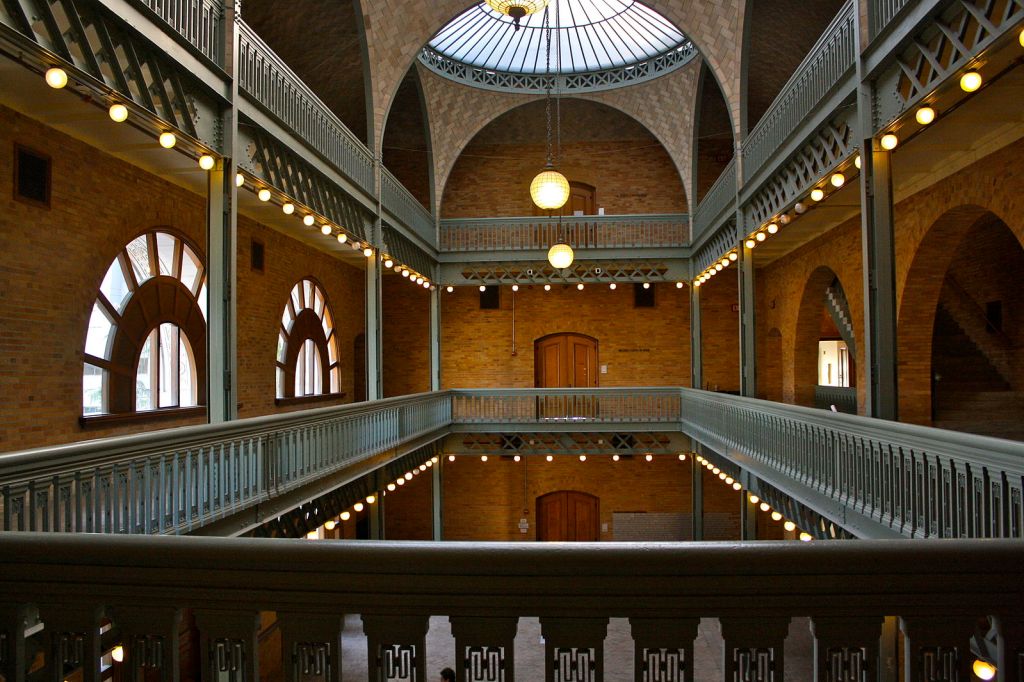
The interior of Hearst Mining Building, UC Berkeley campus.

By the late 1900’s, the mining company had excavated over 300 miles of tunnels and extracted nearly 40 million ounces of gold (equivalent to $100B today).  Over the years, the mine had gone deeper and deeper, eventually reaching the 8000 foot level (about 3000 feet below sea level). 

This unique structure presented a unique opportunity for a nuclear chemist, Ray Davis, at Brookhaven National Laboratory who was interested in the physics of neutrinos, the elementary particles that Enrico Fermi had named the “little neutral ones” that accompany radioactive decay. 

Neutrinos are unlike any other fundamental particles, passing through miles of solid rock as if it were transparent, except for exceedingly rare instances when a neutrino might collide with a nucleus.  However, neutrino detectors on the surface of the Earth were overwhelmed by signals from cosmic rays.  What was needed was a thick shield to protect the neutrino detector, and what better shield than thousands of feet of rock? 

Davis approached the Homestake mining company to request space in one of their tunnels for his detector.  While a mining company would not usually be receptive to requests like this, one of its senior advisors had previously had an academic career at Harvard, and he tipped the scales in favor of Davis.  The experiment would proceed.

The Solar Neutrino Problem

>>> After we disembark onto the 4100 level (4100 feet below the surface) from the Ross Shaft, we load onto the rail cars of a toy train, the track width little more than a foot wide.  The diminutive engine clunks and clangs and jerks itself forward, gathering speed as it pushes and pulls us, disappearing into a dark hole (called a drift) on a mile-long trek to our experimental site.  Twice we get stuck, the engine wheels spinning without purchase, and it is not clear if the engineers can get it going again. 

At this point we have been on the track for a quarter of an hour and the prospect of walking back to the Ross is daunting.  The only other way out, the Yates Shaft, is down for repairs.  The drift is unlit except by us with our battery-powered headlamps sweeping across the rock face, and who knows how long the batteries will last?  The ground is broken and uneven, punctuated with small pools of black water.  There would be a lot of stumbling and falls if we had to walk our way out.  I guess this is why I had to initial and sign in twenty different places on six pages, filled with legal jargon nearly as dense as the rock around us, before they let me come down here. <<<

In 1965, the Homestake mining crews carved out a side cavern for Davis near the Yates shaft at the 4850 level of the mine.  He constructed a large vat to hold cleaning fluid that contained lots of chlorine atoms.  When a rare neutrino interacted with a chlorine nucleus, the nucleus would convert to argon and give off a characteristic flash of light.  By tallying the flashes of light, and by calculating how likely it was for a neutrino to interact with a nucleus, the total flux of neutrinos through the vat could be back calculated.

The main source for neutrinos in our neck of the solar system is the sun.  As hydrogen fuses into helium, it gives off neutrinos.  These pass through the overlying layers of the sun and pass through the Earth and through Davis’ vat—except those rare cases when chlorine converts to argon.  The rate at which solar neutrinos should be detected in the vat was calculated very accurately by John Bahcall at Cal Tech.

By the early 1970’s, there were enough data that the total neutrino flux could be calculated and compared to the theoretical value based on the fusion reactions in the sun—and they didn’t match.  Worse, they didn’t match within a factor of three!  There were three times fewer neutrino events detected that there should have been.  Where were all the missing neutrinos?
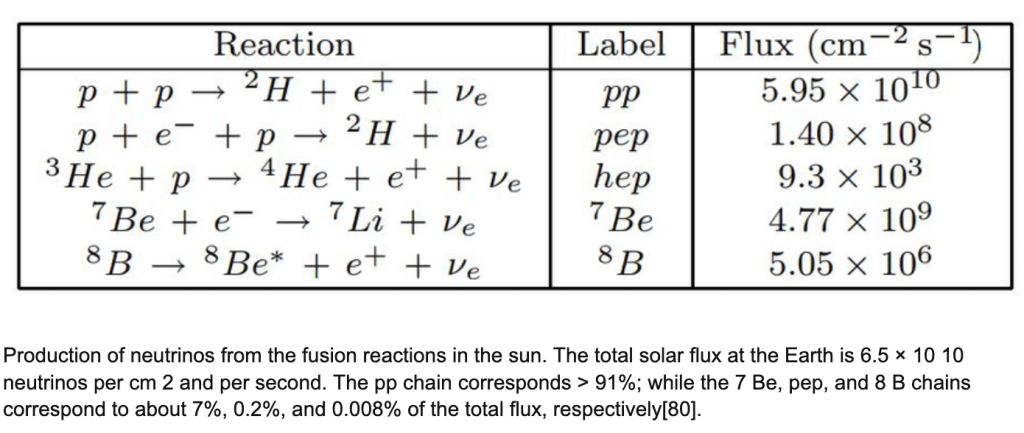
Origins and fluxes of solar neutrinos.

This came to be called the “Solar neutrino problem”.  At first, everyone assumed that the experiment was wrong, but Davis knew he was right.  Then others said the theoretical values were wrong, but Bahcall knew he was right.  The problem was, that Davis and Bahcall couldn’t both be right, could they?

Enter neutrino oscillations

The neutrinos coming from the sun originate mostly as what are known as electron neutrinos.  These interact with a neutron in a chlorine nucleus to convert it to a proton plus an ejected electron.  But if the neutrino were of a different kind, perhaps a muon neutrino, then there isn’t enough energy for the neutron to eject a muon, so the reaction doesn’t take place. 
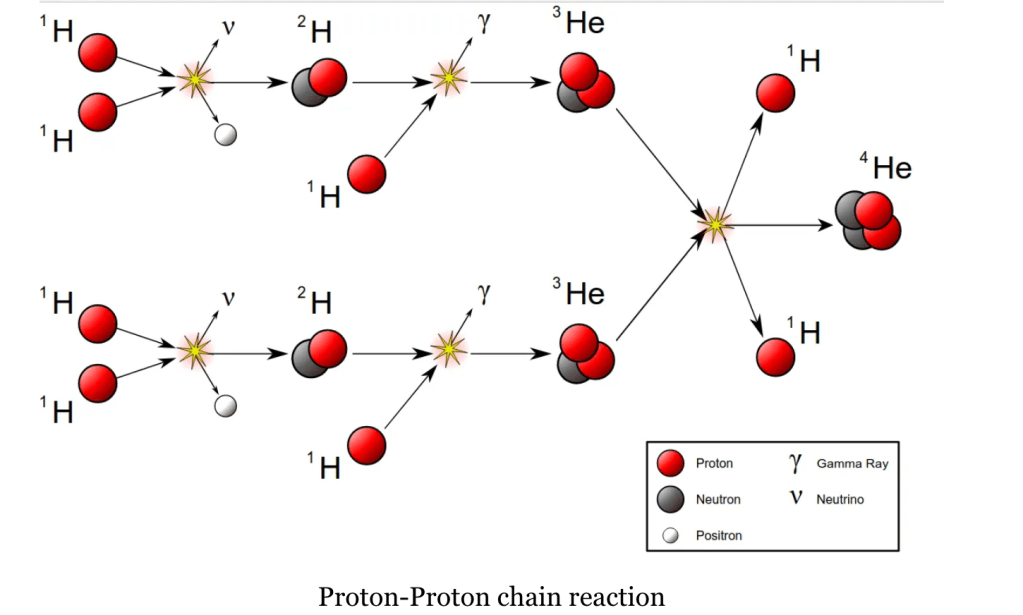
Hydrogen fusion in the sun.

This became the leading explanation for the missing solar neutrinos.  If many of them converted to muon neutrinos on their way to the Earth, then the Davis experiment wouldn’t detect them—hence the missing events.

The way that neutrinos can oscillate from electron neutrinos to muon neutrinos is if neutrinos have a very small but finite mass.  This was the solution, then, to the solar neutrino problem.  Neutrinos have mass.  Ray Davis was awarded the Nobel Prize in Physics in 2002 for his discovery of the missing neutrinos.

But one solution begets another problem: the Standard Model of elementary particles says that neutrinos are massless.  What can be going on with the Standard Model?

Once again, the answer may be found deep underground.

Sanford Underground Research Facility (SURF)

>>> The rock of the Homestake is one of the hardest and densest rocks you will find, black as night yet shot through with white streaks of calcite like the tails of comets.  It is impermeable, and despite being so deep, the rock is surprisingly dry—most of the fractures are too tight to allow a trickle through. 

As our toy train picks up speed, the veins flash by in our headlamps, sometimes sparkling with pin pricks of reflected light.  A gold fleck perhaps?  Yet the drift as a whole (or as a hole) is a shabby thing, rusty wedges half buried in the ceiling to keep slabs from falling, bent and battered galvanized metal pinned to the walls by rock bolts to hold them back, flimsy metal webbing strung across the ceiling to keep boulders from crushing our heads.  It’s dirty and dark and damp and hewn haphazardly from the compressed crust.  There is no art, no sense of place.  These shafts were dynamited through, at three-to-five feet per detonation, driven by money and the need for the gold, so nobody had any sense of aesthetics. <<<

The Homestake mine closed operations in 2001 due to the low grade of ore and the sagging price of gold.  They continued pumping water from the mine for two more years in anticipation of handing the extensive underground facility over to the National Science Foundation for use as a deep underground science lab.  However, delays in the transfer and the cost of pumping forced them to turn off the pumps and the water slowly began rising through the levels, taking a year or more to rise and flood the famous 4850 level while negotiations continued. 
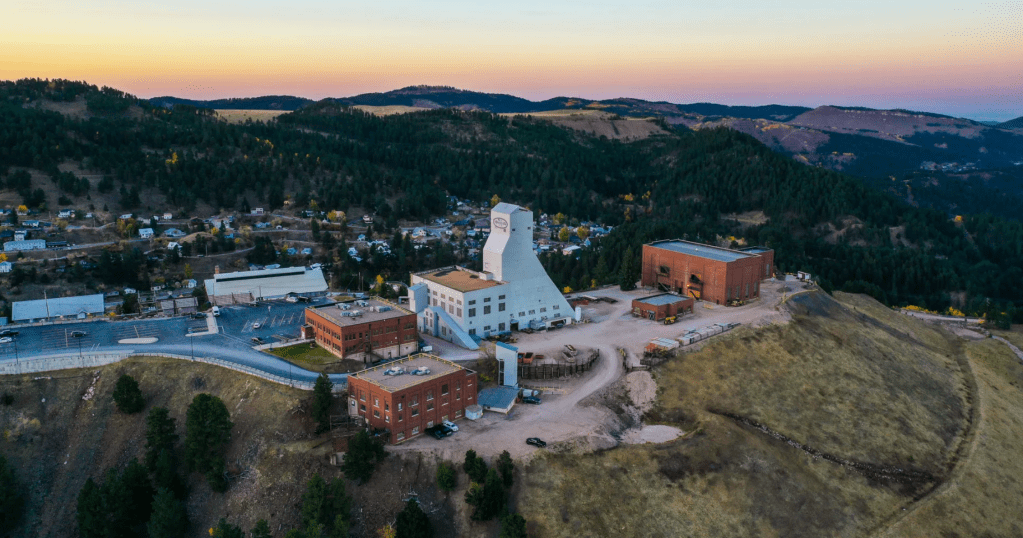
The surface buildings of the Sanford Underground Research Facility (SURF).
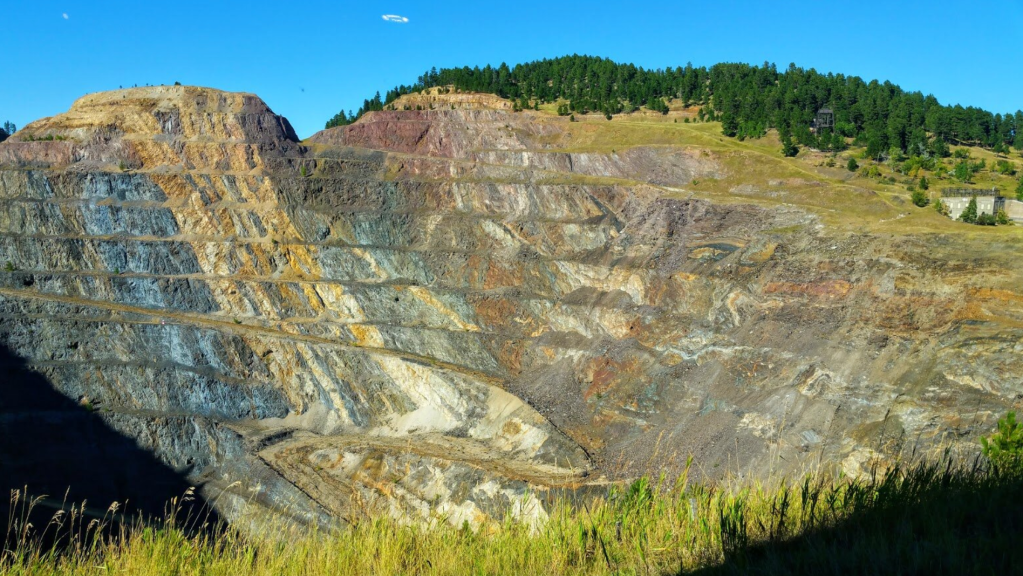
The open pit at Homestake.

Finally, the NSF took over the facility to house the Deep Underground Science and Engineering Laboratory (DUSEL) that would operate at the deepest levels, but these had already been flooded.  After a large donation from South Dakota banker T. Denny Sanford and support from the Governor Mike Rounds, the facility became the Sanford Underground Research Fability (SURF).  The 4850 level was “dewatered”, and the lab was dedicated in 2009.  But things were still not settled.  NSF had second thoughts, and in 2011 the plans for DUSEL (still under water) were terminated and the lab was transferred to the Department of Energy (DOE), administered through the Lawrence Berkeley National Laboratory, to host experiments at the 4850 level and higher.
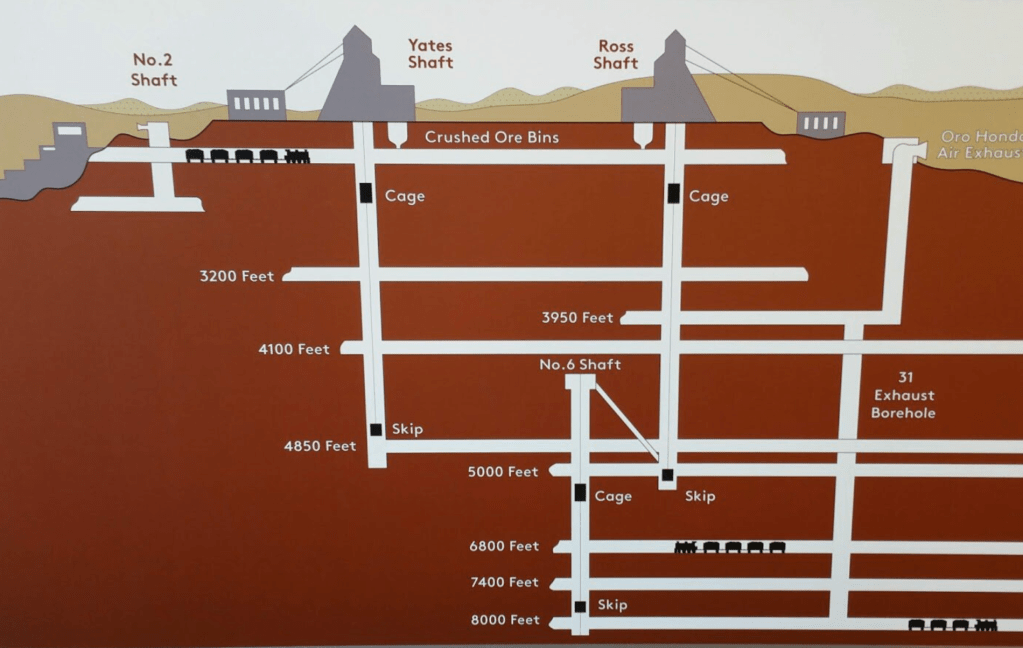
Layout of the mine levels at SURF.

Two early experiments at SURF were the Majorana Demonstrator and LUX. 

The Majorana Demonstrator was an experiment designed to look for neutrino-less double-beta decay where two neutrons in a nucleus decay simultaneously, each emitting a neutrino. A theory of neutrinos proposed by the Italian physicist, Ettore Marjorana, in 1937 that goes beyond the Standard Model ,says that a neutrino is its own antiparticle. If this were the case, then the two neutrinos emitted in the double beta decay could annihilate each otherhence a “neutrinoless” double beta decay. The Demonstrator was too small to actually see such an event, but it tested the concept and laid the ground for later larger experiments. It operated between 2016 and 2021.
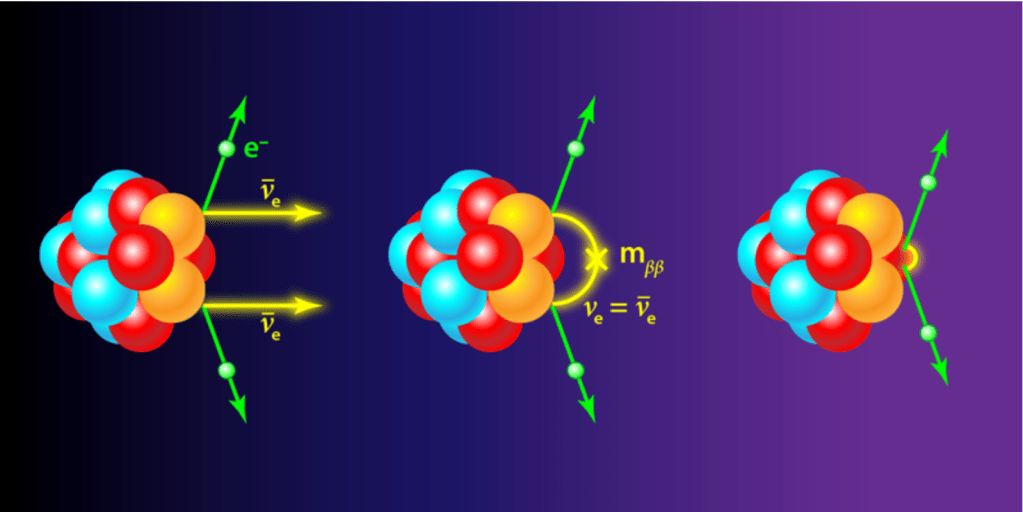
Neutrinoless double-beta decay.

The Large Underground Xenon (LUX) experiment was a prototype for the search for dark matter. Dark matter particles are expected to interact very weakly with ordinary matter (sort of like neutrinos, but even less interactive). Such weakly interacting massive particles (WIMPs) might scatter off a nucleus in an atom of Xenon, shifting the nucleus enough that it emits electrons and light. These would be captured by detectors at the caps of the liquid Xenon container.

Once again, cosmic rays at the surface of the Earth would make the experiment unworkable, but deep underground there is much less background within which to look for the “needle in the haystack”. LUX operated from 2009 to 2016 and was not big enough to hope to see a WIMP, but like the Demonstrator, it was a proof-of-principle to show that the idea worked and could be expanded to a much larger 7-ton experiment called LUX-Zeplin that began in 2020 and is ongoing, looking for the biggest portion of mass in our universe. (About a quarter of the energy of the universe is composed of dark matter. The usual stuff we see around us only makes up about 4% of the energy of the universe.)
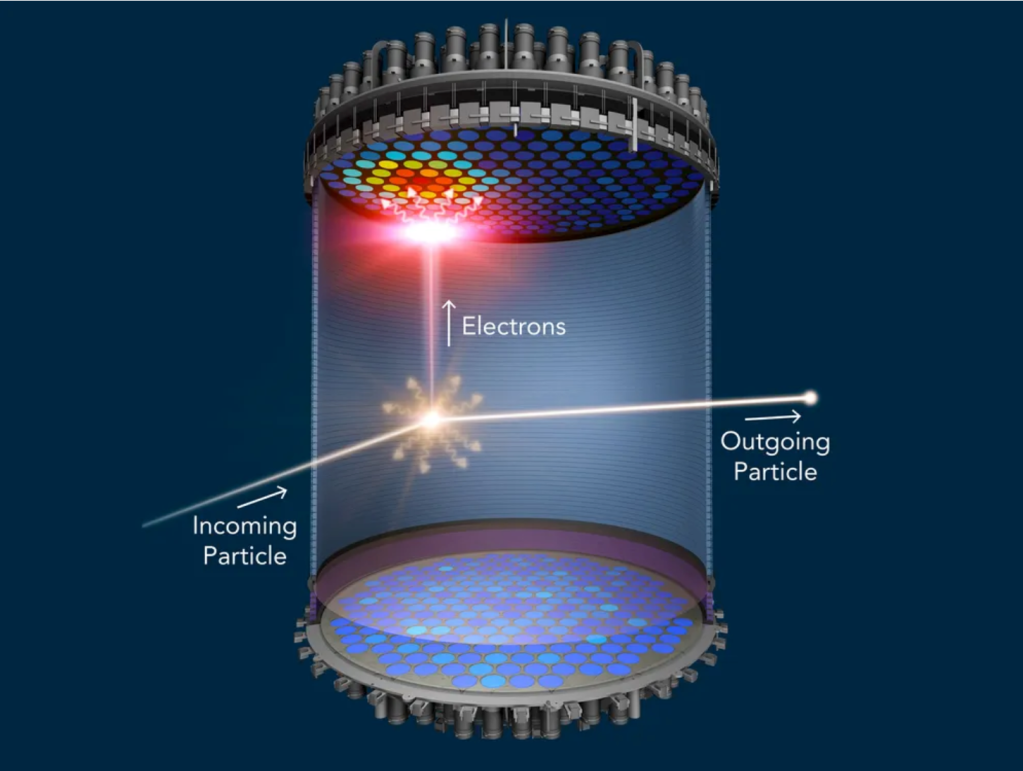
LUX-Zeplin Experiment

Deep Underground Neutrino Experiment (DUNE)

>>> “Always keep a sense of where you are,” Bill the geologist tells us, in case we must hike our way out.  But what sense is there?  I have a natural built-in compass that has served me well over the years, but it seems to run on the heavens.  When I visited South Africa, I had an eerie sense of disorientation the whole time I was there.  When you are a kilometer underground, the heavens are about as far away as Heaven.  There is no sense of orientation, only the sense of lefts and rights. 

We were told there would be signs directing us towards the Ross or Yates Shafts.  But once we are down here, it turns out that these “signs” are crudely spray-painted marks on the black rock, like bad graffiti.  When you see them, your first thought is of kids with spray cans making a mess—until you suddenly recognize an R or an O or two S’s along with an indistinct arrow that points slightly more one way than the other. <<<

Deep Underground Neutrino Experiment (DUNE).

One of the most ambitious high-energy experiments ever devised is the Long Baseline Neutrino Facility (LBNF) that is 800 miles long. It begins in Batavia, Illinois, at the Fermilab accelerator that launches a beam of neutrinos that travel 800 miles through the Earth to detectors at the Deep Underground Neutrino Experiment (DUNE) at SURF in Lead, South Dakota. The neutrinos are expected to oscillate in flavor, just like solar neutrinos, and the detection rates at DUNE could finally answer one of the biggest outstanding questions of physics: Why is our universe made of matter?

At the instant of the Big Bang, equal amounts of matter and antimatter should have been generated, and these should have annihilated in equal manner, and the universe should be filled with nothing but photons. But it’s not. Matter is everywhere. Why?

In the Standard Model there are many symmetries, also known as conserved properties. One power symmetry is known as CPT symmetry, where C is a symmetry of changing particles into the antiparticles, P is a reflection of left-handed or right-handed particles, and T is time-reversal symmetry. Yet there could be a CP symmetry too, which you might expect if time-reversal is taken as a symmetric property of physics. But it’s not!

There is a strange meson called a Kaon that does not decay the same way for its particle and antiparticle pair, violating CP symmetry. This was discovered in 1964 by James Cronin and Val Fitch who won the 1980 Nobel prize in physics. The discovery shocked the physics world. Since then, additional violations of CP symmetry have been observed in quarks. Such a broken symmetry is allowed in the Standard Model of particles, but the effect is so exceedingly smallCP is so extremely close to being a true symmetrythat it cannot explain the size of the matter-antimatter asymmetry in the universe.

Neutrino oscillations also can violate CP symmetry, but the effects have been hard to measurethus the need for DUNE. By creating large amounts of neutrinos, beaming them 800 miles through the Earth, and detecting them in the vast liquid Argon vats in the underground caverns of SURF, the parameters of neutrino oscillation can be measured directly, possibly explaining the matter asymmetry of the universeand answering Samwise’s question of why we are here.

Center for Understanding Subsurface Signals and Permeability (CUSSP)

>>> Finally, in the distance, as we rush down the dark drift, we see a bright glow that grows to envelope us with a string of white LED lights.  The drift is not so shabby here, with fresh pipes and electrical cables laid neatly by the side.  We had arrived at the CUSSP experimental site.  It turned out it was just a few steps away from the inactive Yates Shaft, that, if it had been operating, would have removed the need for the crazy train ride through black rock along broken tunnels.  But that is OK.  Because we are here, and this is what had brought us down into the Earth to answer questions down-to-Earth as we try to answer questions related to our future existence on this planet, learning what we need to generate the power for our high-tech society without making our planet unlivable.  <<<

Not all the science at SURF is so ethereal. For instance, research on Enhanced Geothermal Systems (EGS) is funded by the DOE Office of Basic Energy Sciences.  Geothermal systems can generate power by extracting super-heated water from underground to run turbines. However, superheated water is nasty stuff, very corrosive and full of minerals that tend to block up the fractures that the water flows through. The idea of enhanced geothermal systems is to drill boreholes and use “fracking” to create fractures in the hard rock, possibly refracturing older fractures that had become blocked. If this could be done reliably, then geothermal sites could be kept operating.

The Center for Understanding Subsurface Signals and Permeability (CUSSP) was recently funded by the DoE to use the facilities at SURF to study how well fracks can be controlled. The team is led by Pacific Northwest National Lab (PNNL) with collaborations from Lawrence Berkeley Lab, Maryland, Illinois and Purdue, among others. We are installing seismic equipment as well as electrical resistivity to monitor the induced fractures.

The CUSSP installation on the 4100 level was the destination of our underground journey, to see the boreholes in person and to get a sense of the fracture orientations at the drift wall. During the half hour at the site, rocks were examined, questions were answered, tall tales were told, and it was time to return.

Shooting to the Stars

>>> At the end of the tour, we pack again into the Ross cage and are thrust skyward at 2 meters per second—twice the speed as coming down because of the asymmetry of slack cables that could snag and snap.  Ears pop, and pop again, until the cage slows, and we settle to the exit level, relieved and tired and ready to see the sky. Thinking back, as we were shooting up the shaft, I imagined that the cage would never stop, flying up past the massive hoist, up and onward into the sky and to the stars.  <<<

In a video we had been shown about SURF, Jace DeCory, a scholar of the Lakota Sioux, spoke of the sacred ground of Ȟe Sápa—the Black Hills.  Are we taking again what is not ours?  This time it seems not.  The scientists of SURF are linking us to the stars, bringing knowledge instead of taking gold.  Jace quoted Carl Sagan: “We are made of star-stuff.”  Then she reminded us, the Lakota Sioux have known that all along.

The Doppler Universe

If you are a fan of the Doppler effect, then time trials at the Indy 500 Speedway will floor you.  Even if you have experienced the fall in pitch of a passing train whistle while stopped in your car at a railroad crossing, or heard the falling whine of a jet passing overhead, I can guarantee that you have never heard anything like an Indy car passing you by at 225 miles an hour.

Indy 500 Time Trials and the Doppler Effect

The Indy 500 time trials are the best way to experience the effect, rather than on race day when there is so much crowd noise and the overlapping sounds of all the cars.  During the week before the race, the cars go out on the track, one by one, in time trials to decide the starting order in the pack on race day.  Fans are allowed to wander around the entire complex, so you can get right up to the fence at track level on the straight-away.  The cars go by only thirty feet away, so they are coming almost straight at you as they approach and straight away from you as they leave.  The whine of the car as it approaches is 43% higher than when it is standing still, and it drops to 33% lower than the standing frequency—a ratio almost approaching a factor of two.  And they go past so fast, it is almost a step function, going from a steady high note to a steady low note in less than a second.  That is the Doppler effect!

But as obvious as the acoustic Doppler effect is to us today, it was far from obvious when it was proposed in 1842 by Christian Doppler at a time when trains, the fastest mode of transport at the time, ran at 20 miles per hour or less.  In fact, Doppler’s theory generated so much controversy that the Academy of Sciences of Vienna held a trial in 1853 to decide its merit—and Doppler lost!  For the surprising story of Doppler and the fate of his discovery, see my Physics Today article

From that fraught beginning, the effect has expanded in such importance, that today it is a daily part of our lives.  From Doppler weather radar, to speed traps on the highway, to ultrasound images of babies—Doppler is everywhere.

Development of the Doppler-Fizeau Effect

When Doppler proposed the shift in color of the light from stars in 1842 [1], depending on their motion towards or away from us, he may have been inspired by his walk to work every morning, watching the ripples on the surface of the Vltava River in Prague as the water slipped by the bridge piers.  The drawings in his early papers look reminiscently like the patterns you see with compressed ripples on the upstream side of the pier and stretched out on the downstream side.  Taking this principle to the night sky, Doppler envisioned that binary stars, where one companion was blue and the other was red, was caused by their relative motion.  He could not have known at that time that typical binary star speeds were too small to cause this effect, but his principle was far more general, applying to all wave phenomena. 

Six years later in 1848 [2], the French physicist Armand Hippolyte Fizeau, soon to be famous for making the first direct measurement of the speed of light, proposed the same principle, unaware of Doppler’s publications in German.  As Fizeau was preparing his famous measurement, he originally worked with a spinning mirror (he would ultimately use a toothed wheel instead) and was thinking about what effect the moving mirror might have on the reflected light.  He considered the effect of star motion on starlight, just as Doppler had, but realized that it was more likely that the speed of the star would affect the locations of the spectral lines rather than change the color.  This is in fact the correct argument, because a Doppler shift on the black-body spectrum of a white or yellow star shifts a bit of the infrared into the visible red portion, while shifting a bit of the ultraviolet out of the visible, so that the overall color of the star remains the same, but Fraunhofer lines would shift in the process.  Because of the independent development of the phenomenon by both Doppler and Fizeau, and because Fizeau was a bit clearer in the consequences, the effect is more accurately called the Doppler-Fizeau Effect, and in France sometimes only as the Fizeau Effect.  Here in the US, we tend to forget the contributions of Fizeau, and it is all Doppler.

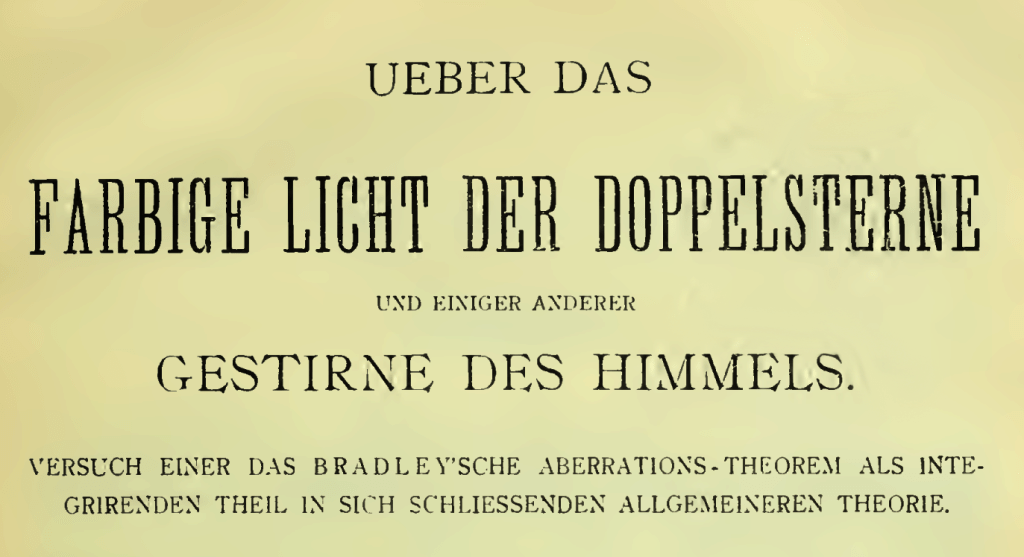
Fig. 1 The title page of Doppler’s 1842 paper [1] proposing the shift in color of stars caused by their motions. (“On the colored light of double stars and a few other stars in the heavens: Study of an integral part of Bradley’s general aberration theory”)
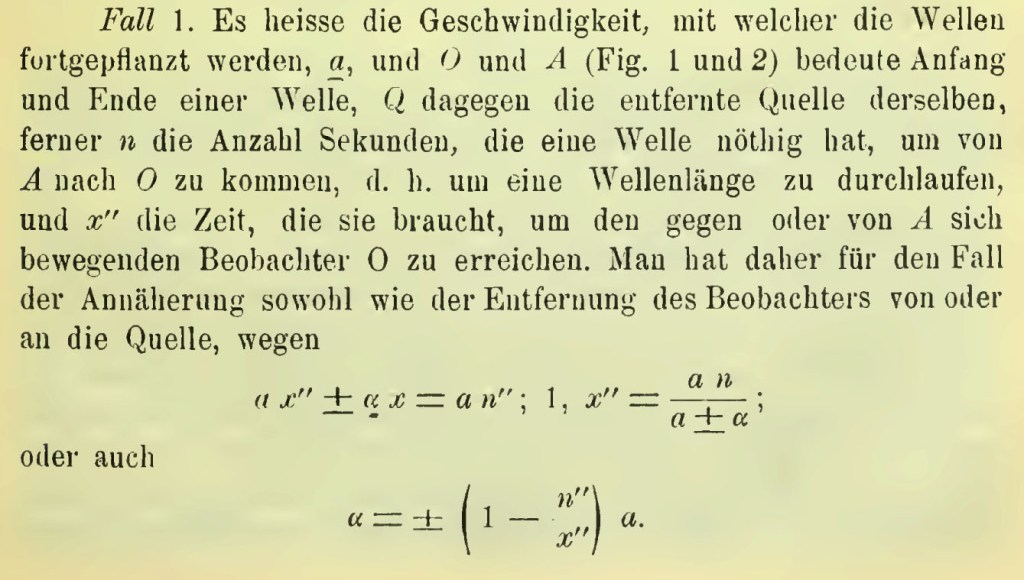
Fig. 2 Doppler used simple proportionality and relative velocities to deduce the first-order change in frequency of waves caused by motion of the source relative to the receiver, or of the receiver relative to the source.
Fig. 3 Doppler’s drawing of what would later be called the Mach cone generating a shock wave. Mach was one of Doppler’s later champions, making dramatic laboratory demonstrations of the acoustic effect, even as skepticism persisted in accepting the phenomenon.

Doppler and Exoplanet Discovery

It is fitting that many of today’s applications of the Doppler effect are in astronomy. His original idea on binary star colors was wrong, but his idea that relative motion changes frequencies was right, and it has become one of the most powerful astrometric techniques in astronomy today. One of its important recent applications was in the discovery of extrasolar planets orbiting distant stars.

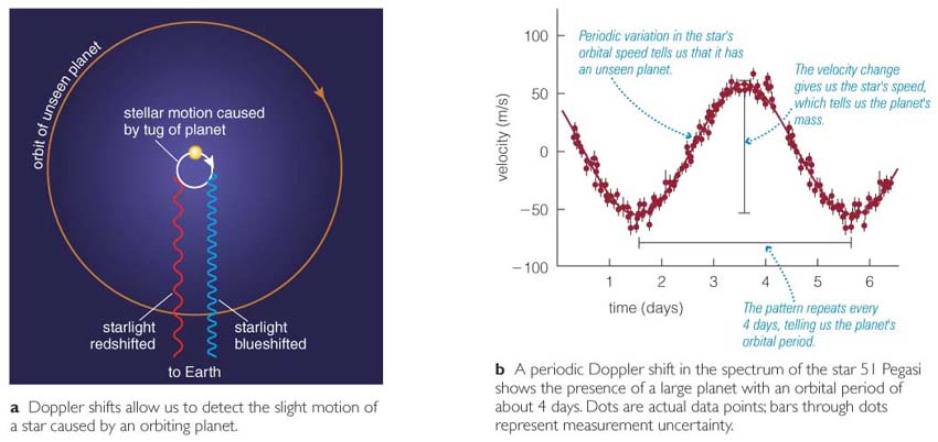
When a large planet like Jupiter orbits a star, the center of mass of the two-body system remains at a constant point, but the individual centers of mass of the planet and the star both orbit the common point. This makes it look like the star has a wobble, first moving towards our viewpoint on Earth, then moving away. Because of this relative motion of the star, the light can appear blueshifted caused by the Doppler effect, then redshifted with a set periodicity. This was observed by Queloz and Mayer in 1995 for the star 51 Pegasi, which represented the first detection of an exoplanet [3]. The duo won the Nobel Prize in 2019 for the discovery.

Fig. 4 A gas giant (like Jupiter) and a star obit a common center of mass causing the star to wobble. The light of the star when viewed at Earth is periodically red- and blue-shifted by the Doppler effect. From Ref.

Doppler and Vera Rubins’ Galaxy Velocity Curves

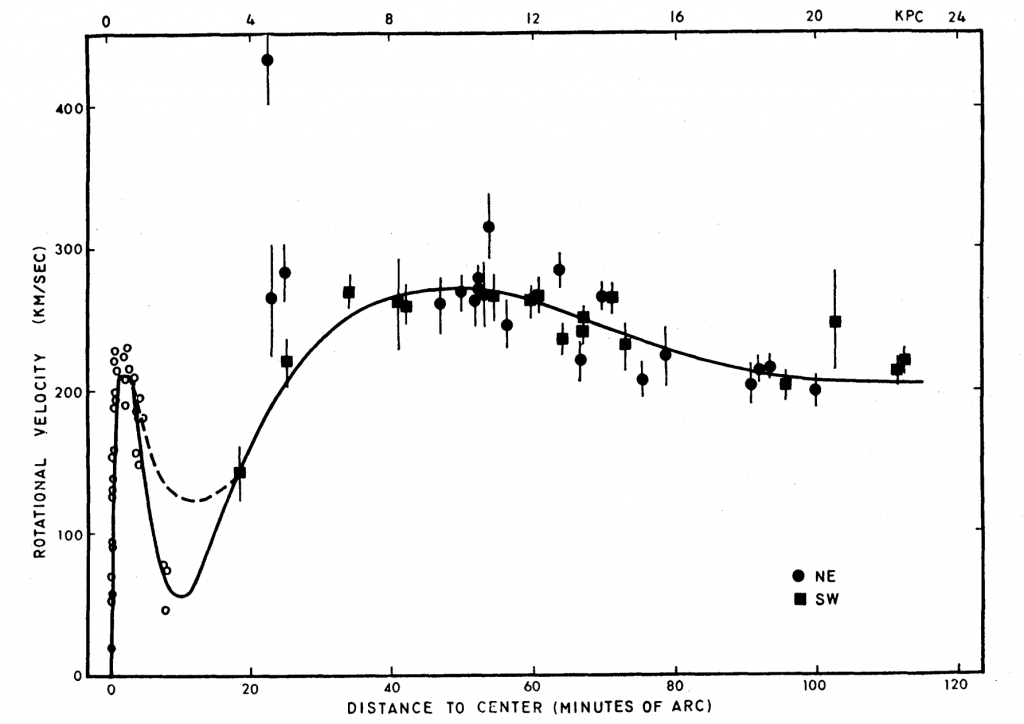
In the late 1960’s and early 1970’s Vera Rubin at the Carnegie Institution of Washington used newly developed spectrographs to use the Doppler effect to study the speeds of ionized hydrogen gas surrounding massive stars in individual galaxies [4]. From simple Newtonian dynamics it is well understood that the speed of stars as a function of distance from the galactic center should increase with increasing distance up to the average radius of the galaxy, and then should decrease at larger distances. This trend in speed as a function of radius is called a rotation curve. As Rubin constructed the rotation curves for many galaxies, the increase of speed with increasing radius at small radii emerged as a clear trend, but the stars farther out in the galaxies were all moving far too fast. In fact, they are moving so fast that they exceeded escape velocity and should have flown off into space long ago. This disturbing pattern was repeated consistently in one rotation curve after another for many galaxies.

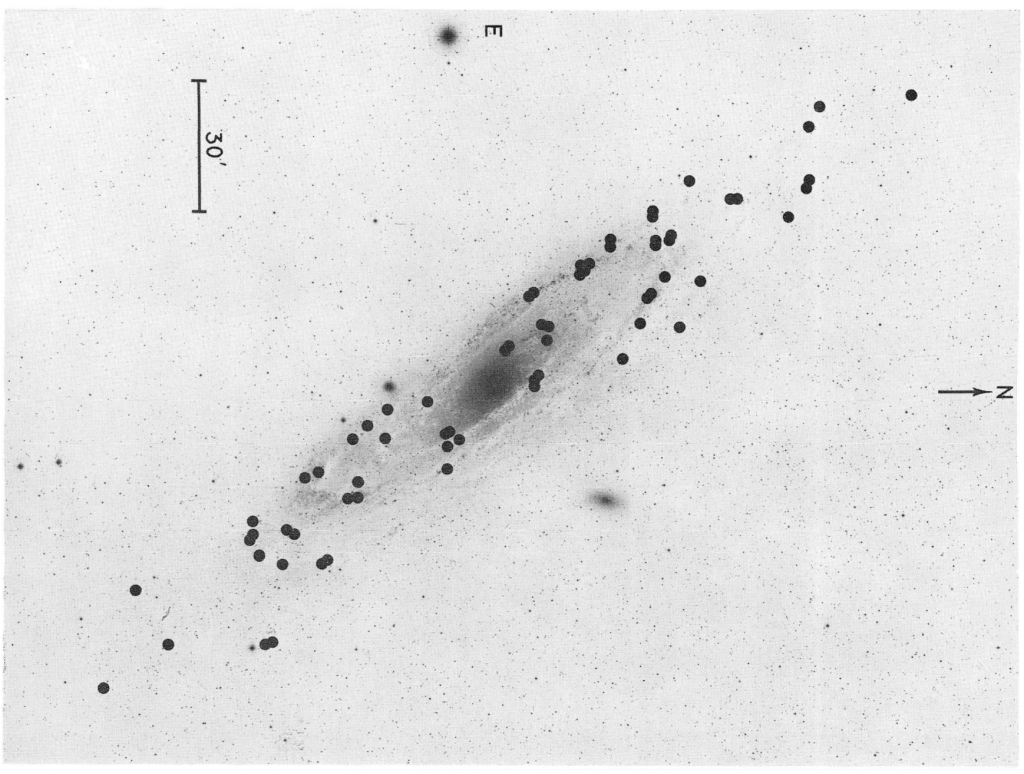
Fig. 5 Locations of Doppler shifts of ionized hydrogen measured by Vera Rubin on the Andromeda galaxy. From Ref.
Fig. 6 Vera Rubin’s velocity curve for the Andromeda galaxy. From Ref.
Fig. 7 Measured velocity curves relative to what is expected from the visible mass distribution of the galaxy. From Ref.

A simple fix to the problem of the rotation curves is to assume that there is significant mass present in every galaxy that is not observable either as luminous matter or as interstellar dust. In other words, there is unobserved matter, dark matter, in all galaxies that keeps all their stars gravitationally bound. Estimates of the amount of dark matter needed to fix the velocity curves is about five times as much dark matter as observable matter. In short, 80% of the mass of a galaxy is not normal. It is neither a perturbation nor an artifact, but something fundamental and large. The discovery of the rotation curve anomaly by Rubin using the Doppler effect stands as one of the strongest evidence for the existence of dark matter.

There is so much dark matter in the Universe that it must have a major effect on the overall curvature of space-time according to Einstein’s field equations. One of the best probes of the large-scale structure of the Universe is the afterglow of the Big Bang, known as the cosmic microwave background (CMB).

Doppler and the Big Bang

The Big Bang was astronomically hot, but as the Universe expanded it cooled. About 380,000 years after the Big Bang, the Universe cooled sufficiently that the electron-proton plasma that filled space at that time condensed into hydrogen. Plasma is charged and opaque to photons, while hydrogen is neutral and transparent. Therefore, when the hydrogen condensed, the thermal photons suddenly flew free and have continued unimpeded, continuing to cool. Today the thermal glow has reached about three degrees above absolute zero. Photons in thermal equilibrium with this low temperature have an average wavelength of a few millimeters corresponding to microwave frequencies, which is why the afterglow of the Big Bang got its name: the Cosmic Microwave Background (CMB).

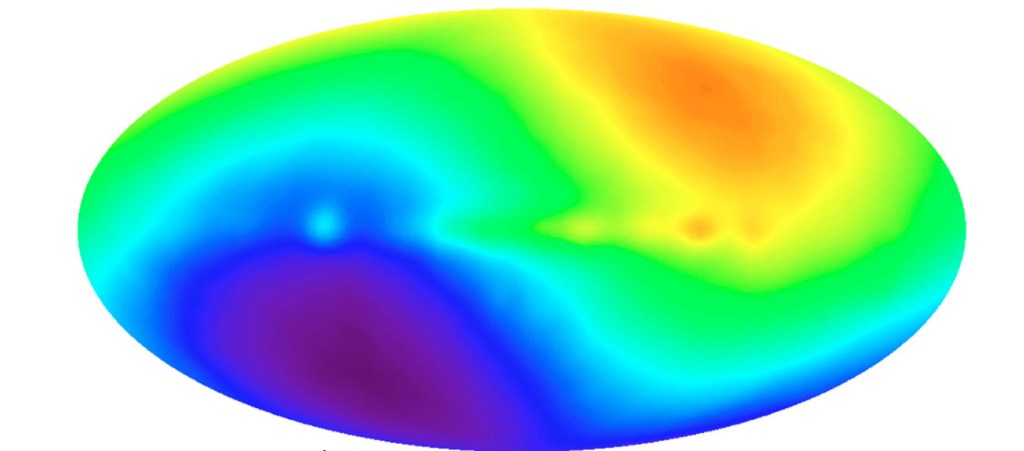
Not surprisingly, the CMB has no preferred reference frame, because every point in space is expanding relative to every other point in space. In other words, space itself is expanding. Yet soon after the CMB was discovered by Arno Penzias and Robert Wilson (for which they were awarded the Nobel Prize in Physics in 1978), an anisotropy was discovered in the background that had a dipole symmetry caused by the Doppler effect as the Solar System moves at 368±2 km/sec relative to the rest frame of the CMB. Our direction is towards galactic longitude 263.85o and latitude 48.25o, or a bit southwest of Virgo. Interestingly, the local group of about 100 galaxies, of which the Milky Way and Andromeda are the largest members, is moving at 627±22 km/sec in the direction of galactic longitude 276o and latitude 30o. Therefore, it seems like we are a bit slack in our speed compared to the rest of the local group. This is in part because we are being pulled towards Andromeda in roughly the opposite direction, but also because of the speed of the solar system in our Galaxy.

Fig. 8 The CMB dipole anisotropy caused by the Doppler effect as the Earth moves at 368 km/sec through the rest frame of the CMB.

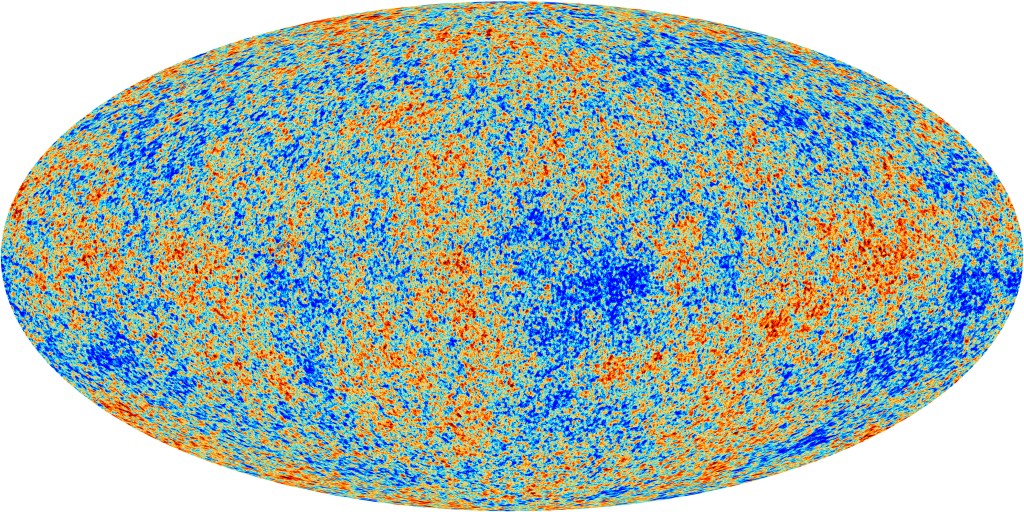
Aside from the dipole anisotropy, the CMB is amazingly uniform when viewed from any direction in space, but not perfectly uniform. At the level of 0.005 percent, there are variations in the temperature depending on the location on the sky. These fluctuations in background temperature are called the CMB anisotropy, and they help interpret current models of the Universe. For instance, the average angular size of the fluctuations is related to the overall curvature of the Universe. This is because, in the early Universe, not all parts of it were in communication with each other. This set an original spatial size to thermal discrepancies. As the Universe continued to expand, the size of the regional variations expanded with it, and the sizes observed today would appear larger or smaller, depending on how the universe is curved. Therefore, to measure the energy density of the Universe, and hence to find its curvature, required measurements of the CMB temperature that were accurate to better than a part in 10,000.

Equivalently, parts of the early universe had greater mass density than others, causing the gravitational infall of matter towards these regions. Then, through the Doppler effect, light emitted (or scattered) by matter moving towards these regions contributes to the anisotropy. They contribute what are known as “Doppler peaks” in the spatial frequency spectrum of the CMB anisotropy.

Fig. 9 The CMB small-scale anisotropy, part of which is contributed by Doppler shifts of matter falling into denser regions in the early universe.

The examples discussed in this blog (exoplanet discovery, galaxy rotation curves, and cosmic background) are just a small sampling of the many ways that the Doppler effect is used in Astronomy. But clearly, Doppler has played a key role in the long history of the universe.

By David D. Nolte, Jan. 23, 2022


References:

[1] C. A. DOPPLER, “Über das farbige Licht der Doppelsterne und einiger anderer Gestirne des Himmels (About the coloured light of the binary stars and some other stars of the heavens),” Proceedings of the Royal Bohemian Society of Sciences, vol. V, no. 2, pp. 465–482, (Reissued 1903) (1842)

[2] H. Fizeau, “Acoustique et optique,” presented at the Société Philomathique de Paris, Paris, 1848.

[3] M. Mayor and D. Queloz, “A JUPITER-MASS COMPANION TO A SOLAR-TYPE STAR,” Nature, vol. 378, no. 6555, pp. 355-359, Nov (1995)

[4] Rubin, Vera; Ford, Jr., W. Kent (1970). “Rotation of the Andromeda Nebula from a Spectroscopic Survey of Emission Regions”. The Astrophysical Journal. 159: 379


Further Reading

D. D. Nolte, “The Fall and Rise of the Doppler Effect,” Physics Today, vol. 73, no. 3, pp. 31-35, Mar (2020)

M. Tegmark, “Doppler peaks and all that: CMB anisotropies and what they can tell us,” in International School of Physics Enrico Fermi Course 132 on Dark Matter in the Universe, Varenna, Italy, Jul 25-Aug 04 1995, vol. 132, in Proceedings of the International School of Physics Enrico Fermi, 1996, pp. 379-416

Dark Matter Mysteries

There is more to the Universe than meets the eye—way more. Over the past quarter century, it has become clear that all the points of light in the night sky, the stars, the Milky Way, the nubulae, all the distant galaxies, when added up with the nonluminous dust, constitute only a small fraction of the total energy density of the Universe. In fact, “normal” matter, like the stuff of which we are made—star dust—contributes only 4% to everything that is. The rest is something else, something different, something that doesn’t show up in the most sophisticated laboratory experiments, not even the Large Hadron Collider [1]. It is unmeasurable on terrestrial scales, and even at the scale of our furthest probe—the Voyager I spacecraft that left our solar system several years ago—there have been no indications of deviations from Newton’s law of gravity. To the highest precision we can achieve, it is invisible and non-interacting on any scale smaller than our stellar neighborhood. Perhaps it can never be detected in any direct sense. If so, then how do we know it is there? The answer comes from galactic trajectories. The motions in and of galaxies have been, and continue to be, the principal laboratory for the investigation of  cosmic questions about the dark matter of the universe.

Today, the nature of Dark Matter is one of the greatest mysteries in physics, and the search for direct detection of Dark Matter is one of physics’ greatest pursuits.

Island Universes

The nature of the Milky Way was a mystery through most of human history. To the ancient Greeks it was the milky circle (γαλαξίας κύκλος , pronounced galaktikos kyklos) and to the Romans it was literally the milky way (via lactea). Aristotle, in his Meteorologica, briefly suggested that the Milky Way might be composed of a large number of distant stars, but then rejected that idea in favor of a wisp, exhaled like breath on a cold morning, from the stars. The Milky Way is unmistakable on a clear dark night to anyone who looks up, far away from city lights. It was a constant companion through most of human history, like the constant stars, until electric lights extinguished it from much of the world in the past hundred years. Geoffrey Chaucer, in his Hous of Fame (1380) proclaimed “See yonder, lo, the Galaxyë Which men clepeth the Milky Wey, For hit is whyt.” (See yonder, lo, the galaxy which men call the Milky Way, for it is white.).

474336main_p1024ay_full

Hubble image of one of the galaxies in the Coma Cluster of galaxies that Fritz Zwicky used to announce that the universe contained a vast amount of dark matter.

Aristotle was fated, again, to be corrected by Galileo. Using his telescope in 1610, Galileo was the first to resolve a vast field of individual faint stars in the Milky Way. This led Emmanual Kant, in 1755, to propose that the Milky Way Galaxy was a rotating disk of stars held together by Newtonian gravity like the disk of the solar system, but much larger. He went on to suggest that the faint nebulae might be other far distant galaxies, which he called “island universes”. The first direct evidence that nebulae were distant galaxies came in 1917 with the observation of a supernova in the Andromeda Galaxy by Heber Curtis. Based on the brightness of the supernova, he estimated that the Andromeda Galaxy was over a million light years away, but uncertainty in the distance measurement kept the door open for the possibility that it was still part of the Milky Way, and hence the possibility that the Milky Way was the Universe.

The question of the nature of the nebulae hinged on the problem of measuring distances across vast amounts of space. By line of sight, there is no yard stick to tell how far away something is, so other methods must be used. Stellar parallax, for instance, can gauge the distance to nearby stars by measuring slight changes in the apparent positions of the stars as the Earth changes its position around the Sun through the year. This effect was used successfully for the first time in 1838 by Fredrich Bessel, and by the year 2000 more than a hundred thousand stars had their distances measured using stellar parallax. Recent advances in satellite observatories have extended the reach of stellar parallax to a distance of about 10,000 light years from the Sun, but this is still only a tenth of the diameter of the Milky Way. To measure distances to the far side of our own galaxy, or beyond, requires something else.

Because of Henrietta Leavitt

In 1908 Henrietta Leavitt, working at the Harvard Observatory as one of the famous female “computers”, discovered that stars whose luminosities oscillate with a steady periodicity, stars known as Cepheid variables, have a relationship between the period of oscillation and the average luminosity of the star [2]. By measuring the distance to nearby Cepheid variables using stellar parallax, the absolute brightness of the Cepheid could be calibrated, and the Cepheid could then be used as “standard candles”. This meant that by observing the period of oscillation and the brightness of a distant Cepheid, the distance to the star could be calculated. Edwin Hubble (1889 – 1953), working at the Mount Wilson observatory in Passedena CA, observed Cepheid variables in several of the brightest nebulae in the night sky. In 1925 he announced his observation of individual Cepheid variables in Andromeda and calculated that Andromeda was more than a million light years away, more than 10 Milky Way diameters (the actual number is about 25 Milky Way diameters). This meant that Andromeda was a separate galaxy and that the Universe was made of more than just our local cluster of stars. Once this door was opened, the known Universe expanded quickly up to a hundred Milky Way diameters as Hubble measured the distances to scores of our neighboring galaxies in the Virgo galaxy cluster. However, it was more than just our knowledge of the universe that was expanding.

Armed with measurements of galactic distances, Hubble was in a unique position to relate those distances to the speeds of the galaxies by combining his distance measurements with spectroscopic observations of the light spectra made by other astronomers. These galaxy emission spectra could be used to measure the Doppler effect on the light emitted by the stars of the galaxy. The Doppler effect, first proposed by Christian Doppler (1803 – 1853) in 1843, causes the wavelength of emitted light to be shifted to the red for objects receding from an observer, and shifted to the blue for objects approaching an observer. The amount of spectral shift is directly proportional the the object’s speed. Doppler’s original proposal was to use this effect to measure the speed of binary stars, which is indeed performed routinely today by astronomers for just this purpose, but in Doppler’s day spectroscopy was not precise enough to accomplish this. However, by the time Hubble was making his measurements, optical spectroscopy had become a precision science, and the Doppler shift of the galaxies could be measured with great accuracy. In 1929 Hubble announced the discovery of a proportional relationship between the distance to the galaxies and their Doppler shift. What he found was that the galaxies [3] are receding from us with speeds proportional to their distance [4]. Hubble himself made no claims at that time about what these data meant from a cosmological point of view, but others quickly noted that this Hubble effect could be explained if the universe were expanding.

Einstein’s Mistake

The state of the universe had been in doubt ever since Heber Curtis observed the supernova in the Andromeda galaxy in 1917. Einstein published a paper that same year in which he sought to resolve a problem that had appeared in the solution to his field equations. It appeared that the universe should either be expanding or contracting. Because the night sky literally was the firmament, it went against the mentality of the times to think of the universe as something intrinsically unstable, so Einstein fixed it with an extra term in his field equations, adding something called the cosmological constant, denoted by the Greek lambda (Λ). This extra term put the universe into a static equilibrium, and Einstein could rest easy with his firm trust in the firmament. However, a few years later, in 1922, the Russian physicist and mathematician Alexander Friedmann (1888 – 1925) published a paper that showed that Einstein’s static equilibrium was actually unstable, meaning that small perturbations away from the current energy density would either grow or shrink. This same result was found independently by the Belgian astronomer Georges Lemaître in 1927, who suggested that not only was the universe  expanding, but that it had originated in a singular event (now known as the Big Bang). Einstein was dismissive of Lemaître’s proposal and even quipped “Your calculations are correct, but your physics is atrocious.” [5] But after Hubble published his observation on the red shifts of galaxies in 1929, Lemaître pointed out that the redshifts would be explained by an expanding universe. Although Hubble himself never fully adopted this point of view, Einstein immediately saw it for what it was—a clear and simple explanation for a basic physical phenomenon that he had foolishly overlooked. Einstein retracted his cosmological constant in embarrassment and gave his support to Lemaître’s expanding universe. Nonetheless, Einstein’s physical intuition was never too far from the mark, and the cosmological constant has been resurrected in recent years in the form of Dark Energy. However, something else, both remarkable and disturbing, reared its head in the intervening years—Dark Matter.

Fritz Zwicky: Gadfly Genius

It is difficult to write about important advances in astronomy and astrophysics of the 20th century without tripping over Fritz Zwicky. As the gadfly genius that he was, he had a tendency to shoot close to the mark, or at least some of his many crazy ideas tended to be right. He was also in the right place at the right time, at the Mt. Wilson observatory nearby Cal Tech with regular access the World’s largest telescope. Shortly after Hubble proved that the nebulae were other galaxies and used Doppler shifts to measure their speeds, Zwicky (with his assistant Baade) began a study of as many galactic speeds and distances as they could. He was able to construct a three-dimensional map of the galaxies in the relatively nearby Coma galaxy cluster, together with their velocities. He then deduced that the galaxies in this isolated cluster were gravitational bound to each other, performing a whirling dance in each others thrall, like stars in globular star clusters in our Milky Way. But there was a serious problem.

Star clusters display average speeds and average gravitational potentials that are nicely balanced, a result predicted from a theorem of mechanics that was named the Virial Theorem by Rudolf Clausius in 1870. The Virial Theorem states that the average kinetic energy of a system of many bodies is directly related to the average potential energy of the system. By applying the Virial Theorem to the galaxies of the Coma cluster, Zwicky found that the dynamics of the galaxies were badly out of balance. The galaxy kinetic energies were far too fast relative to the gravitational potential—so fast, in fact, that the galaxies should have flown off away from each other and not been bound at all. To reconcile this discrepancy of the galactic speeds with the obvious fact that the galaxies were gravitationally bound, Zwicky postulated that there was unobserved matter present in the cluster that supplied the missing gravitational potential. The amount of missing potential was very large, and Zwicky’s calculations predicted that there was 400 times as much invisible matter, which he called “dark matter”, as visible. With his usual flare for the dramatic, Zwicky announced his findings to the World in 1933, but the World shrugged— after all, it was just Zwicky.

Nonetheless, Zwicky’s and Baade’s observations of the structure of the Coma cluster, and the calculations using the Virial Theorem, were verified by other astronomers. Something was clearly happening in the Coma cluster, but other scientists and astronomers did not have the courage or vision to make the bold assessment that Zwicky had. The problem of the Coma cluster, and a growing number of additional galaxy clusters that have been studied during the succeeding years, was to remain a thorn in the side of gravitational theory through half a century, and indeed remains a thorn to the present day. It is an important clue to a big question about the nature of gravity, which is arguably the least understood of the four forces of nature.

Vera Rubin: Galaxy Rotation Curves

Galactic clusters are among the largest coherent structures in the observable universe, and there are many questions about their origin and dynamics. Smaller gravitationally bound structures that can be handled more easily are individual galaxies themselves. If something important was missing in the dynamics of galactic clusters, perhaps the dynamics of the stars in individual galaxies could help shed light on the problem. In the late 1960’s and early 1970’s Vera Rubin at the Carnegie Institution of Washington used newly developed spectrographs to study the speeds of stars in individual galaxies. From simple Newtonian dynamics it is well understood that the speed of stars as a function of distance from the galactic center should increase with increasing distance up to the average radius of the galaxy, and then should decrease at larger distances. This trend in speed as a function of radius is called a rotation curve. As Rubin constructed the rotation curves for many galaxies, the increase of speed with increasing radius at small radii emerged as a clear trend, but the stars farther out in the galaxies were all moving far too fast. In fact, they are moving so fast that they exceeded escape velocity and should have flown off into space long ago. This disturbing pattern was repeated consistently in one rotation curve after another.

A simple fix to the problem of the rotation curves is to assume that there is significant mass present in every galaxy that is not observable either as luminous matter or as interstellar dust. In other words, there is unobserved matter, dark matter, in all galaxies that keeps all their stars gravitationally bound. Estimates of the amount of dark matter needed to fix the velocity curves is about five times as much dark matter as observable matter. This is not the same factor of 400 that Zwicky had estimated for the Coma cluster, but it is still a surprisingly large number. In short, 80% of the mass of a galaxy is not normal. It is neither a perturbation nor an artifact, but something fundamental and large. In fact, there is so much dark matter in the Universe that it must have a major effect on the overall curvature of space-time according to Einstein’s field equations. One of the best probes of the large-scale structure of the Universe is the afterglow of the Big Bang, known as the cosmic microwave background (CMB).

The Big Bang

The Big Bang was incredibly hot, but as the Universe expanded, its temperature cooled. About 379,000 years after the Big Bang, the Universe cooled sufficiently that the electron-nucleon plasma that filled space at that time condensed primarily into hydrogen. Plasma is charged and hence is opaque to photons.  Hydrogen, on the other hand, is neutral and transparent. Therefore, when the hydrogen condensed, the thermal photons suddenly flew free, unimpeded, and have continued unimpeded, continuing to cool, until today the thermal glow has reached about three degrees above absolute zero. Photons in thermal equilibrium with this low temperature have an average wavelength of a few millimeters corresponding to microwave frequencies, which is why the afterglow of the Big Bang got its CMB name.

The CMB is amazingly uniform when viewed from any direction in space, but it is not perfectly uniform. At the level of 0.005 percent, there are variations in the temperature depending on the location on the sky. These fluctuations in background temperature are called the CMB anisotropy, and they play an important role helping to interpret current models of the Universe. For instance, the average angular size of the fluctuations is related to the overall curvature of the Universe. This is because in the early Universe not all parts of it were in communication with each other because of the finite size and the finite speed of light. This set an original spatial size to thermal discrepancies. As the Universe continued to expand, the size of the regional variations expanded with it, and the sizes observed today would appear larger or smaller, depending on how the universe is curved. Therefore, to measure the energy density of the Universe, and hence to find its curvature, required measurements of the CMB temperature that were accurate to better than a part in 10,000.

Andrew Lange and Paul Richards: The Lambda and the Omega

In graduate school at Berkeley in 1982, my first graduate research assistantship was in the group of Paul Richards, one of the world leaders in observational cosmology. One of his senior graduate students at the time, Andrew Lange, was sharp and charismatic and leading an ambitious project to measure the cosmic background radiation on an experiment borne by a Japanese sounding rocket. My job was to create a set of far-infrared dichroic beamsplitters for the spectrometer.   A few days before launch, a technician noticed that the explosive bolts on the rocket nose-cone had expired. When fired, these would open the cone and expose the instrument at high altitude to the CMB. The old bolts were duly replaced with fresh ones. On launch day, the instrument and the sounding rocket worked perfectly, but the explosive bolts failed to fire, and the spectrometer made excellent measurements of the inside of the nose cone all the way up and all the way down until it sank into the Pacific Ocean. I left Paul’s comology group for a more promising career in solid state physics under the direction of Eugene Haller and Leo Falicov, but Paul and Andrew went on to great fame with high-altitude balloon-borne experiments that flew at 40,000 feet, above most of the atmosphere, to measure the CMB anisotropy.

By the late nineties, Andrew was established as a professor at Cal Tech. He was co-leading an experiment called BOOMerANG that flew a high-altitude balloon around Antarctica, while Paul was leading an experiment called MAXIMA that flew a balloon from Palastine, Texas. The two experiments had originally been coordinated together, but operational differences turned the former professor/student team into competitors to see who would be the first to measure the shape of the Universe through the CMB anisotropy.  BOOMerANG flew in 1997 and again in 1998, followed by MAXIMA that flew in 1998 and again in 1999. In early 2000, Andrew and the BOOMerANG team announced that the Universe was flat, confirmed quickly by an announcement by MAXIMA [BoomerMax]. This means that the energy density of the Universe is exactly critical, and there is precisely enough gravity to balance the expansion of the Universe. This parameter is known as Omega (Ω).  What was perhaps more important than this discovery was the announcement by Paul’s MAXIMA team that the amount of “normal” baryonic matter in the Universe made up only about 4% of the critical density. This is a shockingly small number, but agreed with predictions from Big Bang nucleosynthesis. When combined with independent measurements of Dark Energy known as Lambda (Λ), it also meant that about 25% of the energy density of the Universe is made up of Dark Matter—about five times more than ordinary matter. Zwicky’s Dark Matter announcement of 1933, virtually ignored by everyone, had been 75 years ahead of its time [6].

Dark Matter Pursuits

Today, the nature of Dark Matter is one of the greatest mysteries in physics, and the search for direct detection of Dark Matter is one of physics’ greatest pursuits. The indirect evidence for Dark Matter is incontestable—the CMB anisotropy, matter filaments in the early Universe, the speeds of galaxies in bound clusters, rotation curves of stars in Galaxies, gravitational lensing—all of these agree and confirm that most of the gravitational mass of the Universe is Dark. But what is it? The leading idea today is that it consists of weakly interacting particles, called cold dark matter (CDM). The dark matter particles pass right through you without ever disturbing a single electron. This is unlike unseen cosmic rays that are also passing through your body at the rate of several per second, leaving ionized trails like bullet holes through your flesh. Dark matter passes undisturbed through the entire Earth. This is not entirely unbelievable, because neutrinos, which are part of “normal” matter, also mostly pass through the Earth without interaction. Admittedly, the physics of neutrinos is not completely understood, but if ordinary matter can interact so weakly, then dark matter is just more extreme and perhaps not so strange. Of course, this makes detection of dark matter a big challenge. If a particle exists that won’t interact with anything, then how would you ever measure it? There are a lot of clever physicists with good ideas how to do it, but none of the ideas are easy, and none have worked yet.

[1] As of the writing of this chapter, Dark Matter has not been observed in particle form, but only through gravitational effects at large (galactic) scales.

[2] Leavitt, Henrietta S. “1777 Variables in the Magellanic Clouds”. Annals of Harvard College Observatory. LX(IV) (1908) 87-110

[3] Excluding the local group of galaxies that include Andromeda and Triangulum that are gravitationally influenced by the Milky Way.

[4] Hubble, Edwin (1929). “A relation between distance and radial velocity among extra-galactic nebulae”. PNAS 15 (3): 168–173.

[5] Deprit, A. (1984). “Monsignor Georges Lemaître”. In A. Barger (ed). The Big Bang and Georges Lemaître. Reidel. p. 370.

[6] I was amazed to read in Science magazine in 2004 or 2005, in a section called “Nobel Watch”, that Andrew Lange was a candidate for the Nobel Prize for his work on BoomerAng.  Around that same time I invited Paul Richards to Purdue to give our weekly physics colloquium.  There was definitely a buzz going around that the BoomerAng and MAXIMA collaborations were being talked about in Nobel circles.  The next year, the Nobel Prize of 2006 was indeed awarded for work on the Cosmic Microwave Background, but to Mather and Smoot for their earlier work on the COBE satellite.