The Vital Virial of Rudolph Clausius: From Stat Mech to Quantum Mech

I often joke with my students in class that the reason I went into physics is because I have a bad memory.  In biology you need to memorize a thousand things, but in physics you only need to memorize 10 things … and you derive everything else!

Of course, the first question they ask me is “What are those 10 things?”.

That’s a hard question to answer, and every physics professor probably has a different set of 10 things.  Obviously, energy conservation would be first on the list, followed by other conservation laws for various types of momentum.  Inverse-square laws probably come next.  But then what?  What do you need to memorize to be most useful when you are working out physics problems on the back of an envelope, when your phone is dead, and you have no access to your laptop or books?

One of my favorites is the Virial Theorem because it rears its head over and over again, whether you are working on problems in statistical mechanics, orbital mechanics or quantum mechanics.

The Virial Theorem

The Virial Theorem makes a simple statement about the balance between kinetic energy and potential energy (in a conservative mechanical system).  It summarizes in a single form many different-looking special cases we learn about in physics.  For instance, everyone learns early in their first mechanics course that the average kinetic energy <T> of a mass on a spring is equal to the average potential energy <V>.  But this seems different than the problem of a circular orbit in gravitation or electrostatics where the average kinetic energy is equal to half the average potential energy, but with the opposite sign.

Yet there is a unity to these two—it is the Virial Theorem:
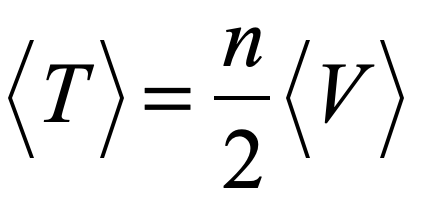
for cases where the potential energy V has power law dependence V ≈ rn.  The harmonic oscillator has n = 2, leading to the well-known equality between average kinetic and potential energy as
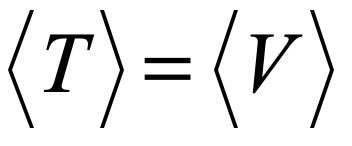
The inverse square force law has a potential that varies with n = -1, leading to the flip in sign.  For instance, for a circular orbit in gravitation, it looks like
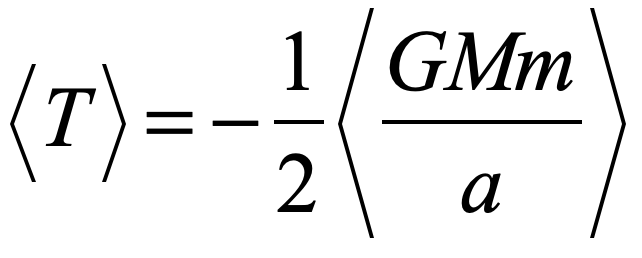
and in electrostatics it looks like
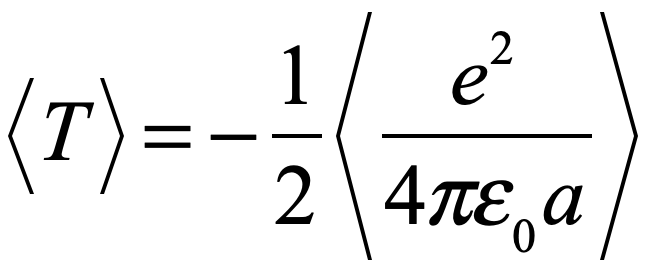
where a is the radius of the orbit. 

Yet orbital mechanics is hardly the only place where the Virial Theorem pops up.  It began its life with statistical mechanics.

Rudolph Clausius and his Virial Theorem

The pantheon of physics is a somewhat exclusive club.  It lets in the likes of Galileo, Lagrange, Maxwell, Boltzmann, Einstein, Feynman and Hawking, but it excludes many worthy candidates, like Gilbert, Stevin, Maupertuis, du Chatelet, Arago, Clausius, Heaviside and Meitner all of whom had an outsized influence on the history of physics, but who often do not get their due.  Of this later group, Rudolph Clausius stands above the others because he was an inventor of whole new worlds and whole new terminologies that permeate physics today.

Within the German Confederation dominated by Prussia in the mid 1800’s, Clausius was among the first wave of the “modern” physicists who emerged from new or reorganized German universities that integrated mathematics with practical topics.  Carl Neumann at Königsberg, Carl Gauss and Max Weber at Göttingen, and Hermann von Helmholtz at Berlin were transforming physics from a science focused on pure mechanics and astronomy to one focused on materials and their associated phenomena, applying mathematics to these practical problems.

Clausius was educated at Berlin under Heinrich Gustav Magnus beginning in 1840, and he completed his doctorate at the University of Halle in 1847.  His doctoral thesis on light scattering in the atmosphere represented an early attempt at treating statistical fluctuations.  Though his initial approach was naïve, it helped orient Clausius to physics problems of statistical ensembles and especially to gases.  The sophistication of his physics matured rapidly and already in 1850 he published his famous paper Über die bewegende Kraft der Wärme, und die Gesetze, welche sich daraus für die Wärmelehre selbst ableiten lassen (About the moving power of heat and the laws that can be derived from it for the theory of heat itself). 
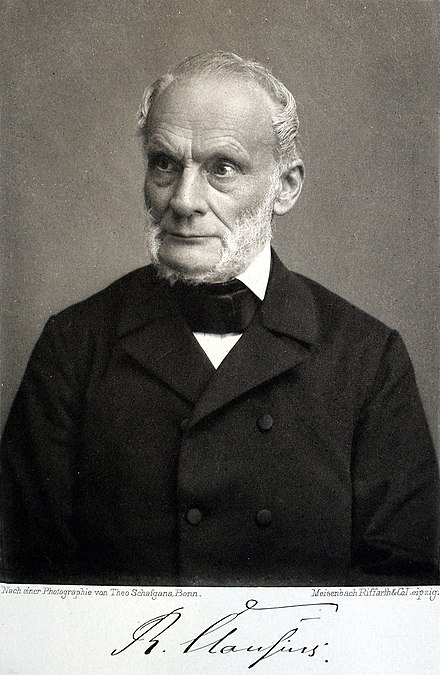
Rudolph Clausius
Fig. 1 Rudolph Clausius.

This was the fundamental paper that overturned the archaic theory of caloric, which had assumed that heat was a form of conserved quantity.  Clausius proved that this was not true, and he introduced what are today called the first and second laws of thermodynamics.  This early paper was one in which he was still striving to simplify thermodynamics, and his second law was mostly a qualitative statement that heat flows from higher temperatures to lower.  He refined the second law four years later in 1854 with Über eine veranderte Form des zweiten Hauptsatzes der mechanischen Wärmetheorie (On a modified form of the second law of the mechanical theory of heat).  He gave his concept the name Entropy in 1865 from the Greek word τροπη (transformation or change) with a prefix similar to Energy. 

Clausius was one of the first to consider the kinetic theory of heat where heat was understood as the average kinetic energy of the atoms or molecules that comprised the gas.  He published his seminal work on the topic in 1857 expanding on earlier work by Augustus Krönig.  Maxwell, in turn, expanded on Clausius in 1860 by introducing probability distributions.  By 1870, Clausius was fully immersed in the kinetic theory as he was searching for mechanical proofs of the second law of thermodynamics.  Along the way, he discovered a quantity based on action-reaction pairs of forces that was related to the kinetic energy.

At that time, kinetic energy was often called vis viva, meaning “living force”.  The singular of force (vis) had a plural (virias), so Clausius—always happy to coin new words—called the action-reaction pairs of forces the virial, and hence he proved the Virial Theorem.

The argument is relatively simple.  Consider the action of a single molecule of the gas subject to a force F that is applied reciprocally from another molecule.  Also, for simplicity consider only a single direction in the gas.  The change of the action over time is given by the derivative

The average over all action-reaction pairs is
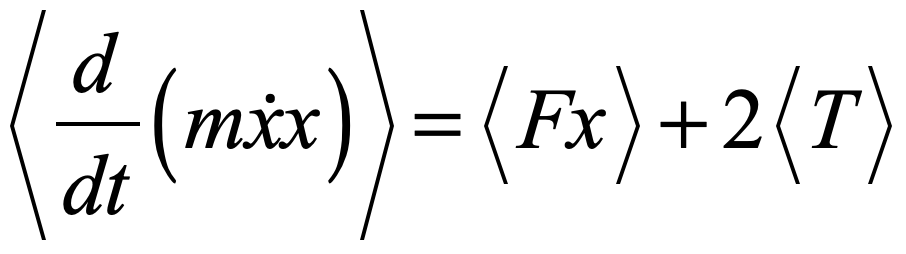
but by the reciprocal nature of action-reaction pairs, the left-hand side balances exactly to zero, giving
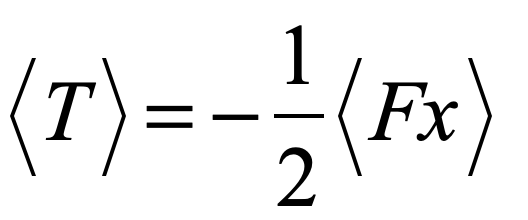
This expression is expanded to include the other directions and to all N bodies to yield the Virial Theorem
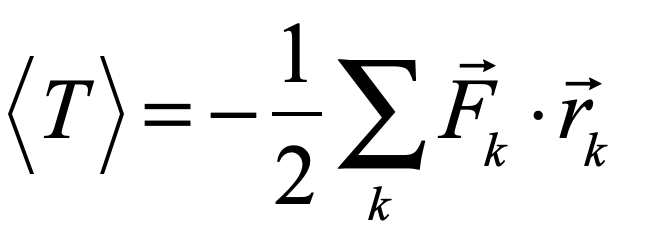
where the sum is over all molecules in the gas, and Clausius called the term on the right the Virial.

An important special case is when the force law derives from a power law
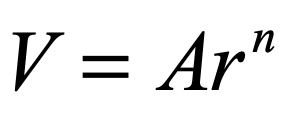
Then the Virial Theorem becomes (again in just one dimension)
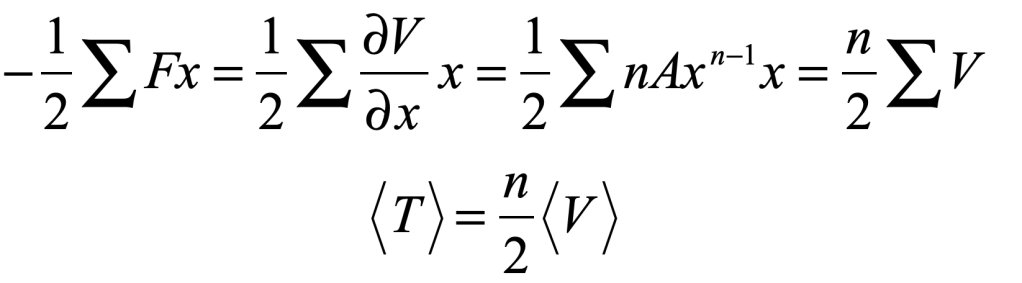
This is often the most useful form of the theorem.  For a spring force, it leads to <T> = <V>.  For gravitational or electrostatic orbits it is  <T> = -1/2<V>.

The Virial in Astrophysics

Clausius originally developed the Virial Theorem for the kinetic theory of gases, but it has applications that go far beyond.  It is already useful for simple orbital systems like masses interacting through central forces, and these can be scaled up to N-body systems like star clusters or galaxies.

Star clusters are groups of hundreds or thousands of stars that are gravitationally bound.  Such a cluster may begin in a highly non-equilibrium configuration, but the mutual interactions among the stars causes a relaxation to an equilibrium configuration of positions and velocities.  This process is known as Virialization.  The time scale for virializaiton depends on the number of stars and on the initial configuration, such as whether there is a net angular momentum in the cluster.

A gravitational simulation of 700 stars is shown in Fig. 2. The stars are distributed uniformly with zero velocities. The cluster collapses under gravitational attraction, rebounds and approaches a steady state. The Virial Theorem applies at long times. The simulation assumed all motion was in the plane, and a regularization term was added to the gravitational potential to keep forces bounded.

Simulation of the virial theorem for a star cluster with kinetic and potential energy graphs
Fig. 2 A numerical example of the Virial Theorem for a star cluster of 700 stars beginning in a uniform initial state, collapsing under gravitational attraction, rebounding and then approaching a steady state. The kinetic energy and the potential energy of the system satisfy the Virial Theorem at long times.

The Virial in Quantum Physics

Quantum theory holds strong analogs to classical mechanics.  For instance, the quantum commutation relations have strong similarities to Poisson Brackets.  Similarly, the Virial in classical physics has a direct quantum analog.

Begin with the commutator between the Hamiltonian H and the action composed as the product of the position operator and the momentum operator XnPn

Expand the two commutators on the right to give
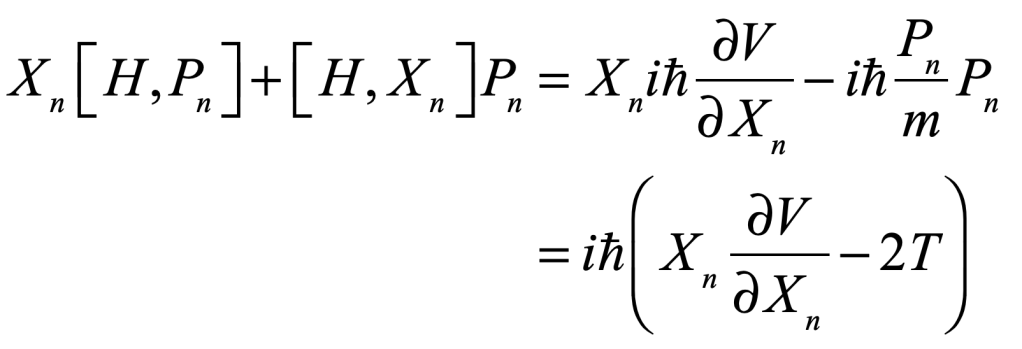
Now recognize that the commutator with the Hamiltonian is Ehrenfest’s Theorem on the time dependence of the operators
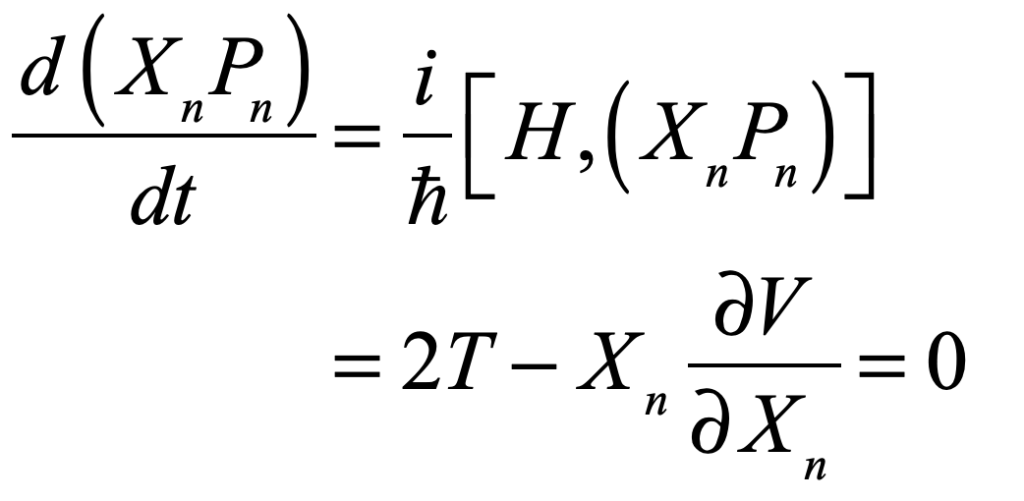
which equals zero when the system become stationary or steady state.  All that remains is to take the expectation value of the equation (which can include many-body interactions as well)

which is the quantum form of the Virital Theorem which is identical to the classical form when the expectation value is replaced by the ensemble average.

For the hydrogen atom this is
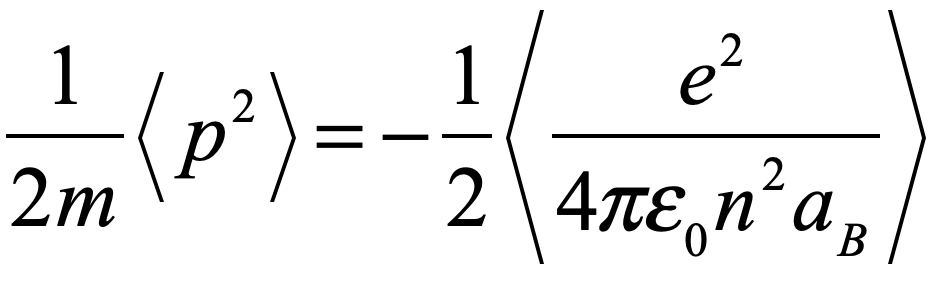
for principal quantum number n and Bohr radius aB.  The quantum energy levels of the hydrogen atom are
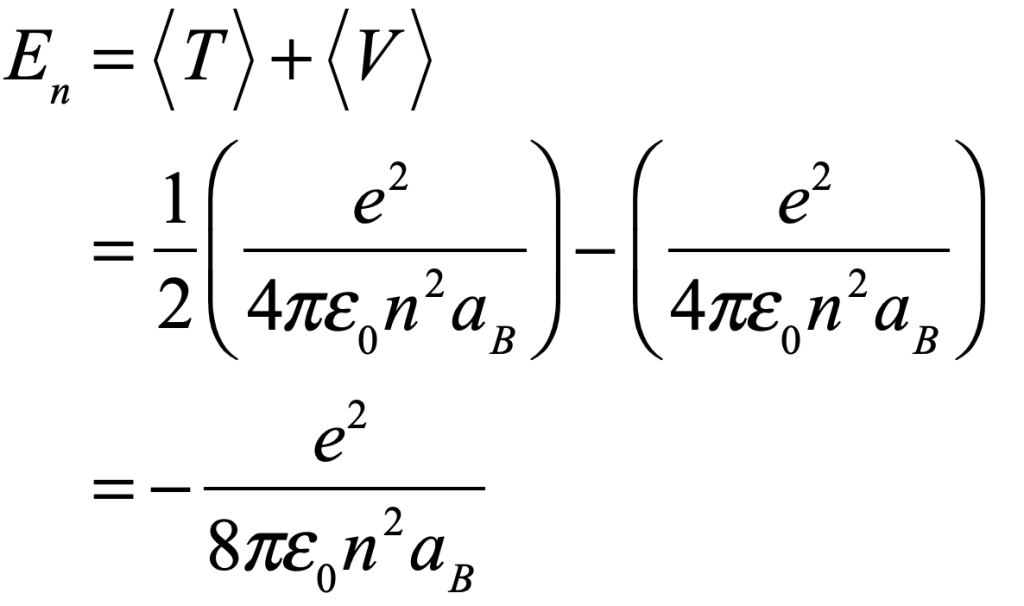
By David D. Nolte, July 24, 2024

References

“Ueber die bewegende Kraft der Warme and die Gesetze welche sich daraus für die Warmelehre selbst ableiten lassen,” in Annalen der Physik, 79 (1850), 368–397, 500–524.

Über eine veranderte Form des zweiten Hauptsatzes der mechanischen Wärmetheorie, Annalen der Physik, 93 (1854), 481–506.

Ueber die Art der Bewegung, welche wir Warmenennen, Annalen der Physik, 100 (1857), 497–507.

Clausius, RJE (1870). “On a Mechanical Theorem Applicable to Heat”. Philosophical Magazine. Series 4. 40 (265): 122–127.

Matlab Code

function [y0,KE,Upoten,TotE] = Nbody(N,L)   %500, 100, 0

A = -1;        % Grav factor
eps = 1;        % 0.1
K = 0.00001;    %0.000025

format compact

mov_flag = 1;
if mov_flag == 1
    moviename = 'DrawNMovie';
    aviobj = VideoWriter(moviename,'MPEG-4');
    aviobj.FrameRate = 10;
    open(aviobj);
end

hh = colormap(jet);
%hh = colormap(gray);
rie = randintexc(255,255);       % Use this for random colors
%rie = 1:64;                     % Use this for sequential colors
for loop = 1:255
    h(loop,:) = hh(rie(loop),:);
end
figure(1)
fh = gcf;
clf;
set(gcf,'Color','White')
axis off

thet = 2*pi*rand(1,N);
rho = L*sqrt(rand(1,N));
X0 = rho.*cos(thet);
Y0 = rho.*sin(thet);

Vx0 = 0*Y0/L;   %1.5 for 500   2.0 for 700
Vy0 = -0*X0/L;
% X0 = L*2*(rand(1,N)-0.5);
% Y0 = L*2*(rand(1,N)-0.5);
% Vx0 = 0.5*sign(Y0);
% Vy0 = -0.5*sign(X0);
% Vx0 = zeros(1,N);
% Vy0 = zeros(1,N);

for nloop = 1:N
    y0(nloop) = X0(nloop);
    y0(nloop+N) = Y0(nloop);
    y0(nloop+2*N) = Vx0(nloop);
    y0(nloop+3*N) = Vy0(nloop);
end

T = 300;  %500
xp = zeros(1,N); yp = zeros(1,N);

for tloop = 1:T
    tloop
    
    delt = 0.005;
    tspan = [0 loop*delt];
    opts = odeset('RelTol',1e-2,'AbsTol',1e-5);
    [t,y] = ode45(@f5,tspan,y0,opts);
    
    %%%%%%%%% Plot Final Positions
    
    [szt,szy] = size(y);
    
    % Set nodes
    ind = 0; xpold = xp; ypold = yp;
    for nloop = 1:N
        ind = ind+1;
        xp(ind) = y(szt,ind+N);
        yp(ind) = y(szt,ind);
    end
    delxp = xp - xpold;
    delyp = yp - ypold;
    maxdelx = max(abs(delxp));
    maxdely = max(abs(delyp));
    maxdel = max(maxdelx,maxdely);
    
    rngx = max(xp) - min(xp);
    rngy = max(yp) - min(yp);
    maxrng = max(abs(rngx),abs(rngy));
    
    difepmx = maxdel/maxrng;
    
    crad = 2.5;
    subplot(1,2,1)
    gca;
    cla;
    
    % Draw nodes
    for nloop = 1:N
        rn = rand*63+1;
        colorval = ceil(64*nloop/N);
        
        rectangle('Position',[xp(nloop)-crad,yp(nloop)-crad,2*crad,2*crad],...
            'Curvature',[1,1],...
            'LineWidth',0.1,'LineStyle','-','FaceColor',h(colorval,:))
        
    end
    
    [syy,sxy] = size(y);
    y0(:) = y(syy,:);
    
    rnv = (2.0 + 2*tloop/T)*L;    % 2.0   1.5
    
    axis equal
    axis([-rnv rnv -rnv rnv])
    box on
    drawnow
    pause(0.01)
    
    KE = sum(y0(2*N+1:4*N).^2);
    
    Upot = 0;
    for nloop = 1:N
        for mloop = nloop+1:N
            dx = y0(nloop)-y0(mloop);
            dy = y0(nloop+N) - y0(mloop+N);
            dist = sqrt(dx^2+dy^2+eps^2);
            Upot = Upot + A/dist;
        end
    end
    
    Upoten = Upot;
    
    TotE = Upoten + KE;
    
    if tloop == 1
        TotE0 = TotE;
    end

    Upotent(tloop) = Upoten;
    KEn(tloop) = KE;
    TotEn(tloop) = TotE;
    
    xx = 1:tloop;
    subplot(1,2,2)
    plot(xx,KEn,xx,Upotent,xx,TotEn,'LineWidth',3)
    legend('KE','Upoten','TotE')
    axis([0 T -26000 22000])     % 3000 -6000 for 500   6000 -8000 for 700
    
    
    fh = figure(1);
    
    if mov_flag == 1
        frame = getframe(fh);
        writeVideo(aviobj,frame);
    end
    
end

if mov_flag == 1
    close(aviobj);
end

%%%%%%%%%%%%%%%%%%%%%%%%%%%%%%%%%%%%%%%%%%
    function yd = f5(t,y)
        
        for n1loop = 1:N
            
            posx = y(n1loop);
            posy = y(n1loop+N);
            momx = y(n1loop+2*N);
            momy = y(n1loop+3*N);
            
            tempcx = 0; tempcy = 0;
            
            for n2loop = 1:N
                if n2loop ~= n1loop
                    cposx = y(n2loop);
                    cposy = y(n2loop+N);
                    cmomx = y(n2loop+2*N);
                    cmomy = y(n2loop+3*N);
                    
                    dis = sqrt((cposy-posy)^2 + (cposx-posx)^2 + eps^2);
                    CFx = 0.5*A*(posx-cposx)/dis^3 - 5e-5*momx/dis^4;
                    CFy = 0.5*A*(posy-cposy)/dis^3 - 5e-5*momy/dis^4;
                    
                    tempcx = tempcx + CFx;
                    tempcy = tempcy + CFy;
                    
                end
            end
                        
            ypp(n1loop) = momx;
            ypp(n1loop+N) = momy;
            ypp(n1loop+2*N) = tempcx - K*posx;
            ypp(n1loop+3*N) = tempcy - K*posy;
        end
        
        yd=ypp'; 
     
    end     % end f5

end     % end Nbody
Books by David D. Nolte at Oxford University Press
Read more in Books by David D. Nolte at Oxford University Press

Dark Matter Mysteries

There is more to the Universe than meets the eye—way more. Over the past quarter century, it has become clear that all the points of light in the night sky, the stars, the Milky Way, the nubulae, all the distant galaxies, when added up with the nonluminous dust, constitute only a small fraction of the total energy density of the Universe. In fact, “normal” matter, like the stuff of which we are made—star dust—contributes only 4% to everything that is. The rest is something else, something different, something that doesn’t show up in the most sophisticated laboratory experiments, not even the Large Hadron Collider [1]. It is unmeasurable on terrestrial scales, and even at the scale of our furthest probe—the Voyager I spacecraft that left our solar system several years ago—there have been no indications of deviations from Newton’s law of gravity. To the highest precision we can achieve, it is invisible and non-interacting on any scale smaller than our stellar neighborhood. Perhaps it can never be detected in any direct sense. If so, then how do we know it is there? The answer comes from galactic trajectories. The motions in and of galaxies have been, and continue to be, the principal laboratory for the investigation of  cosmic questions about the dark matter of the universe.

Today, the nature of Dark Matter is one of the greatest mysteries in physics, and the search for direct detection of Dark Matter is one of physics’ greatest pursuits.

Island Universes

The nature of the Milky Way was a mystery through most of human history. To the ancient Greeks it was the milky circle (γαλαξίας κύκλος , pronounced galaktikos kyklos) and to the Romans it was literally the milky way (via lactea). Aristotle, in his Meteorologica, briefly suggested that the Milky Way might be composed of a large number of distant stars, but then rejected that idea in favor of a wisp, exhaled like breath on a cold morning, from the stars. The Milky Way is unmistakable on a clear dark night to anyone who looks up, far away from city lights. It was a constant companion through most of human history, like the constant stars, until electric lights extinguished it from much of the world in the past hundred years. Geoffrey Chaucer, in his Hous of Fame (1380) proclaimed “See yonder, lo, the Galaxyë Which men clepeth the Milky Wey, For hit is whyt.” (See yonder, lo, the galaxy which men call the Milky Way, for it is white.).

474336main_p1024ay_full

Hubble image of one of the galaxies in the Coma Cluster of galaxies that Fritz Zwicky used to announce that the universe contained a vast amount of dark matter.

Aristotle was fated, again, to be corrected by Galileo. Using his telescope in 1610, Galileo was the first to resolve a vast field of individual faint stars in the Milky Way. This led Emmanual Kant, in 1755, to propose that the Milky Way Galaxy was a rotating disk of stars held together by Newtonian gravity like the disk of the solar system, but much larger. He went on to suggest that the faint nebulae might be other far distant galaxies, which he called “island universes”. The first direct evidence that nebulae were distant galaxies came in 1917 with the observation of a supernova in the Andromeda Galaxy by Heber Curtis. Based on the brightness of the supernova, he estimated that the Andromeda Galaxy was over a million light years away, but uncertainty in the distance measurement kept the door open for the possibility that it was still part of the Milky Way, and hence the possibility that the Milky Way was the Universe.

The question of the nature of the nebulae hinged on the problem of measuring distances across vast amounts of space. By line of sight, there is no yard stick to tell how far away something is, so other methods must be used. Stellar parallax, for instance, can gauge the distance to nearby stars by measuring slight changes in the apparent positions of the stars as the Earth changes its position around the Sun through the year. This effect was used successfully for the first time in 1838 by Fredrich Bessel, and by the year 2000 more than a hundred thousand stars had their distances measured using stellar parallax. Recent advances in satellite observatories have extended the reach of stellar parallax to a distance of about 10,000 light years from the Sun, but this is still only a tenth of the diameter of the Milky Way. To measure distances to the far side of our own galaxy, or beyond, requires something else.

Because of Henrietta Leavitt

In 1908 Henrietta Leavitt, working at the Harvard Observatory as one of the famous female “computers”, discovered that stars whose luminosities oscillate with a steady periodicity, stars known as Cepheid variables, have a relationship between the period of oscillation and the average luminosity of the star [2]. By measuring the distance to nearby Cepheid variables using stellar parallax, the absolute brightness of the Cepheid could be calibrated, and the Cepheid could then be used as “standard candles”. This meant that by observing the period of oscillation and the brightness of a distant Cepheid, the distance to the star could be calculated. Edwin Hubble (1889 – 1953), working at the Mount Wilson observatory in Passedena CA, observed Cepheid variables in several of the brightest nebulae in the night sky. In 1925 he announced his observation of individual Cepheid variables in Andromeda and calculated that Andromeda was more than a million light years away, more than 10 Milky Way diameters (the actual number is about 25 Milky Way diameters). This meant that Andromeda was a separate galaxy and that the Universe was made of more than just our local cluster of stars. Once this door was opened, the known Universe expanded quickly up to a hundred Milky Way diameters as Hubble measured the distances to scores of our neighboring galaxies in the Virgo galaxy cluster. However, it was more than just our knowledge of the universe that was expanding.

Armed with measurements of galactic distances, Hubble was in a unique position to relate those distances to the speeds of the galaxies by combining his distance measurements with spectroscopic observations of the light spectra made by other astronomers. These galaxy emission spectra could be used to measure the Doppler effect on the light emitted by the stars of the galaxy. The Doppler effect, first proposed by Christian Doppler (1803 – 1853) in 1843, causes the wavelength of emitted light to be shifted to the red for objects receding from an observer, and shifted to the blue for objects approaching an observer. The amount of spectral shift is directly proportional the the object’s speed. Doppler’s original proposal was to use this effect to measure the speed of binary stars, which is indeed performed routinely today by astronomers for just this purpose, but in Doppler’s day spectroscopy was not precise enough to accomplish this. However, by the time Hubble was making his measurements, optical spectroscopy had become a precision science, and the Doppler shift of the galaxies could be measured with great accuracy. In 1929 Hubble announced the discovery of a proportional relationship between the distance to the galaxies and their Doppler shift. What he found was that the galaxies [3] are receding from us with speeds proportional to their distance [4]. Hubble himself made no claims at that time about what these data meant from a cosmological point of view, but others quickly noted that this Hubble effect could be explained if the universe were expanding.

Einstein’s Mistake

The state of the universe had been in doubt ever since Heber Curtis observed the supernova in the Andromeda galaxy in 1917. Einstein published a paper that same year in which he sought to resolve a problem that had appeared in the solution to his field equations. It appeared that the universe should either be expanding or contracting. Because the night sky literally was the firmament, it went against the mentality of the times to think of the universe as something intrinsically unstable, so Einstein fixed it with an extra term in his field equations, adding something called the cosmological constant, denoted by the Greek lambda (Λ). This extra term put the universe into a static equilibrium, and Einstein could rest easy with his firm trust in the firmament. However, a few years later, in 1922, the Russian physicist and mathematician Alexander Friedmann (1888 – 1925) published a paper that showed that Einstein’s static equilibrium was actually unstable, meaning that small perturbations away from the current energy density would either grow or shrink. This same result was found independently by the Belgian astronomer Georges Lemaître in 1927, who suggested that not only was the universe  expanding, but that it had originated in a singular event (now known as the Big Bang). Einstein was dismissive of Lemaître’s proposal and even quipped “Your calculations are correct, but your physics is atrocious.” [5] But after Hubble published his observation on the red shifts of galaxies in 1929, Lemaître pointed out that the redshifts would be explained by an expanding universe. Although Hubble himself never fully adopted this point of view, Einstein immediately saw it for what it was—a clear and simple explanation for a basic physical phenomenon that he had foolishly overlooked. Einstein retracted his cosmological constant in embarrassment and gave his support to Lemaître’s expanding universe. Nonetheless, Einstein’s physical intuition was never too far from the mark, and the cosmological constant has been resurrected in recent years in the form of Dark Energy. However, something else, both remarkable and disturbing, reared its head in the intervening years—Dark Matter.

Fritz Zwicky: Gadfly Genius

It is difficult to write about important advances in astronomy and astrophysics of the 20th century without tripping over Fritz Zwicky. As the gadfly genius that he was, he had a tendency to shoot close to the mark, or at least some of his many crazy ideas tended to be right. He was also in the right place at the right time, at the Mt. Wilson observatory nearby Cal Tech with regular access the World’s largest telescope. Shortly after Hubble proved that the nebulae were other galaxies and used Doppler shifts to measure their speeds, Zwicky (with his assistant Baade) began a study of as many galactic speeds and distances as they could. He was able to construct a three-dimensional map of the galaxies in the relatively nearby Coma galaxy cluster, together with their velocities. He then deduced that the galaxies in this isolated cluster were gravitational bound to each other, performing a whirling dance in each others thrall, like stars in globular star clusters in our Milky Way. But there was a serious problem.

Star clusters display average speeds and average gravitational potentials that are nicely balanced, a result predicted from a theorem of mechanics that was named the Virial Theorem by Rudolf Clausius in 1870. The Virial Theorem states that the average kinetic energy of a system of many bodies is directly related to the average potential energy of the system. By applying the Virial Theorem to the galaxies of the Coma cluster, Zwicky found that the dynamics of the galaxies were badly out of balance. The galaxy kinetic energies were far too fast relative to the gravitational potential—so fast, in fact, that the galaxies should have flown off away from each other and not been bound at all. To reconcile this discrepancy of the galactic speeds with the obvious fact that the galaxies were gravitationally bound, Zwicky postulated that there was unobserved matter present in the cluster that supplied the missing gravitational potential. The amount of missing potential was very large, and Zwicky’s calculations predicted that there was 400 times as much invisible matter, which he called “dark matter”, as visible. With his usual flare for the dramatic, Zwicky announced his findings to the World in 1933, but the World shrugged— after all, it was just Zwicky.

Nonetheless, Zwicky’s and Baade’s observations of the structure of the Coma cluster, and the calculations using the Virial Theorem, were verified by other astronomers. Something was clearly happening in the Coma cluster, but other scientists and astronomers did not have the courage or vision to make the bold assessment that Zwicky had. The problem of the Coma cluster, and a growing number of additional galaxy clusters that have been studied during the succeeding years, was to remain a thorn in the side of gravitational theory through half a century, and indeed remains a thorn to the present day. It is an important clue to a big question about the nature of gravity, which is arguably the least understood of the four forces of nature.

Vera Rubin: Galaxy Rotation Curves

Galactic clusters are among the largest coherent structures in the observable universe, and there are many questions about their origin and dynamics. Smaller gravitationally bound structures that can be handled more easily are individual galaxies themselves. If something important was missing in the dynamics of galactic clusters, perhaps the dynamics of the stars in individual galaxies could help shed light on the problem. In the late 1960’s and early 1970’s Vera Rubin at the Carnegie Institution of Washington used newly developed spectrographs to study the speeds of stars in individual galaxies. From simple Newtonian dynamics it is well understood that the speed of stars as a function of distance from the galactic center should increase with increasing distance up to the average radius of the galaxy, and then should decrease at larger distances. This trend in speed as a function of radius is called a rotation curve. As Rubin constructed the rotation curves for many galaxies, the increase of speed with increasing radius at small radii emerged as a clear trend, but the stars farther out in the galaxies were all moving far too fast. In fact, they are moving so fast that they exceeded escape velocity and should have flown off into space long ago. This disturbing pattern was repeated consistently in one rotation curve after another.

A simple fix to the problem of the rotation curves is to assume that there is significant mass present in every galaxy that is not observable either as luminous matter or as interstellar dust. In other words, there is unobserved matter, dark matter, in all galaxies that keeps all their stars gravitationally bound. Estimates of the amount of dark matter needed to fix the velocity curves is about five times as much dark matter as observable matter. This is not the same factor of 400 that Zwicky had estimated for the Coma cluster, but it is still a surprisingly large number. In short, 80% of the mass of a galaxy is not normal. It is neither a perturbation nor an artifact, but something fundamental and large. In fact, there is so much dark matter in the Universe that it must have a major effect on the overall curvature of space-time according to Einstein’s field equations. One of the best probes of the large-scale structure of the Universe is the afterglow of the Big Bang, known as the cosmic microwave background (CMB).

The Big Bang

The Big Bang was incredibly hot, but as the Universe expanded, its temperature cooled. About 379,000 years after the Big Bang, the Universe cooled sufficiently that the electron-nucleon plasma that filled space at that time condensed primarily into hydrogen. Plasma is charged and hence is opaque to photons.  Hydrogen, on the other hand, is neutral and transparent. Therefore, when the hydrogen condensed, the thermal photons suddenly flew free, unimpeded, and have continued unimpeded, continuing to cool, until today the thermal glow has reached about three degrees above absolute zero. Photons in thermal equilibrium with this low temperature have an average wavelength of a few millimeters corresponding to microwave frequencies, which is why the afterglow of the Big Bang got its CMB name.

The CMB is amazingly uniform when viewed from any direction in space, but it is not perfectly uniform. At the level of 0.005 percent, there are variations in the temperature depending on the location on the sky. These fluctuations in background temperature are called the CMB anisotropy, and they play an important role helping to interpret current models of the Universe. For instance, the average angular size of the fluctuations is related to the overall curvature of the Universe. This is because in the early Universe not all parts of it were in communication with each other because of the finite size and the finite speed of light. This set an original spatial size to thermal discrepancies. As the Universe continued to expand, the size of the regional variations expanded with it, and the sizes observed today would appear larger or smaller, depending on how the universe is curved. Therefore, to measure the energy density of the Universe, and hence to find its curvature, required measurements of the CMB temperature that were accurate to better than a part in 10,000.

Andrew Lange and Paul Richards: The Lambda and the Omega

In graduate school at Berkeley in 1982, my first graduate research assistantship was in the group of Paul Richards, one of the world leaders in observational cosmology. One of his senior graduate students at the time, Andrew Lange, was sharp and charismatic and leading an ambitious project to measure the cosmic background radiation on an experiment borne by a Japanese sounding rocket. My job was to create a set of far-infrared dichroic beamsplitters for the spectrometer.   A few days before launch, a technician noticed that the explosive bolts on the rocket nose-cone had expired. When fired, these would open the cone and expose the instrument at high altitude to the CMB. The old bolts were duly replaced with fresh ones. On launch day, the instrument and the sounding rocket worked perfectly, but the explosive bolts failed to fire, and the spectrometer made excellent measurements of the inside of the nose cone all the way up and all the way down until it sank into the Pacific Ocean. I left Paul’s comology group for a more promising career in solid state physics under the direction of Eugene Haller and Leo Falicov, but Paul and Andrew went on to great fame with high-altitude balloon-borne experiments that flew at 40,000 feet, above most of the atmosphere, to measure the CMB anisotropy.

By the late nineties, Andrew was established as a professor at Cal Tech. He was co-leading an experiment called BOOMerANG that flew a high-altitude balloon around Antarctica, while Paul was leading an experiment called MAXIMA that flew a balloon from Palastine, Texas. The two experiments had originally been coordinated together, but operational differences turned the former professor/student team into competitors to see who would be the first to measure the shape of the Universe through the CMB anisotropy.  BOOMerANG flew in 1997 and again in 1998, followed by MAXIMA that flew in 1998 and again in 1999. In early 2000, Andrew and the BOOMerANG team announced that the Universe was flat, confirmed quickly by an announcement by MAXIMA [BoomerMax]. This means that the energy density of the Universe is exactly critical, and there is precisely enough gravity to balance the expansion of the Universe. This parameter is known as Omega (Ω).  What was perhaps more important than this discovery was the announcement by Paul’s MAXIMA team that the amount of “normal” baryonic matter in the Universe made up only about 4% of the critical density. This is a shockingly small number, but agreed with predictions from Big Bang nucleosynthesis. When combined with independent measurements of Dark Energy known as Lambda (Λ), it also meant that about 25% of the energy density of the Universe is made up of Dark Matter—about five times more than ordinary matter. Zwicky’s Dark Matter announcement of 1933, virtually ignored by everyone, had been 75 years ahead of its time [6].

Dark Matter Pursuits

Today, the nature of Dark Matter is one of the greatest mysteries in physics, and the search for direct detection of Dark Matter is one of physics’ greatest pursuits. The indirect evidence for Dark Matter is incontestable—the CMB anisotropy, matter filaments in the early Universe, the speeds of galaxies in bound clusters, rotation curves of stars in Galaxies, gravitational lensing—all of these agree and confirm that most of the gravitational mass of the Universe is Dark. But what is it? The leading idea today is that it consists of weakly interacting particles, called cold dark matter (CDM). The dark matter particles pass right through you without ever disturbing a single electron. This is unlike unseen cosmic rays that are also passing through your body at the rate of several per second, leaving ionized trails like bullet holes through your flesh. Dark matter passes undisturbed through the entire Earth. This is not entirely unbelievable, because neutrinos, which are part of “normal” matter, also mostly pass through the Earth without interaction. Admittedly, the physics of neutrinos is not completely understood, but if ordinary matter can interact so weakly, then dark matter is just more extreme and perhaps not so strange. Of course, this makes detection of dark matter a big challenge. If a particle exists that won’t interact with anything, then how would you ever measure it? There are a lot of clever physicists with good ideas how to do it, but none of the ideas are easy, and none have worked yet.

[1] As of the writing of this chapter, Dark Matter has not been observed in particle form, but only through gravitational effects at large (galactic) scales.

[2] Leavitt, Henrietta S. “1777 Variables in the Magellanic Clouds”. Annals of Harvard College Observatory. LX(IV) (1908) 87-110

[3] Excluding the local group of galaxies that include Andromeda and Triangulum that are gravitationally influenced by the Milky Way.

[4] Hubble, Edwin (1929). “A relation between distance and radial velocity among extra-galactic nebulae”. PNAS 15 (3): 168–173.

[5] Deprit, A. (1984). “Monsignor Georges Lemaître”. In A. Barger (ed). The Big Bang and Georges Lemaître. Reidel. p. 370.

[6] I was amazed to read in Science magazine in 2004 or 2005, in a section called “Nobel Watch”, that Andrew Lange was a candidate for the Nobel Prize for his work on BoomerAng.  Around that same time I invited Paul Richards to Purdue to give our weekly physics colloquium.  There was definitely a buzz going around that the BoomerAng and MAXIMA collaborations were being talked about in Nobel circles.  The next year, the Nobel Prize of 2006 was indeed awarded for work on the Cosmic Microwave Background, but to Mather and Smoot for their earlier work on the COBE satellite.