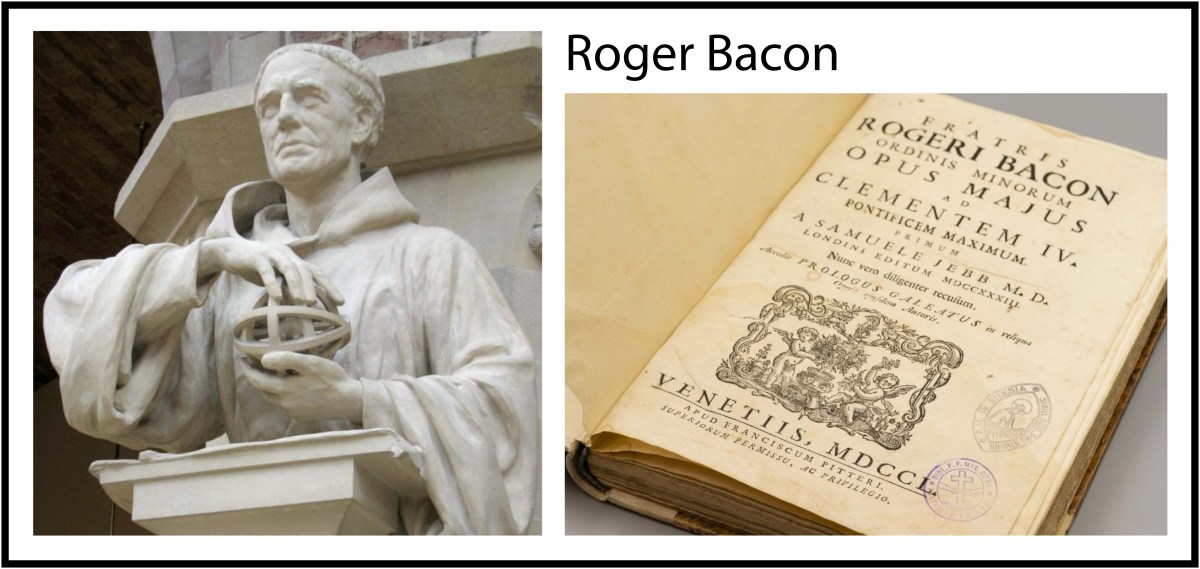
Roger Bacon and his Opus Majus

Roger Bacon and the Art of Grant Proposal Writing

It’s amazing what a little house arrest can do for the active mind. It provides time and focus as well as protection from earthly distractions that dissipate the intellect. How much more productive might we be if freed from the daily grind?

For Galileo Galilei, house arrest after ridiculing the pope gave him time to write his “Two New Sciences” that had been percolating in the back of his mind for decades. His arrest gave birth to the sciences of mechanics and strength of materials.

For Augustin Fresnel, house arrest after supporting royalists against Napoleon was the perfect retreat from building roads and bridges to explore the physics of light scattering and interference. His arrest gave birth to the physics of optical interference.

For Jean-Victor Poncelet, whiling away his time as a prisoner of war in Russia after Napoleon’s disastrous march on Moscow, it kept him occupied and sane. His confinement gave birth to the theory of projective geometry.

For Piotr Kapitsa, exiled under Stalin for not joining the Party, he could focus on his physics. His arrest gave birth to the physics of dynamic equilibrium.

For Roger Bacon (121? – 1292), the medieval Franciscan friar who was under effective house arrest (his monastic cell) and prohibited from publishing anything, his arrest gave birth to the first science grant proposal.

The Rise of Roger Bacon

More has been written about Roger Bacon that is fantasy than the truth. In truth, almost nothing is known of his background, other than that he came from a wealthy family. They paid for him to go to college, at the age of thirteen, at Oxford, where he studied until he received his magister’s degree around 1240. Because Oxford was a religious college, his degree allowed him to teach anywhere under the umbrella of the Catholic Church, whether in Bologna, Rome, Paris or Oxford. Latin was the universal language, and the Christian faith was the universal context of all the young universities, so that scholars could move at will among these great centers of learning, despite the constant wars that raged between England and France. Bacon began teaching at Oxford, but the university in Paris at that time removed their prohibition against the teaching of Aristotle’s science, so he was recruited in 1241 to teach science in the Faculty of Arts, in the English division of the University of Paris.

During his time in Paris, across seven years, starting when he was around 30 years old, he began to shift his perspective on the state of learning in the university system. At that time, scholarly discourse was based on creative citation of the authorities, much like discourse is in law, citing court cases and legal precedence. New ideas arose by finding ambiguities or contradictions in established texts and then arguing for a new theory that could explain or contain formerly conflicting points of view. This kind of learning was endlessly self-referential and backwards focused, never moving forward beyond the frontiers of what was known.

At Paris, he met Peter Peregrinus, whose open-mindedness came as a revelation to Bacon. Peregrinus was willing to study anything, no mater how arcane (even magic tricks), burrowing down to the finest detail to understand how it worked. This meant using direct observation in place of cited authorities as the foundation for creating new ideas that could explain what was observed. At the time this was a radical departure, because it meant that the realm of knowledge could be added to, not just refined. It also elevated the individual to the level of the ancient authorities in their ability to devine new truths about nature. These new attitudes about observation and experimentation were reinforced when Bacon returned to Oxford in 1247 where he was exposed to the ideas of Robert Grosseteste.

Grosseteste and Bacon at Oxford

Robert Grosseteste (1170 – 1251) was born poor but his brilliance must have been recognized early by some priest with influence, because his education was supported by the Church. He was educated at Oxford and began teaching there, rising through the ranks to become the Magister Scholarum (Master of the Schools … like Chancellor) of Oxford University in 1215, a position he held for six years. This high office allowed him a latitude of thought that would have been impossible in a lesser position, and he slowly changed the mindset at the university away from the verbal arguments of Scholasticism.

Teaching at Oxford focused on the quadrivium (geometry, arithmetic, music, and astronomy), which was not “science” as we would understand it today, but it had some of the ingredients. Grosseteste emphasized the importance of observation of nature to test theoretical predictions, and he enlisted geometry and arithmetic as tools to describe observations. These both were innovations over the previous Scholastic emphasis of pure reason divorced from direct experience (eperimentum). Grosseteste’s favorite topic for observation and experience was the natural behavior of light and optics, in part because the behavior of rays of light could be captured using geometry.

Grosseteste stepped down from the chancellory in 1221 to teach at Franciscan monasteries that were closely associated with university life. He was still teaching there at the time when Bacon entered Oxford, but it is not known if they ever had an association. By the time Bacon returned to Oxford in 1247, Grosseteste had moved on to become the Bishop of Lincoln, but his legacy of natural philosophy was firmly embedded in the mindset of the faculty teaching the quadrivium.

After arriving back at Oxford, Bacon embraced Grosseteste’s teachings and began systematically expanding on them. From Grosseteste, he adopted the need to validate theory by direct experience, to use of mathematics to describe phenomena, and he chose the study of light and optics as the prime example of the new approach. He used his access to his family’s wealth to buy an extremely large assortment of books and tables and instruments. The value of these purchases today would be in the range of a million dollars or so; it was a vast collection of academic value. He was an independent scholar, and independently wealthy, so it is hard to understand why, a few years later in 1251, he joined the Franciscan Order with its vow of severe poverty.

It may have been Grosseteste’s association with the Franciscans (although Grosseteste never joined the order himself), or the close association of the Franciscans with higher learning. It may also have been because Bacon was accumulating enemies as he pushed Grosseteste’s ideas to more radical extremes. Bacon was known to be arrogant and caustic, and his willingness to entertain new ideas, possibly going against traditional Church doctrine, was putting him more at risk at a time when deviating from doctrine could be physically dangerous. Joining the Franciscans might have been a sort of protection for him, though he would have had to give up his collection of books, tables and instruments because of the poverty vow. At first, this seemed a shrewd move, but in time it unravelled into a personal nightmare.
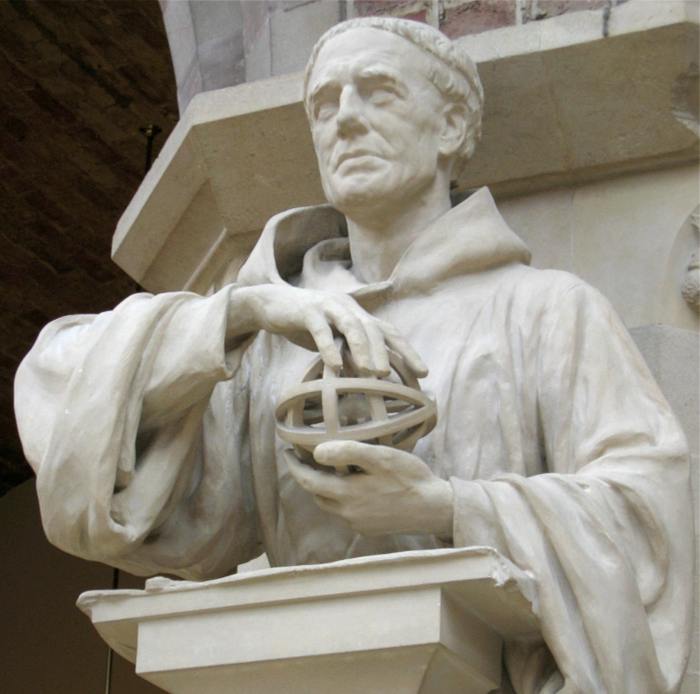
Statue of Roger Bacon at Oxford

Roger Bacon in Crisis

The Church has always been buffeted by the persistent emergence of heresies against doctrine, and it always has worked to stamp them out. Around the time of Bacon, the most dangerous heresy was Joachimism, or the heresy of the Eternal Gospel. It had strange ideas about the Apocolypse that did not sit well with Church teachings, so it was aggressively banned. Unfortunately, many Franciscan academics were in the thick of it, and they were also in a position to publish books about it. In 1256, only 5 years after joining the Franciscan order, the new leader of the order banned writing on any unsanctioned topic, trapping Bacon with no publishable outlet for his ideas. But that didn’t stop him from talking.

In 1264, the French lawyer and diplomat Cardinal Guy de Foulques was in England to mediate between Henry III and his barons who were on the edge of revolt over Henry’s abuse of power. During a quiet period in the negotiations, Bacon and de Foulques met and talked. It was a rare outlet for Bacon who had been pent up for years. He impressed de Foulques with his wide-ranging ideas about education reform to move beyond the stagnation of Scholasticism. Bacon argued for an emphasis on science and math as a way to uncover natures secrets, and he promoted the learning of languages (Arabic and Hebrew and Greek) to better learn from all the intellectual output of other cultures. It must have been a heady conversation, and Bacon was probably thrilled to have such an esteemed listener. But his own life was poised on disaster.

Three events collapsed Bacon’s world around him. First, despite de Fulques efforts, negotiations broke down and the Second Baron’s War broke out. Second, Bacon’s wealthy family supported the king but were overrun by the Barons and ruined. Third, Bacon and his ideas were now deemed too dangerous by his Franciscan superiors, and he was sent to a convent outside of Paris in effective house arrest as his days were filled with menial tasks purposely meant to exhaust him and give him no time to think.

One year into the war and into Bacon’s exile to Paris, Cardinal de Fulques was elected pope as Clement IV. He took up the mantel of Christ just as Christianity was in retreat on multiple fronts. In the northeast it was under assault by the terrifying and highly successful Mongol invasion, in the southwest by a military incursion into Spain from Moorish Morroco, and in the Levant by the Mamluk Sultanate as they recaptured the last Christian outposts from the Crusades. Clement needed help, and he never forgot his conversation with Bacon about how to use science and math to give the Christian forces the upper hand. At the time of their talk, Bacon had been so persuasive while pitching his ideas so hard, that Clement had walked away with the impression that it was all already written up. So he sent a letter to Bacon in Paris asking for an immediate report on the status of Bacon’s program. That letter was a trigger for one of the most astounding bursts of creative scholarship of the Middle Ages. It was also the trigger for what may be called the first scientific grant proposal.

Roger Bacon’s Opus

When the Pope’s letter arrived in Paris, Bacon was ten years into the Franciscan prohibition against publishing and two years into his sentence of menial labor. To respond to the Pope’s request was both a dream and nightmare. It was a dream, because it gave Bacon the ear of the most powerful person in Europe and an outlet for all his pent up ideas. It was a nightmare, because he had no time to do the work and no resources to accomplish it.

To create a manuscript in the 13th century was a long and expensive process that required funds to buy materials. His family had just been ruined financially in the Baron’s war, so he secretly turned to friends to help support the project. He also worked mostly at night while spending his days on all his duties at the convent.

His central thesis was clear: Christian forces were in retreat because their enemies had both technological and logistical superiority. To gain the upper hand in the fight required a reform of teaching across Europe. By better understanding the laws of nature through math and science, they could develop technologically superior weapons. By better understanding languages, they would have access to learning from other cultures. By better understanding moral philosophy, they would gain the advantage of the moral high ground.

To show how to put these ideas into practice, Bacon chose specific examples. He picked the study of optics (perspectiva) as a way to practice detailed observation and mathematical description of physical phenomena. He promoted the questioning of authority as a way to escape the ruts of old thinking, opening the mind to new possibilities. He championed astronomy and calendar reform to stop the seasons from drifting across the years and to improve logistic planning. He supported geography as a way to better understand where future threats might emerge.
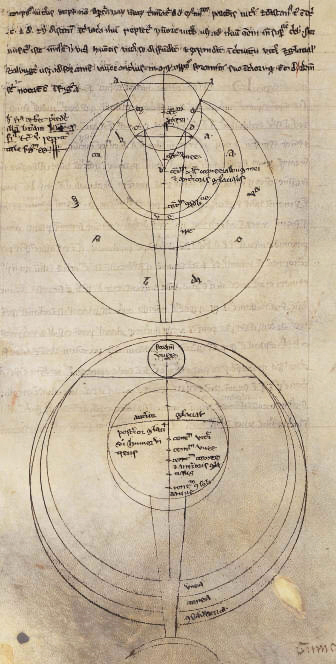
Roger Bacon’s optical studies.

In a little over one year, Bacon wrote four manuscripts that contained nearly a million words in total. To put that in perspective, a typical academic book published today has about 100,000 words. Therefore, Bacon wrote in one year the equivalent of about 10 academic books at a time without word processors and without paper, all written by hand in permanent ink on expensive parchment. This output was put into three works — the Opus Majus, the Opus Minus and the Opus Tertium — plus a fourth manuscript that was the first of its kind: the grant proposal.

The Letter on the Secret Works of Art and Nature

The primary purpose of Bacon’s response to the Pope was to ask him to fund research. The Opus, despite its massive size, was simply an outline that needed to be filled in, an activity that required time and money and freedom (as a way to escape his house arrest). Bacon was approaching the age of 50 and his time was running out. Life expectancy for someone who survived childhood in the 13th century was only about 55 years.

To clearly communicate the urgency of his program and the advantages that could be gained by adopting it, Bacon wrote Epistola de Secretis Operibus (Letter on the Secret Works of Art and Nature). He took out all the stops and let his imagination run free to describe what might be possible with applied physics.

Bacon envisioned machines that would move mechanically across land or water without the need for human power (automobiles and ships). He suggested other machines that could move secretly under water to surprise an enemy (submarines). He even imagined machines that could transport a man through the air, speeding him across a battlefield (airplanes). From the study of optics, he proposed the ability to make far things appear close (telescopes). From the study of mechanics, he envisioned bridges that could span great distances (suspension bridge), and systems that could support weights much larger than could be lifted by man (mechanical and civil engineering). And he gave the formula for a chemical mixture that could destroy the walls of cities (gunpowder).

The letter reads like the classic section of a grant proposal that lists potential benefits. He may have been looking far into the future, much farther than we do now when we write modern grant proposals, but his reasoning was surprisingly sound, based on the knowledge that would be gained by studying the laws of nature, i.e., science.

Unfortunately, shortly after Bacon secretly delivered his works to the Pope through a trusted student, the Pope died, possibly never having read any of it. Worse, Bacon was later imprisoned in Italy, placed in solitary confinement for ten years because of fear of his radical ideas. He was finally released, around the age of 80, never having accomplished his grand program. He died two years later at his beloved Oxford.
Why Do Librarians Hate Books?

Beware! 

If you love books, don’t read this post.  Close the tab and look away from the second burning of the Library of Alexandria.

If you love books, then run to your favorite library (if it is still there), and take out every book you have ever thought of.  Fill your rooms and offices with checked-out books, the older the better, and never, ever, return them.  Keep clicking on RENEW, for as long as they let you.

The librarians had paved paradise and put up a parking lot. 

If you love books, the kind of rare valueless books on topics only you care about, then Librarians—the former Jedi gatekeepers of knowledge—have turned to the dark side, deaccessioning the unpopular books in the stacks, pulling their loan cards like tomb stones, shipping the books away in unmarked boxes like body bags to large warehouses to be sold for pennies—and you may never see them again.

The End of Physics

Just a few years ago my university, with little warning and no consultation with the physics faculty, closed the heart and soul of the Physics Department—our Physics Library.  It was a bright warm space where we met colleagues, quietly discussing deep theories, a place to escape for a minute or two, or for an hour, to browse a book picked from the shelf of new acquisitions—always something unexpected you would never think to search for online.  But that wasn’t the best part.

The best part was the three floors above, filled with dark and dusty stacks that seemed to rise higher than the building itself.  This was where you found the gems—books so old or so arcane that when you pulled them from the shelf to peer inside, they sent you back, like a time machine, to an era when physicists thought differently—not wrong, but differently.  And your understanding of your own physics was changed, seen with a longer lens, showing you things that went deeper than you expected, and you emerged from the stacks a changed person.

And then it was gone. 

They didn’t even need the space.  At a university where space is always in high demand, and turf wars erupt between departments who try to steal space in each other’s buildings, the dark cavernous rooms of the ex-physics library stood empty for years as the powers at be tried to figure out what to do with it.

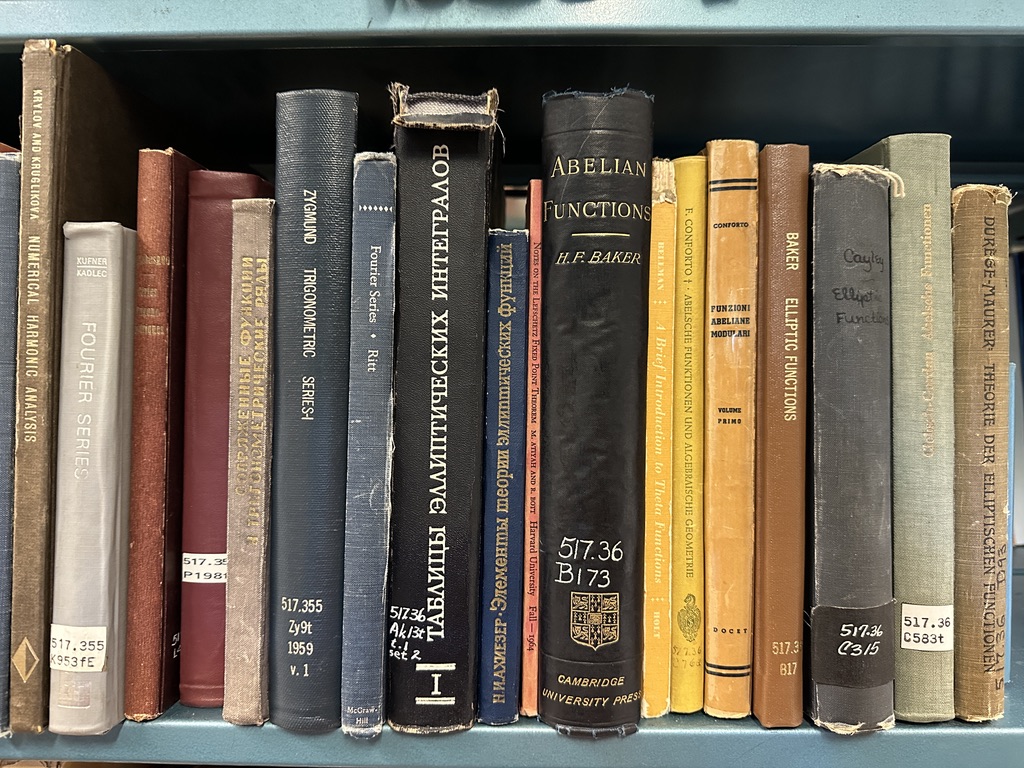
This is the way a stack in a university library should look. It was too late to take a picture of a stack in my physics library, so this is from the Math library … the only topical library still left at my university among the dozen that existed only a few years ago.

So, I determined to try to understand how a room that stood empty would be more valuable to a university than a room full of books.  What I discovered was at the same time both mundane and shocking.  Mundane, because it delves into the rules and regulations that govern how universities function.  Shocking, because it is a betrayal of the very mission of universities and university libraries.

How to Get Accreditation Without Really Trying

Little strikes fear in the heart of a college administrator like the threat of losing accreditation.  Accreditation is the stamp of approval that drives sales—sales of slots in the freshman incoming class.  Without accreditation, a college is nothing more than a bunch of buildings housing over-educated educators.  But with accreditation, the college has a mandate to educate and has the moral authority to mold the minds of the next generation.

In times past—not too long past—let’s say up to the end of the last millennium, to receive accreditation, a college or university would need to spend something around 3% of its operating budget on the upkeep of its libraries.  For a moderate-sized university library system, this was on the order of $20M per year.  The requirement was a boon to the librarians who kept a constant lookout for new books to buy to populate the beloved “new acquisitions” shelf.

Librarians reveled in their leverage over the university administrators: buy books or lose accreditation.  It was a powerful negotiating position to be in.  But all that changed in the early 2000’s.  Universities are always strapped for cash (despite tuition increases rising at two-times the rate of inflation) and the librarian’s $20M cash cow was a tempting target.  Universities are also powerful, running their billion-dollar-a-year operations, and they lobbied the very organizations that give the accreditations, convincing them to remove the requirement for the minimum library budget.  After all, in the digital world, who needs expensive buildings filled with books, the vast majority of which never get checked out?

The Deaccessioning Wars: Double Fold

Twenty some years ago, a bibliovisionary by the name of Nicholson Baker recognized the book armegeddon of his age and wrote about it in Double Fold: Libraries and the Assault on Paper (Vintage Books/Random House, 2001).  Libraries everywhere were in the midst of an orgy of deaccessioning.  To deaccession a book means to remove it from the card catalog (an anachronism) and ship it off to second-hand book dealers.  But it was worse than that.  Many of the books, as well as rare journals and rarer newspapers, were being “guillotined” by cutting out each page and scanning it into some kind of visual/digital format before pitching all the pages into the recycle bin. The argument in favor of guillotining is that all paper must eventually decay to dust (a false assumption). 

The way to test whether a book, or a newspaper, is on its way to dissolution is to do the double fold test on a corner of a page.  You fold the corner over then back the other way—double fold—and repeat.  The double-fold number of a book is how many double folds it takes for the little triangular piece to fall off.  Any number less than a selected threshold gives a librarian carte blanch to deaccession the book, and maybe to guillotine it, regardless of how the book may be valued.

Librarians generally hate Baker’s little book Double Fold because deaccessioning is always a battle.  Given finite shelf space, for every new acquisition, something old needs to go.  How do you choose?  Any given item might be valued by someone, so an objective test that removes all shades of gray is the double-fold.  It is a blunt instrument, one that Nicholas Baker abhorred, but it does make room for the new—if that is all that a university library is for.

As an aside, as I write this blog, my university library, which does not own a copy of Double Fold, and through which I had to request a copy via Interlibrary Loan (ILL), is threatening me with punitive action if I don’t relinquish it because it is a few weeks overdue.  If my library had actually owned a copy, I could have taken it out and kept it on my office shelf for years, as long as I kept hitting that “renew” button on the library page.  (On the other hand, my university does own a book by the archivist Cox who wrote a poorly argued screed to try to refute Baker.)

The End of Deep Knowledge

Baker is already twenty years out of date, although his message is more dire now than ever.  In his day, deaccessioning was driven by that problem of finite shelf space—one book out for one book in.  Today, when virtually all new acquisitions are digital, that argument is moot.  Yet the current rate at which books are disappearing from libraries, and libraries themselves are disappearing from campuses, is nothing short of cataclysmic, dwarfing the little double-fold problem that Baker originally railed against.

My university used to have a dozen specialized libraries scattered across campus, with the Physics Library one of them.  Now there are maybe three in total.  One of those is the Main Library which was an imposing space filled with the broadest range of topics and a truly impressive depth of coverage.  You could stand in front of any stack and find beautifully produced volumes (with high-quality paper that would never fail the double fold test) on beautifully detailed topics, going as deep as you could wish to the very foundations of knowledge.

I am a writer of the history of science and technology, and as I write, I often will form a very specific question about how a new idea emerged.  What was its context?  How did it break free of old mindsets?  Why was it just one individual who saw the path forward?  What made them special?

My old practice was to look up a few books in the library catalog that may or may not have the kinds of answers I was looking for, then walk briskly across campus to the associated library (great for exercise and getting a break from my computer).  I would scan across the call numbers on the spines of the books until I found the book I sought—and then I would step back and look at the whole stack. 

Without fail, I would find gems I never knew existed, sometimes three, four or five shelves away from the book I first sought.  They were often on topics I never would have searched online.  And to find those gems, I would take down book after book, scanning them quickly before returning them to the shelf (yes, I know, re-shelving is a no-no, but the whole stack would be emptied if I followed the rules) and moving to the next—something you could never do online.  In ten minutes, or maybe half an hour if I lost track of time, I would have three or four books crucial to my argument in the crook of my arm, ready to walk down the stairs to circulation to take them out.  Often, the book that launched my search was not even among them.

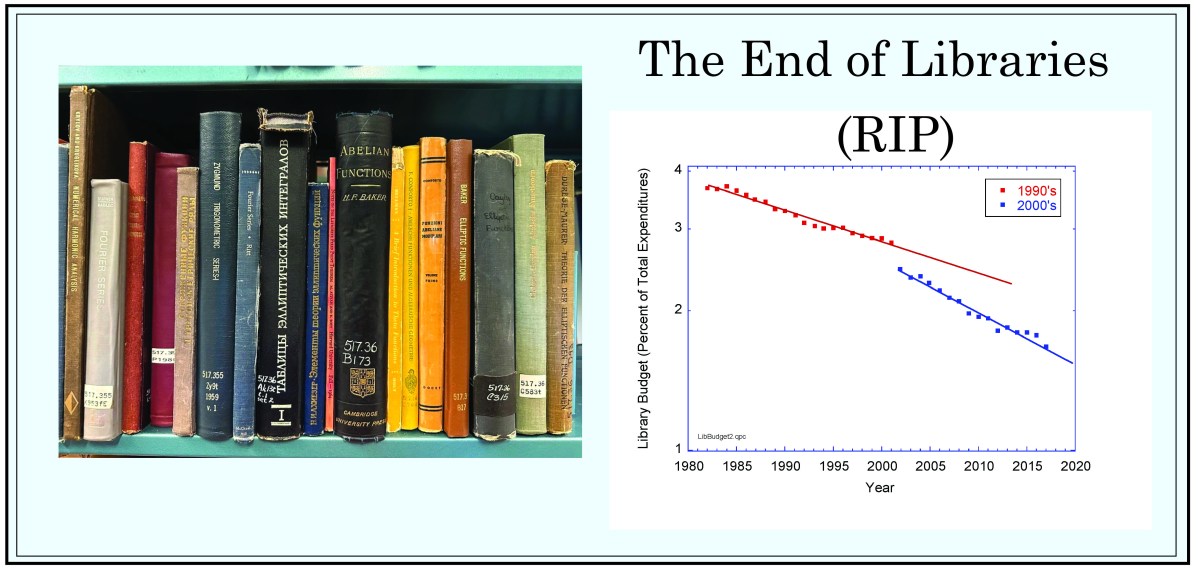
A photo from the imperiled Math Library. The publication dates of the books on this short shelf range from the 1870’s to the 1970’s. A historian of mathematics could spend a year mining the stories that these books tell.

I thought that certainly this main library was safe, and I was looking forward to years ahead of me, even past retirement, buried in its stacks, sleuthing out the mysteries of the evolution of knowledge.

And then it was gone.

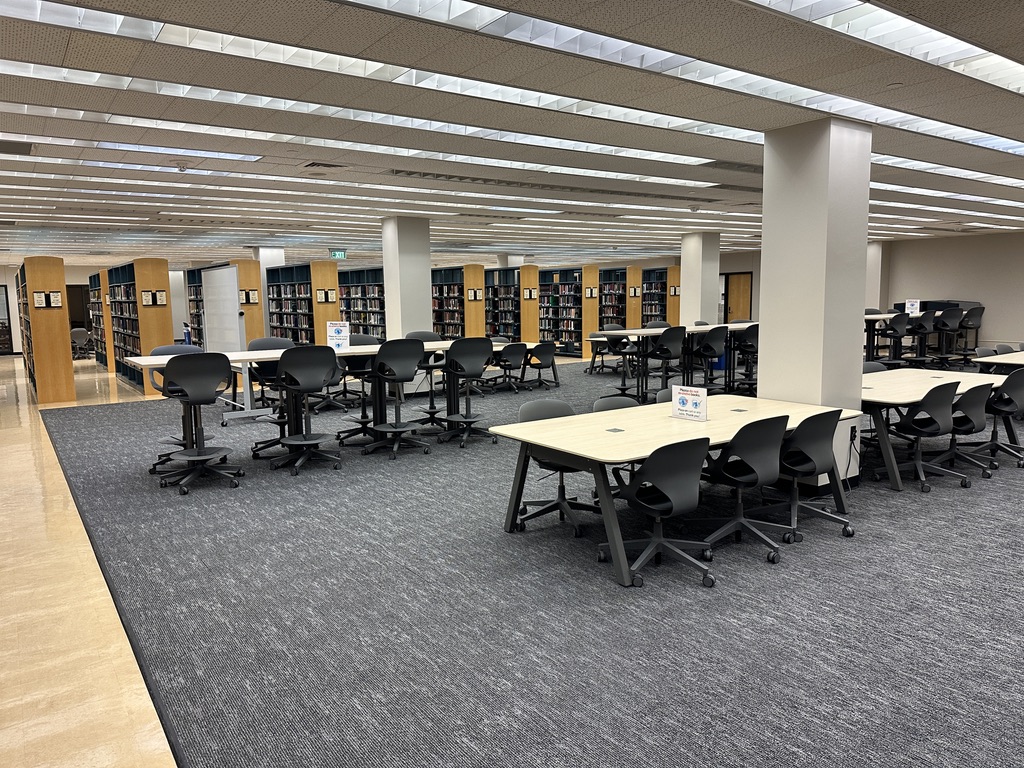
Not the building or the space—they were still there.  But the rows upon rows of stacks had been replaced with study space that students didn’t even need.  Once again, empty space was somehow more valuable to the library than having that space filled with books.  The librarians had paved paradise and put up a parking lot.  To me, it was like a death in the family. 

The Main Library after the recent remodel. This photo was taken at 11 am during the first week of the Fall semester 2024. This room used to be filled with full stacks of books. Now only about 10-20% of the books remain in the library. Notice the complete absence of students.

Why not bulldoze Williamsburg, Virginia, after digital capture? Why not burn the USS Constitution in Boston Bay after photographing it? Why not flatten the Alamo?

I recently looked up a book that was luckily still available at the Main Library in one of its few remaining stacks.  So I went to find it.  The shelves all around it were only about two-thirds filled, the wide gaps looking like abandoned store-fronts in a failing city.  And what books did remain were the superficial ones—the ones that any undergrad might want to take out to get an overview of some well-worn topic (which they could probably just get on Wikipedia).  All the deep knowledge (which Wikipedia will never see) was gone. 

I walked out with exactly the one book I had gone to find—not a single surprising gem to accompany it.  But the worst part is the opportunity cost: I will never know what I had failed to discover!

The stacks in 2024 are about 1/3 empty, and only about 20% of the stacks remain. The books that survived are the obvious ones.

Shrinking Budgets and Predatory Publishers

So why is a room that stands empty more valuable to a university than a room full of books? Here are the mundane and shocking answers.

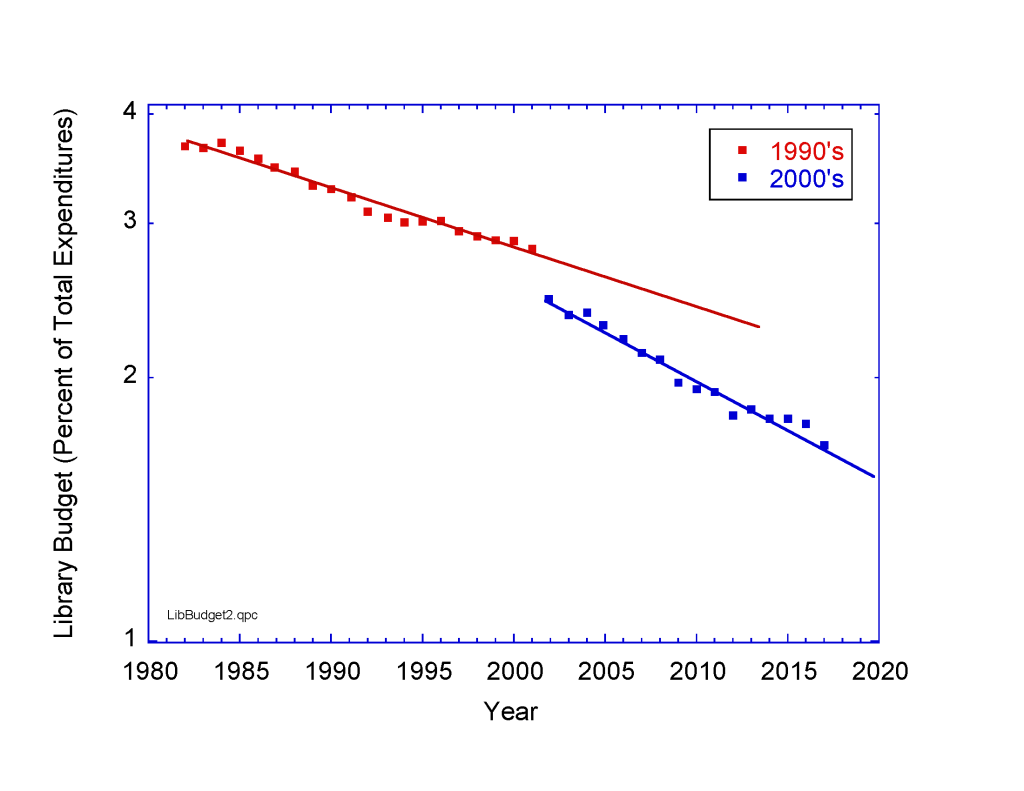
On the one hand, library budgets are under assault. The following figure shows library expenditures as a percentage of total university expenditures averaged for 40 major university libraries tabulated by the ARL (Association of Research Libraries) from 1982 to 2017. There is an exponential decrease in the library budget as a function of year, with a break right around 2000-2001 when accreditation was no longer linked to library expenditures. Then the decay accelerated.

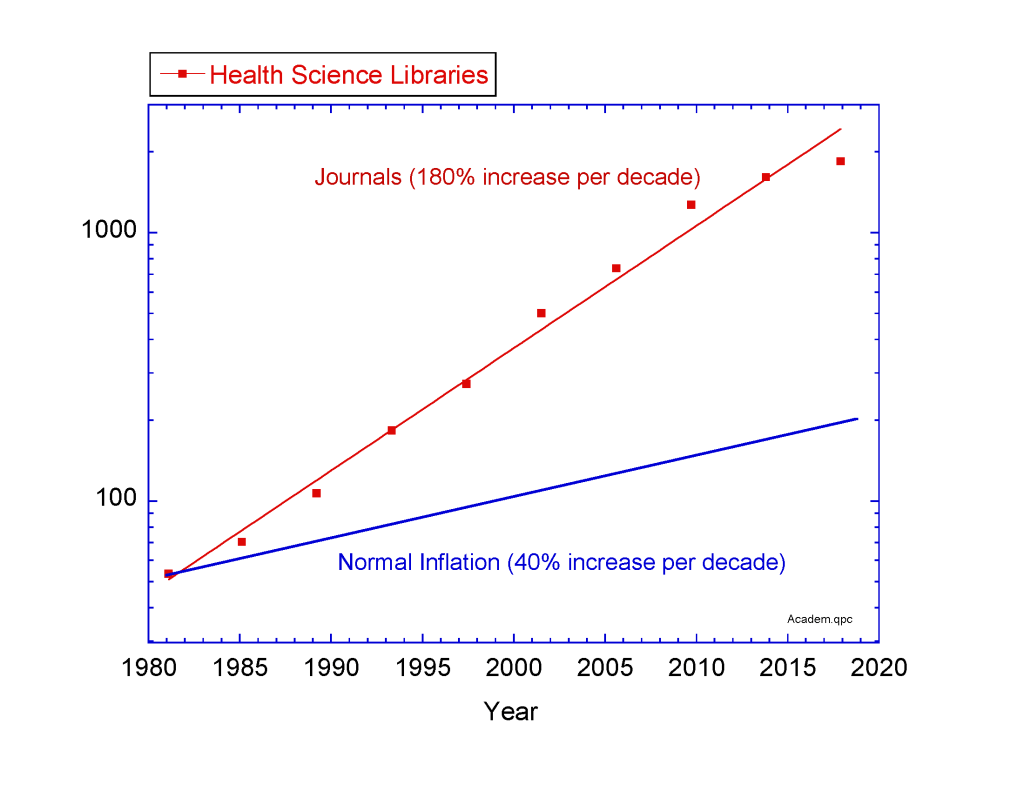
Combine decreasing rates of library funding with predatory publishers, and the problem is compounded. The following figure shows the increasing price of journal subscriptions that universities must pay relative to the normal inflation rate. The journal publishers are increasing their prices exponentially, tripling the cost each decade, a rate that erodes library budgets even more. Therefore, it is tempting to say that librarians don’t actually hate books, but are victims of bad economics. But that is the mundane answer.

The shocking answer is that modern librarians find books to be anachronistic. The new hires are by and large “digital librarians” who are focused on providing digital content to serve students who have become much more digital, especially after Covid. There is also a prevailing opinion among university librarians that students want more space to study, hence the removal of stacks to be replaced by soft chairs and open study spaces.

And that is the betrayal. The collections of deep knowledge, which are unique and priceless and irreplaceable, were replaced by generic study space that could be put anywhere at any time, having no intrinsic value.

You can argue that I still have access to the knowledge because of Interlibrary Loan (ILL). But ILL only works if other libraries have yet to remove the book. What happens when every library thinks that some other library has the book, and so they throw their own copy out? At some point that volume will have vanished from all collections and that will be the end of it.

Or you can argue that I can find the book digitally scanned on Internet Archive or Google Books. But I have already found situations where special folio pages, the very pages that I needed to make my argument, had failed to be reproduced in the digital versions. And the books were too rare to be allowed to go through ILL. So I was stuck.

(By the way, this was a rare copy of the works of Francois Arago. In my book Interference: Optical Interferometry and the Scientists who Tamed Light (Oxford University Press, 2023), I make the case that it was Arago who invented the first interferometer in 1816 long before Albert Michelson’s work in 1880. But for the final smoking gun, to prove my case, I needed that folio page which took Herculean efforts to eventually track down. Our Physics Library had the book in its stacks just a decade ago, and I could have just walked upstairs from my office to look at it. Where it is now is anyone’s guess.)

But digital scans are no substitute for the real thing. To hold an old volume in your hands, run off the printing press when the author was still alive, and filled with scribbled notes in the margins by your colleagues from years past, is to commune with history. Why not bulldoze Williamsburg, Virginia, after digital capture? Why not burn the USS Constitution in Boston Bay after photographing it? Why not flatten the Alamo? When you immerse yourself in these historical settings, you gain an understanding that is deeper than possible by browsing an article on Wikipedia.

People react to the real, like real books. Why take that away?

Acknowledgements: This post is the product of several discussions with my brother, James Nolte, a retired reference librarian. He was an early developer of digital libraries, working at Clarkson University in Potsdam, NY in the mid 1980’s. But like Frankenstein, he sometimes worries about the consequences of his own creation.