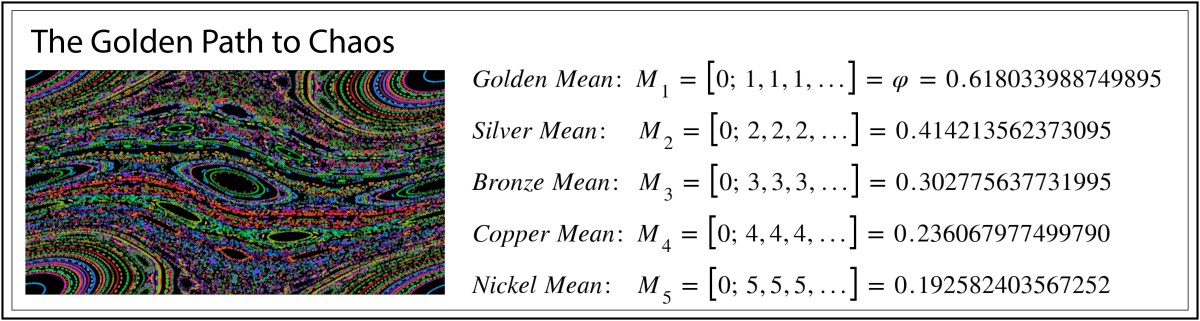
Phase space of the Standard Map showing Hamiltonian Chaos with the first 5 Metallic Means

The Golden Path to Chaos: Adiabatic Twists

If ever there was a magic number that encoded the mysteries of the universe, then surely it must be the golden mean. It seems to pop up everywhere. In flowers and hurricanes. In pine cones and sea shells. In architecture and infinite sums. In telescoping cascades of golden rectangles in the human figure.
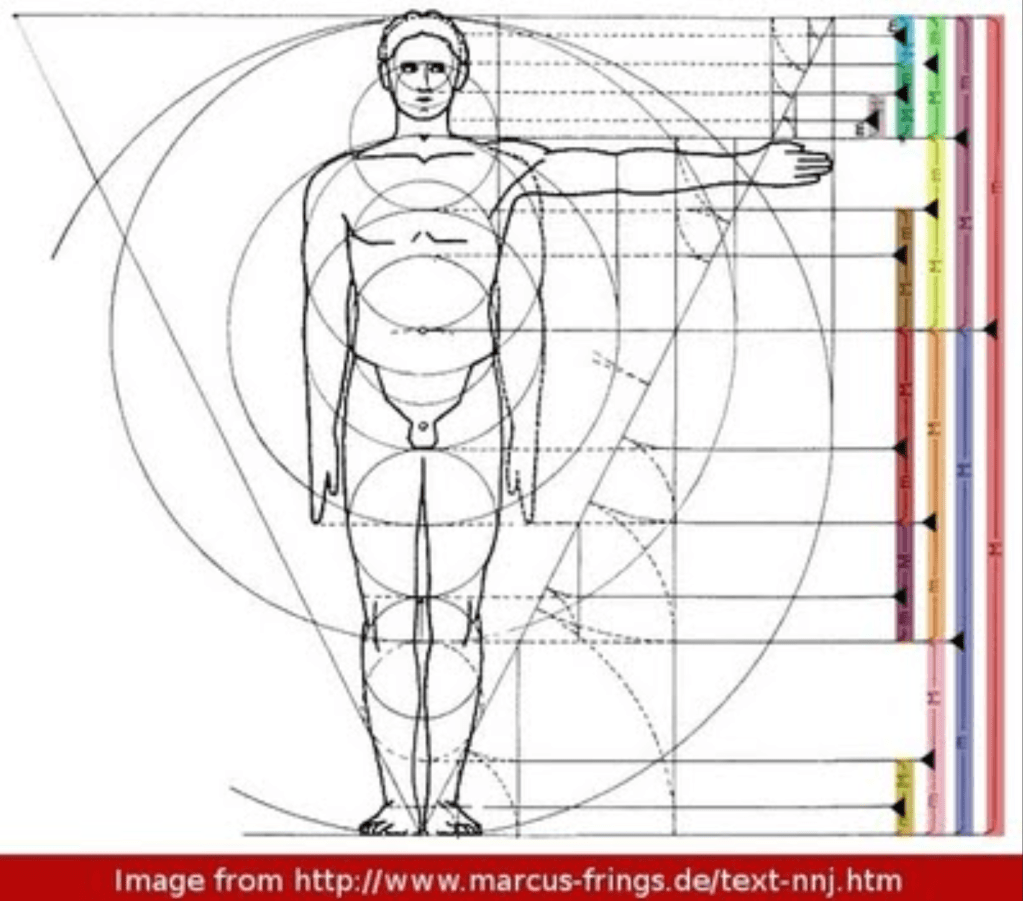
Fig. 1. The golden mean can be found in numerous ratios of the measurements of the human body.

It also rears its head in the world of chaos theory, governing how a twisting dumbbell rotor transitions from regular motion to chaotic motion when it is tapped gently at a regular period.

The Golden Ratio

The Golden ratio can be defined in many ways, but its most common expression is given by
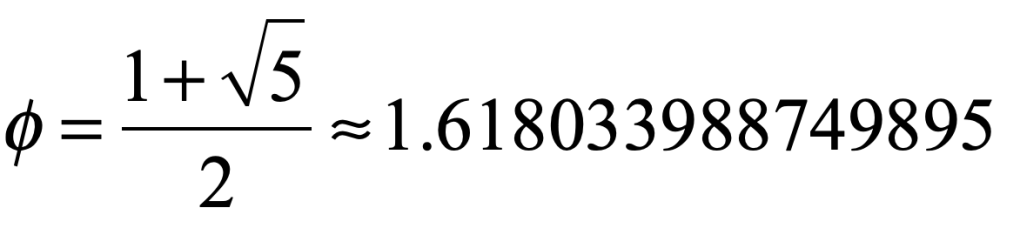
Among its many marvelous properties, one is that it is the hardest number to approximate with a ratio of small integers.  For instance, the ratio 89/55 is a number that is as close as one part in ten thousand to the golden mean but it is hardly a ratio of small integers.  This result may seem obscure, but there is a systematic way to find the ratios of integers that approximate an irrational number. This is known as continued fractions.

The continued fraction for the golden mean has an especially simple repeating form
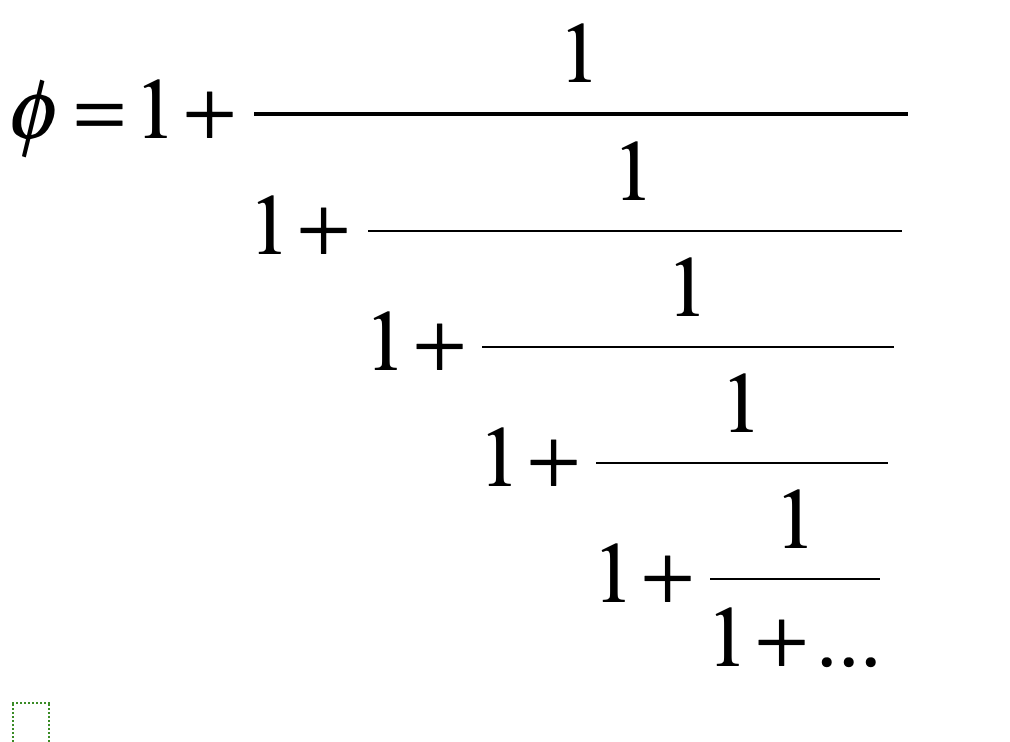
also written as

This continued fraction has the slowest convergence for its continued fraction of any other number. Hence, the Golden Ratio can be considered, using this criterion, to be the most irrational number of all, and it governs the last straw of order as chaos emerges from a surprisingly simple map.

The Kicked Rigid Rotor

The rigid rotator (the simple dumbbell) is one of the iconic systems in physics. It is a classic object in the study of rotational dynamics, showing up in Lagrangian formulations as well as Euler’s equations. It is also a classic system in elementary quantum mechanics, illustrating the quantization of angular momentum. In the current setting (Hamiltonian chaos), it is an example of a periodically perturbed system that displays beautiful phenomena.

In chaos theory, the relationship between a continuous dynamical system and its discrete map is sometimes difficult to identify.  However, a discrete map arises naturally from a randomly kicked dumbbell rotator.  The system has an angular momentum J and a physical angle θ.  The strength of the angular momentum kick is given by the perturbation parameter ε, and the torque of the kick is a function of the physical angle θ.  The kicked rotator has the Hamiltonian
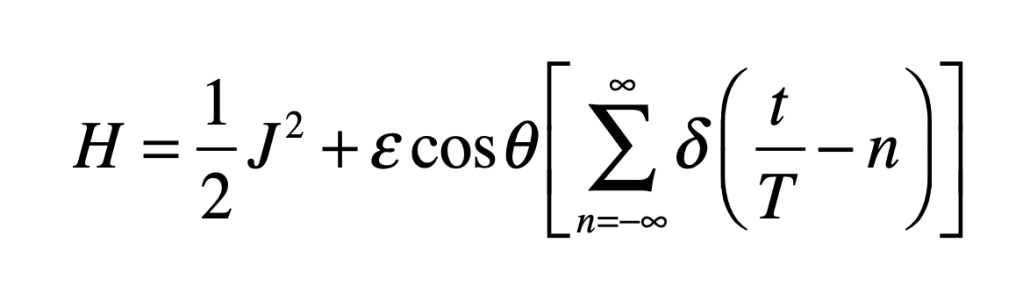
where the kicks are evenly timed with period T.  The perturbation parameter ε can be large.  The perturbation amplitude and sign depend on the instantaneous angle θ.  The equations of motion from Hamilton’s equations are
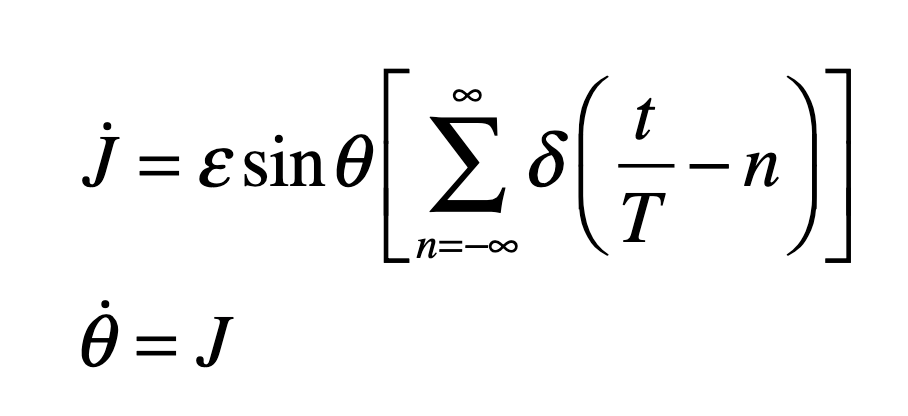
The values for J and θ just before the nth successive kick are Jn and qn, respectively.  Because the evaluation of the variables occurs at the period T, these discrete observations represent the values of a Poincaré section. 

The Chirikov Twist Map

The phase space (in action-angle coordinates) of the rigid rotator is particularly attractive for applications because it is simply a linear flow that has increasing velocities with increasing action J. In action-angle representation, it is a twist map, where circles outside the radius for J = 0 twist in one direction but inside that radius they twist in the opposite direction. David Birkhoff showed in 1913, while proving Poincaré’s last geometric theorem, that a simple periodic perturbation of this system creates a set of closed trajectories (around an elliptical point) and a set of open trajectories (around a hyperbolic point).
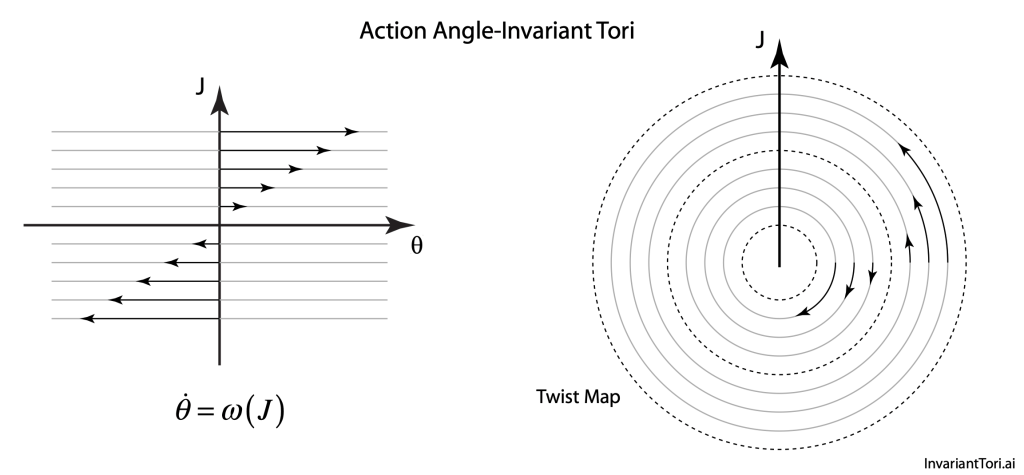
Fig. 2. The action-angle phase space of a rigid rotator, plus the associated twist map.

The rotator dynamics are continuous between each kick, leading to the discrete map (known as the Standard Map or the Chirikov Map)
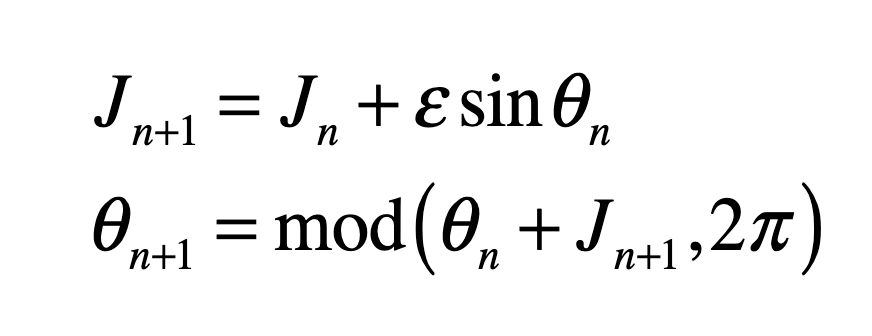
in which the rotator is “strobed”, or observed, at regular periods of 2π. When ε = 0, the orbits on the (θ, J) plane are simply horizontal lines—the rotator spins with regular motion at a speed determined by J.

As the strength of the kick ε increases from zero, the Poicaré-Birkhoff theorem kicks in, and a first “island chain” appears with a single elliptical point paired with a single hyperbolic point. Then at larger values of ε new island chains appear, first with two islands, then with three, as in the figure below with ε = 0.3. Orbits that produce two islands are in a 2:1 resonance, and with three islands are in either a 3:1 or a 3:2 resonance. With increasing ε, more and more island chains open up, representing higher resonances.
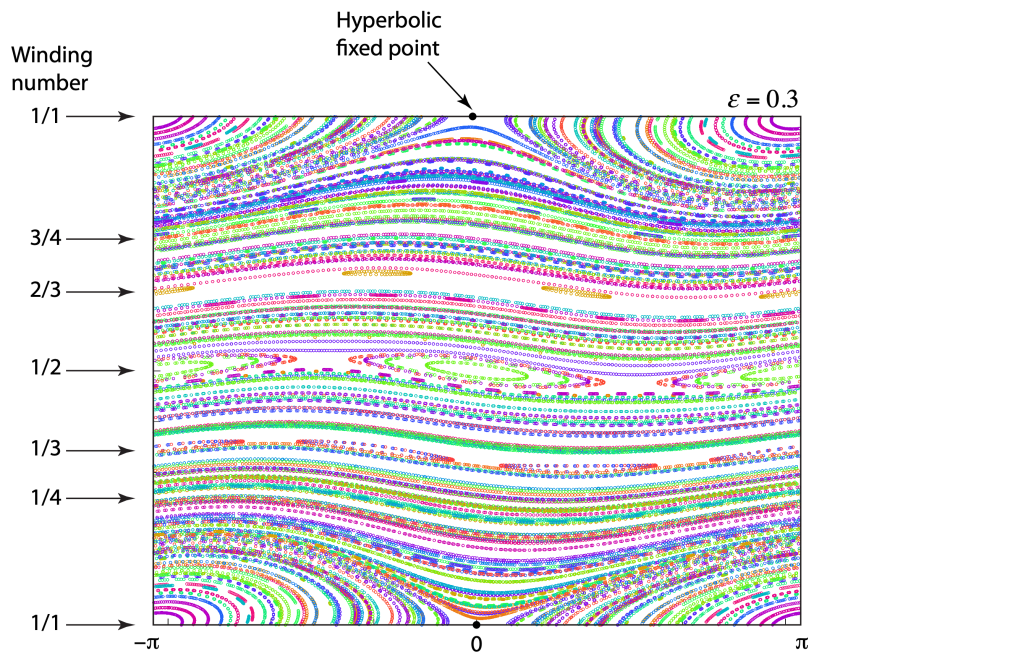
Fig. 3 Chirikov map for ε = 0.3. The 1/1, 1/2 and 1/3 (2/3) island chains have opened with a primary hyperbolic point on the 1/1 resonance.

Each resonance is associated with a ratio of small integers: 1/2; 2/3; 3/4; 4/5 and beyond. These are the natural harmonics of the system. As the integers get larger, the ratios begin to approximate irrational numbers.

For instance, the number pi is approximated to increasing accuracy by the sequence of ratios:
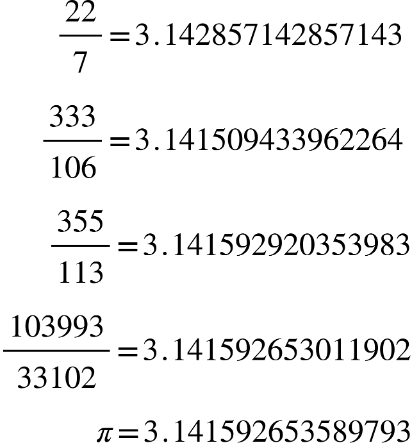
Fig. Successive convergents of the irrational number pi.

These are called convergents and are obtained by taking more terms in the continued fraction representation of pi.

One of the fundamental findings of the theory of resonances in Hamiltonian systems is the decreasing “weight” of resonances associated with ratios of larger integers. Therefore, the 1:2 resonance is by far the most robust, the first to spring into existence, and it survives up to extremely strong perturbations. The 1:3 resonance is also relativety robust, but already the 1:4 and 1:5 resonances are more sensitive to perturbation and break up into island chains under moderate perturbation. Clearly the 22:7 ratio would not be sensitive nor the 333:106 resonance. These orbits would resist breaking up. Furthermore, once a resonance turns into an island chain, it creates hyperbolic points that can nucleate chaotic trajectories.

An example of the twist map at strong perturbation ε = 1.0 is shown in Fig. 4. There are numerous island chains. It is easy to find the 1:2 through the 1:7 resonances, but beyond that it is much more difficult to find these rational resonance. Furthermore, there are significant regions of chaotic trajectories associated with the hyperbolic points of the 1:2, 1:3, 1:4 and 1:5 resonances.
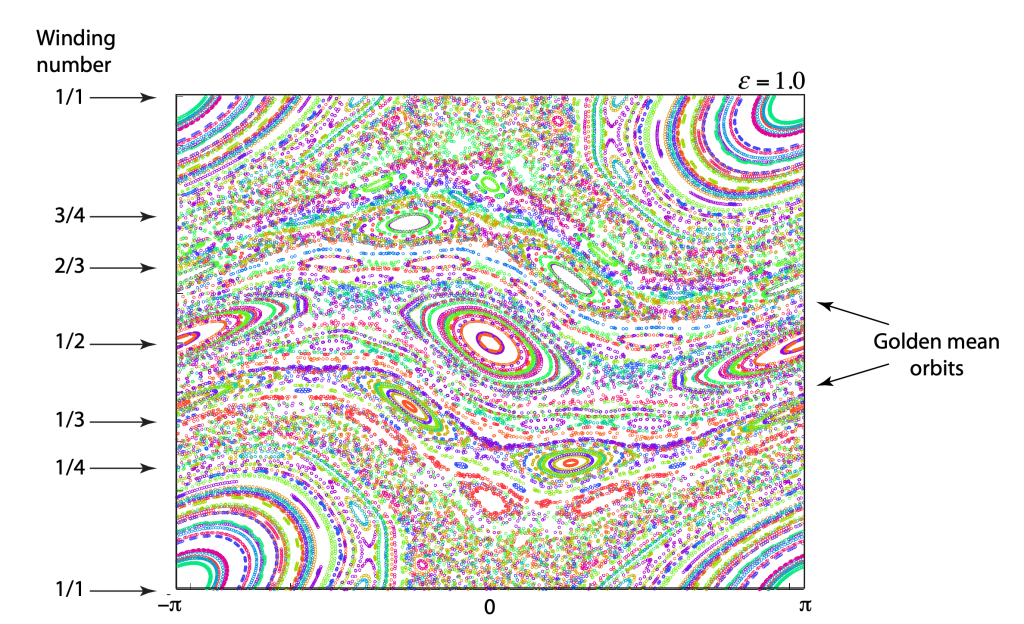
Fig. 4. The Standard map at ε = 1.0 slightly above the threshold for the dissolution of the Golde-Mean-Orbit.

In the midst of the island chains and the chaos, there are still continuous (open) orbits that span the phase space without breaks. These are the most irrational numbers–numbers like the golden mean. These are the last orbits to break up. The critical threshold for the breakup of the golden-mean orbit is ε = 0.971. The plot in Fig. 4 is just above that threshold.

All of this behavior of the Standard Map follows from KAM theory, developed by Kolmogorov, Arnold and Moser in the early 1960’s. Although the standard map is specific to the tapped spinning disk, the results and behavior are very general for a wide class of two-dimensional Hamiltonian dynamical systems.

Adiabatic Following: Orbits of the Noble Means

The golden mean is not the only “slowest convergent” among irrational numbers. There are an entire class of irrational numbers whose continued fractions terminate with an infinite series of “1”s. These are known as the “Noble Means”. Examples are:
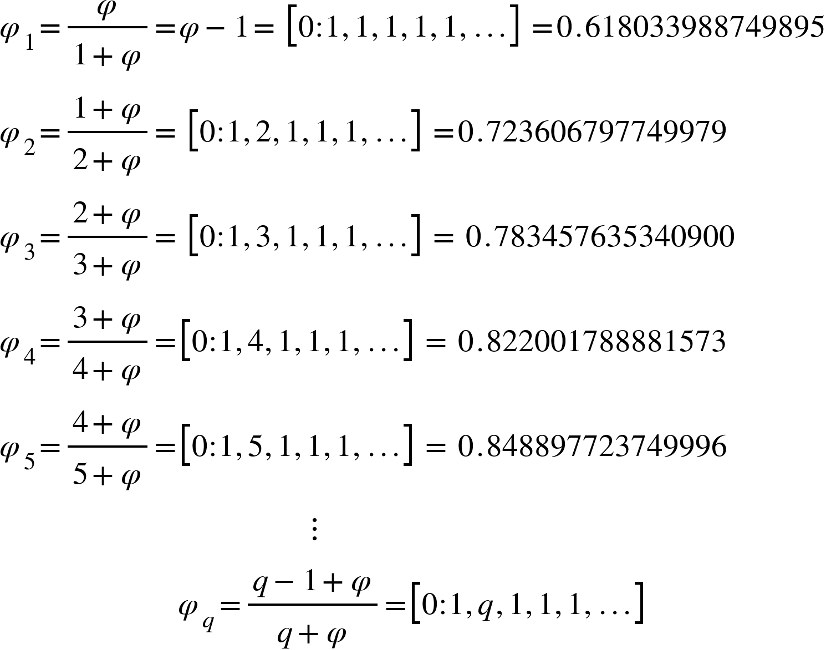
where the sequence, as q increases to infinity, converges on unity asymptotically among the set of irrationals with the slowest convergents.

There are also the so-called “Metallic Means”, beginning with Gold and moving to Silver, Bronze, Copper, and Nickel. These are:
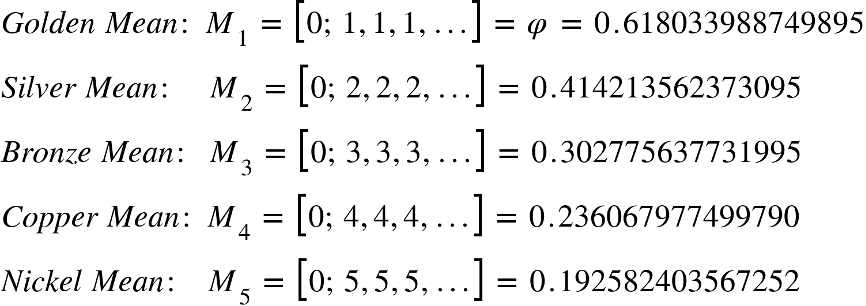
The challenge for numerical simulations is to find the orbits associated with these Metallic Means for large perturbation parameters ε. One cannot simply pick an initial condition for the Standard Map equal to a Metallic Mean, because at large perturbation, all the orbits have already shifted from their zero-perturbation values.

One of the most important principles in classical mechanics is the concept of adiabatic invariance. All the most common conservation laws of introductory physics–conservation of energy, momentum, and angular momentum–are consequences of adiabatic invariance. Indeed, the phase space of the rigid rotator is ideal for tracking adiabatic invariance because the J-value is the adiabatic invariant. In the numerical simulation, one begins with ε = 0, chooses an initial condition J = φn, and iterates the map as ε slowly increases.

This is shown in the following YouTube video. You will see five special orbits evolve as the perturbation is slowly increased. These are M1 (red), M2 (blue), M3 (green) and two resonances 3:1 (cyan) and 4:1 (magenta). The resonances are expected to break into island chains at relativity low perturbation ε, which is confirmed in the video.

Fig. 5 YouTube video of the Standard Map and special orbits as the perturbation slowly (adiabatically) increases.

Interestingly, the silver mean breaks into a 5:1 island chain around the same perturbation level. This is because the Silver Mean equals 0.414 which approaches 8/5 at moderate perturbation. Therefore, the Silver Mean orbit is “captured” by a 1:5 resonance and remains stable up to very large perturbations approaching ε = 1. The Bronze Mean is captured relativity early into the 1:1 resonance island.

References:

Music: The Beat Lessons (Band Camp): Link

D. D. Nolte, Introduction to Modern Dynamics, 2nd ed. (Oxford University Press, 2019) Link


This Post is Based on Simulations from Chapter 5 of IMD, 2nd edition

This Blog Post is a Companion to the undergraduate physics textbook Modern Dynamics: Chaos, Networks, Space and Time, 2nd ed. (Oxford, 2019) introducing Lagrangians and Hamiltonians, chaos theory, complex systems, synchronization, neural networks, econophysics and Special and General Relativity to Junior and Senior physics majors.

Henri Poincaré and his Homoclinic Tangle

Will the next extinction-scale asteroid strike the Earth in our lifetime? 

This existential question—the question of our continued existence on this planet—is rhetorical, because there are far too many bodies in our solar system to accurately calculate all trajectories of all asteroids. 

The solar system is what is known as an N-body problem.  And even the N is not well determined.  The asteroid belt alone has over a million extinction-sized asteroids, and there are tens of millions of smaller ones that could still do major damage to life on Earth if they hit.  To have a hope of calculating even one asteroid trajectory do we ignore planetary masses that are too small?  What is too small?  What if we only consider the Sun, the Earth and Jupiter?  This is what Euler did in 1760, and he still had to make more assumptions.

Stability of the Solar System

Once Newton published his Principia, there was a pressing need to calculate the orbit of the Moon (see my blog post on the three-body problem).  This was important for navigation, because if the daily position of the moon could be known with sufficient accuracy, then ships would have a means to determine their longitude at sea.  However, the Moon, Earth and Sun are already a three-body problem, which still ignores the effects of Mars and Jupiter on the Moon’s orbit, not to mention the problem that the Earth is not a perfect sphere.  Therefore, to have any hope of success, toy systems that were stripped of all their obfuscating detail were needed.

Euler investigated simplified versions of the three-body problem around 1760, treating a body attracted to two fixed centers of gravity moving in the plane, and he solved it using elliptic integrals. When the two fixed centers are viewed in a coordinate frame that is rotating with the Sun-Earth system, it can come close to capturing many of the important details of the system. In 1762 Euler tried another approach, called the restricted three-body problem, where he considered a massless Moon attracted to a massive Earth orbiting a massive Sun, again all in the plane. Euler could not find general solutions to this problem, but he did stumble on an interesting special case when the three bodies remain collinear throughout their motions in a rotating reference frame.

It was not the danger of asteroids that was the main topic of interest in those days, but the question whether the Earth itself is in a stable orbit and is safe from being ejected from the Solar system.  Despite steadily improving methods for calculating astronomical trajectories through the nineteenth century, this question of stability remained open.

Poincaré and the King Oscar Prize of 1889

Some years ago I wrote an article for Physics Today called “The Tangled Tale of Phase Space” that tracks the historical development of phase space. One of the chief players in that story was Henri Poincaré (1854 – 1912). Henri Poincare was the Einstein before Einstein. He was a minor celebrity and was considered to be the greatest genius of his era. The event in his early career that helped launch him to stardom was a mathematics prize announced in 1887 to honor the birthday of King Oscar II of Sweden. The challenge problem was as simple as it was profound: Prove rigorously whether the solar system is stable.

This was the old N-body problem that had so far resisted solution, but there was a sense at that time that recent mathematical advances might make the proof possible. There was even a rumor that Dirichlet had outlined such a proof, but no trace of the outline could be found in his papers after his death in 1859.

The prize competition was announced in Acta Mathematica, written by the Swedish mathematician Gösta Mittag-Leffler. It stated:

Given a system of arbitrarily many mass points that attract each according to Newton’s law, under the assumption that no two points ever collide, try to find a representation of the coordinates of each point as a series in a variable that is some known function of time and for all of whose values the series converges uniformly.

The timing of the prize was perfect for Poincaré who was in his early thirties and just beginning to make his mark on mathematics. He was working on the theory of dynamical systems and was developing a new viewpoint that went beyond integrating single trajectories by focusing more broadly on whole classes of solutions. The question of the stability of the solar system seemed like a good problem to use to sharpen his mathematical tools. The general problem was still too difficult, so he began with Euler’s restricted three-body problem. He made steady progress, and along the way he invented an array of new techniques for studying the general properties of dynamical systems. One of these was the Poincaré section. Another was his set of integral invariants, one of which is recognized as the conservation of volume in phase space, also known as Liouville’s theorem, although it was Ludwig Boltzmann who first derived this result (see my Physics Today article). Eventually, he believed he had proven that the restricted three-body problem was stable.

By the time Poincaré had finished is prize submission, he had invented a new field of mathematical analysis, and the judges of the prize submission recognized it. Poincaré was named the winner, and his submission was prepared for publication in the Acta. However, Mittag-Leffler was a little concerned by a technical objection that had been raised, so he forwarded the comment to Poincaré for him to look at. At first, Poincaré thought the objection could easily be overcome, but as he worked on it and delved deeper, he had a sudden attack of panic. Trajectories near a saddle point did not converge. His proof of stability was wrong!

He alerted Mittag-Leffler to stop the presses, but it was too late. The first printing had been completed and review copies had already been sent to the judges. Mittag-Leffler immediately wrote to them asking for their return while Poincaré worked nonstop to produce a corrected copy. When he had completed his reanalysis, he had discovered a divergent feature of the solution to the dynamical problem near saddle points that is recognized today as the discovery of chaos. Poincaré paid for the reprinting of his paper out of his own pocket and (almost) all of the original printing was destroyed. This embarrassing moment in the life of a great mathematician was virtually forgotten until it was brought to light by the historian Barrow-Green in 1994 [1].

Poincaré is still a popular icon in France. Here is the Poincaré cafe in Paris.
A crater on the Moon is named after Poincaré.

Chaos in the Poincaré Return Map

Despite the fact that his conclusions on the stability of the 3-body problem flipped, Poincaré’s new tools for analyzing dynamical systems earned him the prize. He did not stop at his modified prize submission but continued working on systematizing his methods, publishing New Methods in Celestial Mechanics in several volumes through the 1890’s. It was here that he fully explored what happens when a trajectory approaches a saddle point of dynamical equilibrium.

The third volume of a three-book series that grew from Poincaré’s award-winning paper

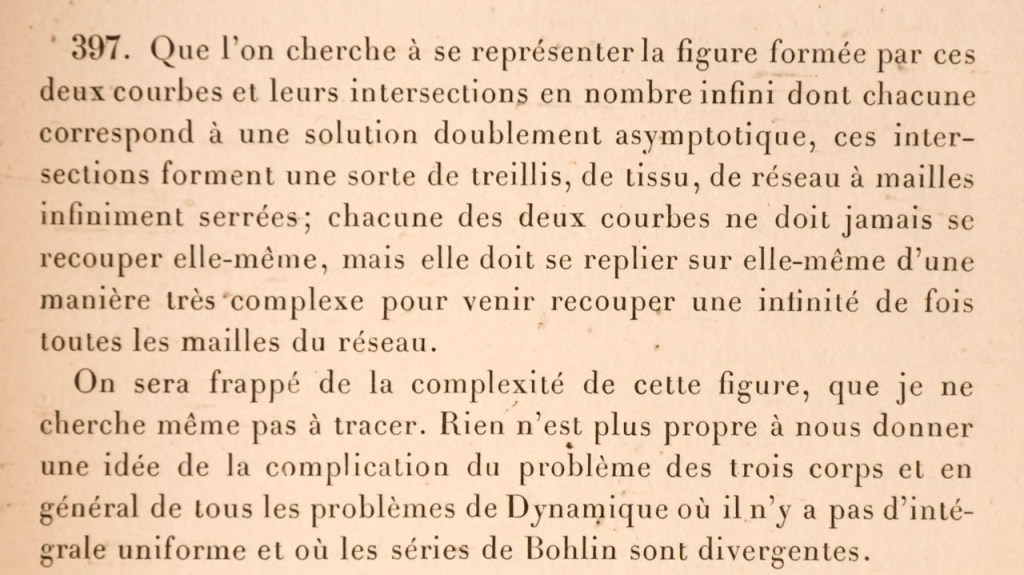
To visualize a periodic trajectory, Poincaré invented a mathematical tool called a “first-return map”, also known as a Poincaré section. It was a way of taking a higher dimensional continuous trajectory and turning it into a simple iterated discrete map. Therefore, one did not need to solve continuous differential equations, it was enough to just iterate the map. In this way, complicated periodic, or nearly periodic, behavior could be explored numerically. However, even armed with this weapon, Poincaré found that iterated maps became unstable as a trajectory that originated from a saddle point approached another equivalent saddle point. Because the dynamics are periodic, the outgoing and incoming trajectories are opposite ends of the same trajectory, repeated with 2-pi periodicity. Therefore, the saddle point is also called a homoclinic point, meaning that trajectories in the discrete map intersect with themselves. (If two different trajectories in the map intersect, that is called a heteroclinic point.) When Poincaré calculated the iterations around the homoclinic point, he discovered a wild and complicated pattern in which a trajectory intersected itself many times. Poincaré wrote:

[I]f one seeks to visualize the pattern formed by these two curves and their infinite number of intersections … these intersections form a kind of lattice work, a weave, a chain-link network of infinitely fine mesh; each of the two curves can never cross itself, but it must fold back on itself in a very complicated way so as to recross all the chain-links an infinite number of times .… One will be struck by the complexity of this figure, which I am not even attempting to draw. Nothing can give us a better idea of the intricacy of the three-body problem, and of all the problems of dynamics in general…

Poincaré’s first view of chaos.

This was the discovery of chaos! Today we call this “lattice work” the “homoclinic tangle”. He could not draw it with the tools of his day … but we can!

Chirikov’s Standard Map

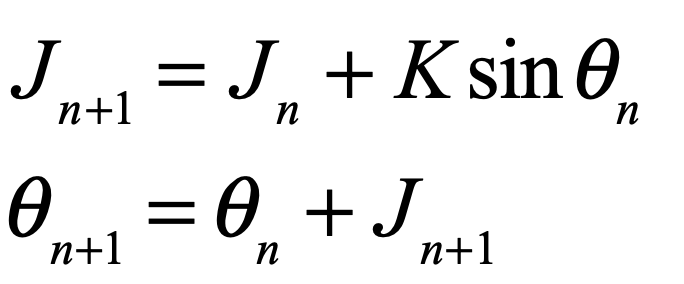
The restricted 3-body problem is a bit more complicated than is needed to illustrate Poincaré’s homoclinic tangle. A much simpler model is a discrete map called Chirikov’s Map or the Standard Map. It describes the Poincaré section of a periodically kicked oscillator that rotates or oscillates in the angular direction with an angular momentm J. The map has the simple form

in which the angular momentum in updated first, and then the angle variable is updated with the new angular momentum. When plotted on the (θ,J) plane, the standard map produces a beautiful kaleidograph of intertwined trajectories piercing the Poincaré plane, as shown in the figure below. The small points or dots are successive intersections of the higher-dimensional trajectory intersecting a plane. It is possible to trace successive points by starting very close to a saddle point (on the left) and connecting successive iterates with lines. These lines merge into the black trace in the figure that emerges along the unstable manifold of the saddle point on the left and approaches the saddle point on the right generally along the stable manifold.

Fig. Standard map for K = 0.97 at the transition to full chaos. The dark line is the trajectory of the unstable manifold emerging from the saddle point at (p,0). Note the wild oscillations as it approaches the saddle point at (3pi,0).

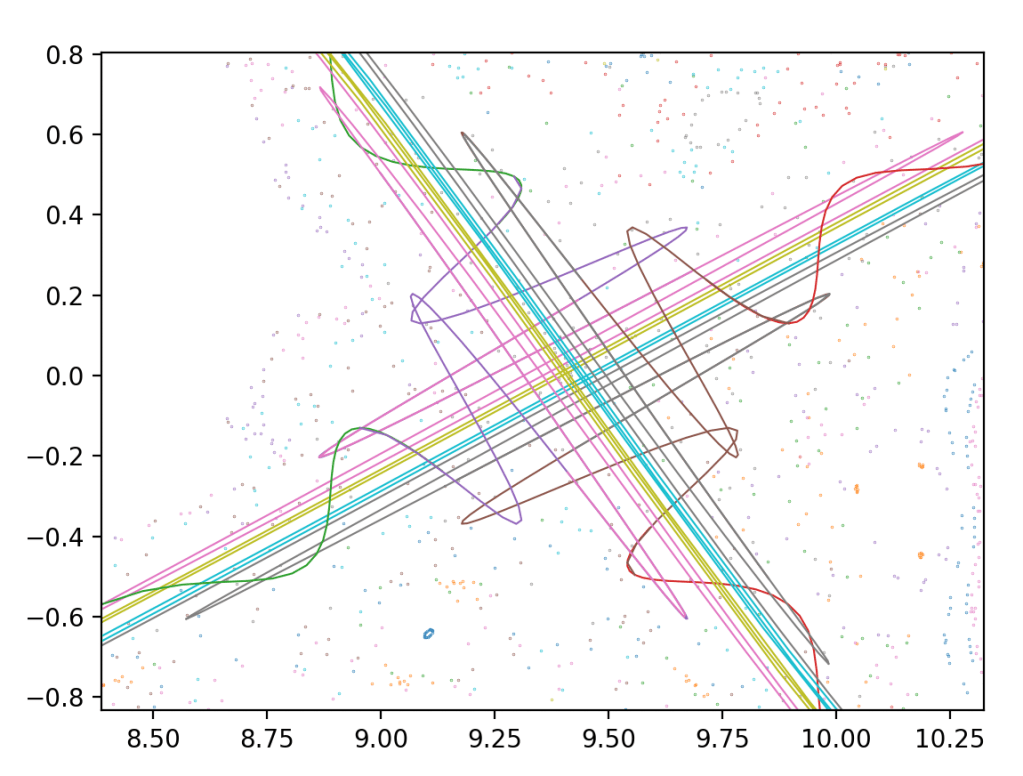
However, as the successive iterates approach the new saddle (which is really just the old saddle point because of periodicity) it crosses the stable manifold again and again, in ever wilder swings that diverge as it approaches the saddle point. This is just one trace. By calculating traces along all four stable and unstable manifolds and carrying them through to the saddle, a lattice work, or homoclinic tangle emerges.

Two of those traces originate from the stable manifolds, so to calculate their contributions to the homoclinic tangle, one must run these traces backwards in time using the inverse Chirikov map. This is

The four traces all intertwine at the saddle point in the figure below with a zoom in on the tangle in the next figure. This is the lattice work that Poincaré glimpsed in 1889 as he worked feverishly to correct the manuscript that won him the prize that established him as one of the preeminent mathematicians of Europe.

Fig. The homoclinic tangle caused by the folding of phase space trajectories as stable and unstable manifolds criss-cross in the Poincare map at the saddle point. This was the figure that Poincaré could not attempt to draw because of its complexity.
Fig. A zoom-in of the homoclinic tangle at the saddle point as the stable and unstable manifolds create a lattice of intersections. This is the fundamental origin of chaos and the sensitivity to initial conditions (SIC) that make forecasting almost impossible in chaotic systems.


The Path from Galileo’s Trajectory to Complex Systems and Quantum Science.

Read more about the history of chaos theory in Galileo Unbound from Oxford University Press


Python Code: StandmapHom.py

(Python code on GitHub.)

#!/usr/bin/env python3
# -*- coding: utf-8 -*-
"""
StandmapHom.py
Created on Sun Aug  2  2020
"Introduction to Modern Dynamics" 2nd Edition (Oxford, 2019)
@author: nolte
"""

import numpy as np
from matplotlib import pyplot as plt
from numpy import linalg as LA

plt.close('all')

eps = 0.97

np.random.seed(2)

plt.figure(1)

for eloop in range(0,100):

    rlast = 2*np.pi*(0.5-np.random.random())
    thlast = 4*np.pi*np.random.random()
    
    rplot = np.zeros(shape=(200,))
    thetaplot = np.zeros(shape=(200,))
    for loop in range(0,200):
        rnew = rlast + eps*np.sin(thlast)
        thnew = np.mod(thlast+rnew,4*np.pi)
        
        thetaplot[loop] = np.mod(thnew-np.pi,4*np.pi)     
        rtemp = np.mod(rnew + np.pi,2*np.pi)
        rplot[loop] = rtemp - np.pi
  
        rlast = rnew
        thlast = thnew
        
    plt.plot(np.real(thetaplot),np.real(rplot),'o',ms=0.2)
    plt.xlim(xmin=np.pi,xmax=4*np.pi)
    plt.ylim(ymin=-2.5,ymax=2.5)
        
plt.savefig('StandMap')

K = eps
eps0 = 5e-7

J = [[1,1+K],[1,1]]
w, v = LA.eig(J)

My = w[0]
Vu = v[:,0]     # unstable manifold
Vs = v[:,1]     # stable manifold

# Plot the unstable manifold
Hr = np.zeros(shape=(100,150))
Ht = np.zeros(shape=(100,150))
for eloop in range(0,100):
    
    eps = eps0*eloop

    roldu1 = eps*Vu[0]
    thetoldu1 = eps*Vu[1]
    
    Nloop = np.ceil(-6*np.log(eps0)/np.log(eloop+2))
    flag = 1
    cnt = 0
    
    while flag==1 and cnt < Nloop:
        
        ru1 = roldu1 + K*np.sin(thetoldu1)
        thetau1 = thetoldu1 + ru1
        
        roldu1 = ru1
        thetoldu1 = thetau1
        
        if thetau1 > 4*np.pi:
            flag = 0
            
        Hr[eloop,cnt] = roldu1
        Ht[eloop,cnt] = thetoldu1 + 3*np.pi
        cnt = cnt+1
    
x = Ht[0:99,12] - 2*np.pi
x2 = 6*np.pi - x
y = Hr[0:99,12]
y2 = -y
plt.plot(x,y,linewidth =0.75)
plt.plot(x2,y2,linewidth =0.75)

del x,y
x = Ht[5:39,15] - 2*np.pi
x2 = 6*np.pi - x
y = Hr[5:39,15]
y2 = -y
plt.plot(x,y,linewidth =0.75)
plt.plot(x2,y2,linewidth =0.75)

del x,y
x = Ht[12:69,16] - 2*np.pi
x2 = 6*np.pi - x
y = Hr[12:69,16]
y2 = -y
plt.plot(x,y,linewidth =0.75)
plt.plot(x2,y2,linewidth =0.75)

del x,y
x = Ht[15:89,17] - 2*np.pi
x2 = 6*np.pi - x
y = Hr[15:89,17]
y2 = -y
plt.plot(x,y,linewidth =0.75)
plt.plot(x2,y2,linewidth =0.75)

del x,y
x = Ht[30:99,18] - 2*np.pi
x2 = 6*np.pi - x
y = Hr[30:99,18]
y2 = -y
plt.plot(x,y,linewidth =0.75)
plt.plot(x2,y2,linewidth =0.75)

# Plot the stable manifold
del Hr, Ht
Hr = np.zeros(shape=(100,150))
Ht = np.zeros(shape=(100,150))
#eps0 = 0.03
for eloop in range(0,100):
    
    eps = eps0*eloop

    roldu1 = eps*Vs[0]
    thetoldu1 = eps*Vs[1]
    
    Nloop = np.ceil(-6*np.log(eps0)/np.log(eloop+2))
    flag = 1
    cnt = 0
    
    while flag==1 and cnt < Nloop:
        
        thetau1 = thetoldu1 - roldu1
        ru1 = roldu1 - K*np.sin(thetau1)

        roldu1 = ru1
        thetoldu1 = thetau1
        
        if thetau1 > 4*np.pi:
            flag = 0
            
        Hr[eloop,cnt] = roldu1
        Ht[eloop,cnt] = thetoldu1
        cnt = cnt+1
    
x = Ht[0:79,12] + np.pi
x2 = 6*np.pi - x
y = Hr[0:79,12]
y2 = -y
plt.plot(x,y,linewidth =0.75)
plt.plot(x2,y2,linewidth =0.75)

del x,y
x = Ht[4:39,15] + np.pi
x2 = 6*np.pi - x
y = Hr[4:39,15]
y2 = -y
plt.plot(x,y,linewidth =0.75)
plt.plot(x2,y2,linewidth =0.75)

del x,y
x = Ht[12:69,16] + np.pi
x2 =  6*np.pi - x
y = Hr[12:69,16]
y2 = -y
plt.plot(x,y,linewidth =0.75)
plt.plot(x2,y2,linewidth =0.75)

del x,y
x = Ht[15:89,17] + np.pi
x2 =  6*np.pi - x
y = Hr[15:89,17]
y2 = -y
plt.plot(x,y,linewidth =0.75)
plt.plot(x2,y2,linewidth =0.75)

del x,y
x = Ht[30:99,18] + np.pi
x2 =  6*np.pi - x
y = Hr[30:99,18]
y2 = -y
plt.plot(x,y,linewidth =0.75)
plt.plot(x2,y2,linewidth =0.75)

References

[1] D. D. Nolte, “The tangled tale of phase space,” Physics Today, vol. 63, no. 4, pp. 33-38, Apr (2010)

[2] M. C. Gutzwiller, “Moon-Earth-Sun: The oldest three-body problem,” Reviews of Modern Physics, vol. 70, no. 2, pp. 589-639, Apr (1998)

[3] Barrow-Green J. Oscar II’s Prize Competition and the Error in Poindare’s Memoir on the Three Body Problem. Arch Hist Exact Sci 48: 107-131, 1994.

[4] Barrow-Green J. Poincaré and the three body problem. London Mathematical Society, 1997.

[5] https://the-moon.us/wiki/Poincar%C3%A9

[6] Poincaré H and Goroff DL. New methods of celestial mechanics … Edited and introduced by Daniel L. Goroff. New York: American Institute of Physics, 1993.